The Ultimate GEO vs SEO vs AEO Guide for 2026: Everything You Need to Know
Search results now live in three places at once — blue links, answer boxes, and AI-generated summaries. Here's a plain-English breakdown of GEO, SEO, and AEO, how they differ, and how to earn visibility in all three.

The Ultimate GEO vs SEO vs AEO Guide for 2026: Everything You Need to Know
Search results now live in three places at once — blue links, answer boxes, and AI-generated summaries. Here's a plain-English breakdown of GEO, SEO, and AEO, how they differ, and how to earn visibility in all three.
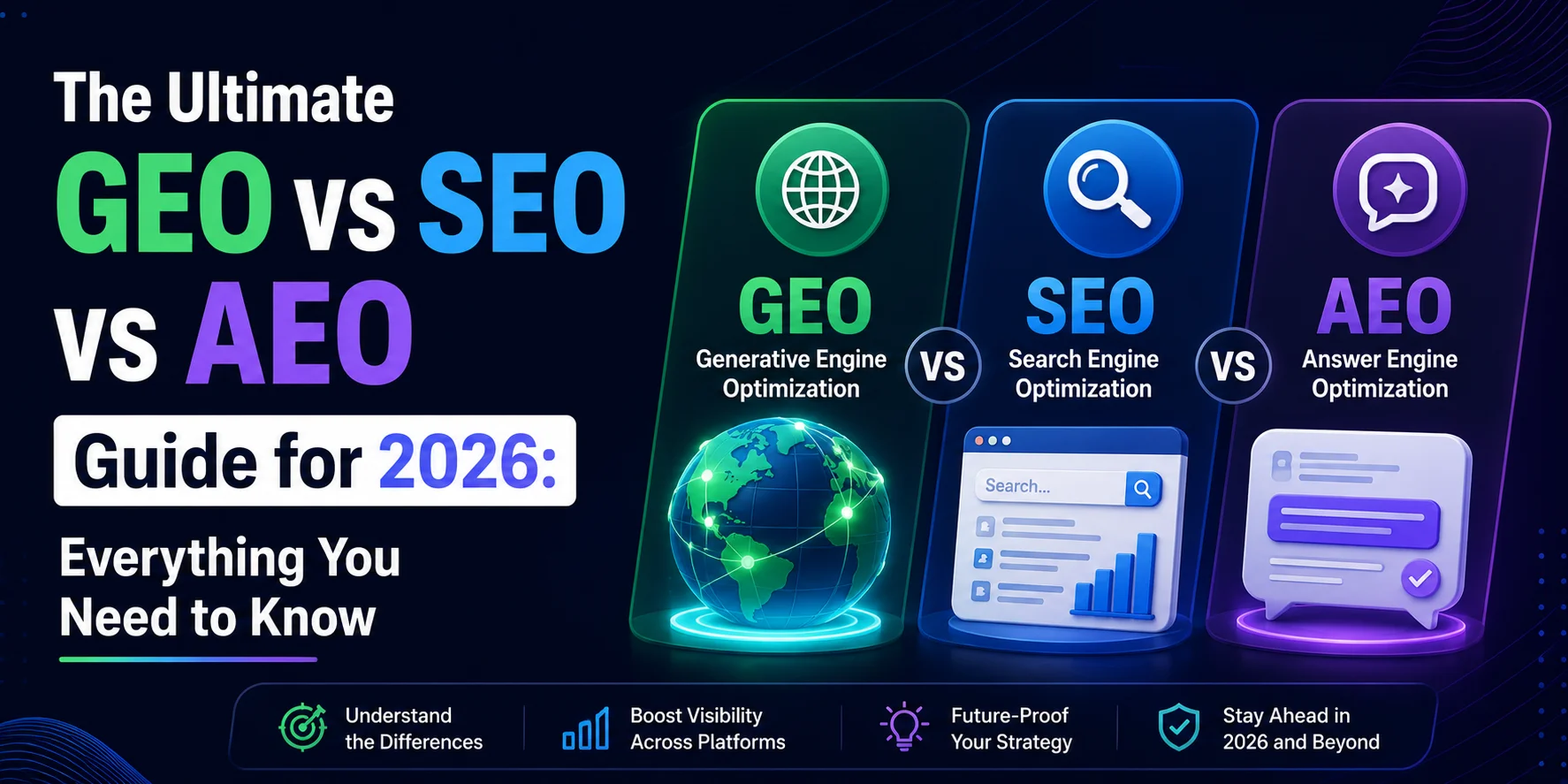
If you've noticed your organic traffic behaving strangely over the last year — impressions holding steady while clicks quietly decline — you're not imagining it. Search has split into three overlapping systems, and each one rewards a different kind of optimization. This guide breaks down GEO vs SEO vs AEO explained in plain terms, shows you where they overlap, and gives you a working GEO optimization checklist you can apply today.
1. What is Generative Engine Optimization (GEO)
What is Generative Engine Optimization (GEO)? GEO is the practice of structuring and writing content so that generative AI systems — like Google's AI Overviews, ChatGPT, Perplexity, and Gemini — can understand it, trust it, and cite it inside an AI-generated answer. Instead of optimizing purely for a ranking position, GEO optimizes for being the source an AI model chooses to pull from when it composes a response.
also Checkout -> How to Get Your Content Cited by AI
Where traditional search returns a list of links for a person to click through, generative engines synthesize an answer directly, often citing two to five sources at the bottom or inline. GEO is the discipline of becoming one of those cited sources — consistently, across many related queries, not just one exact-match keyword.
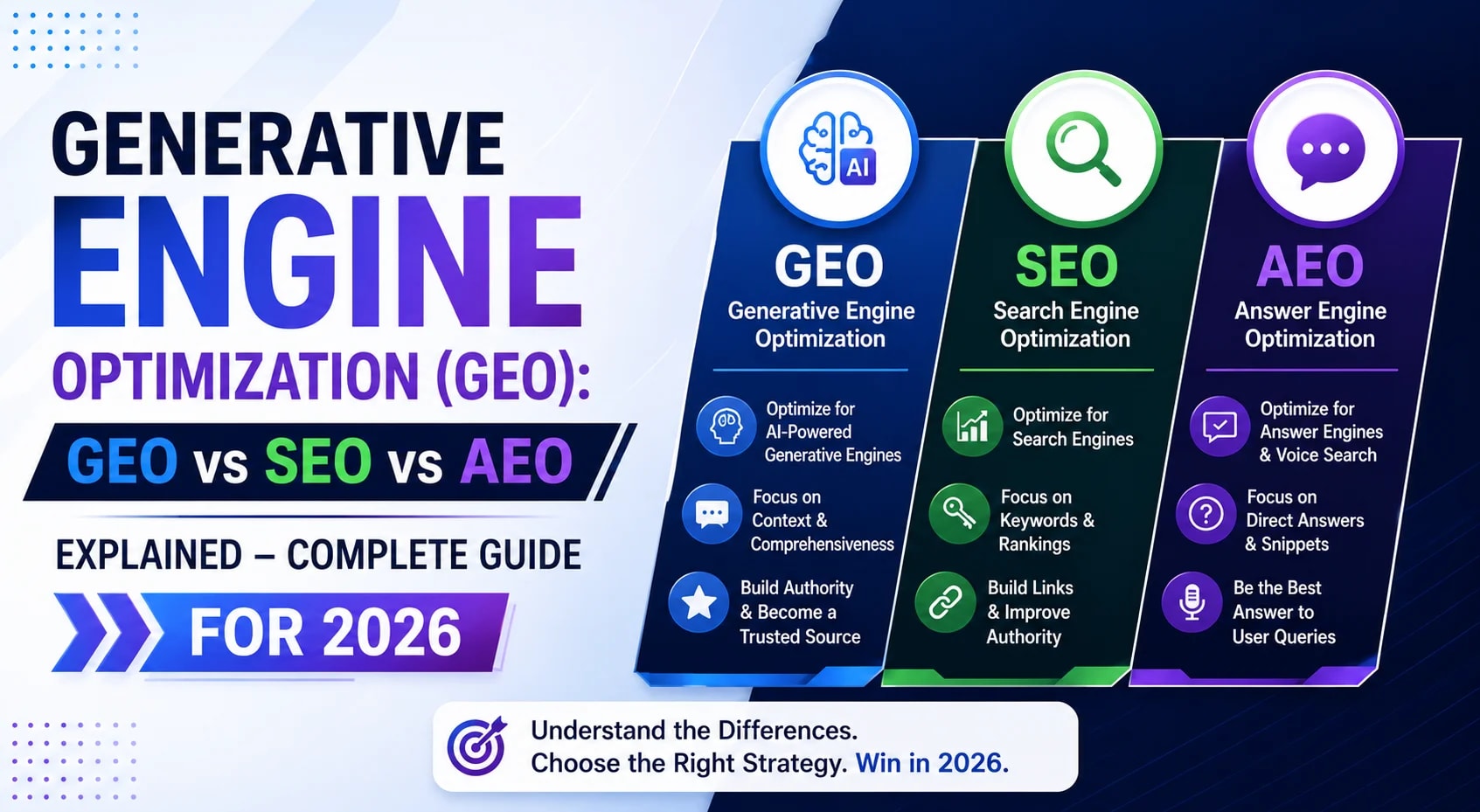
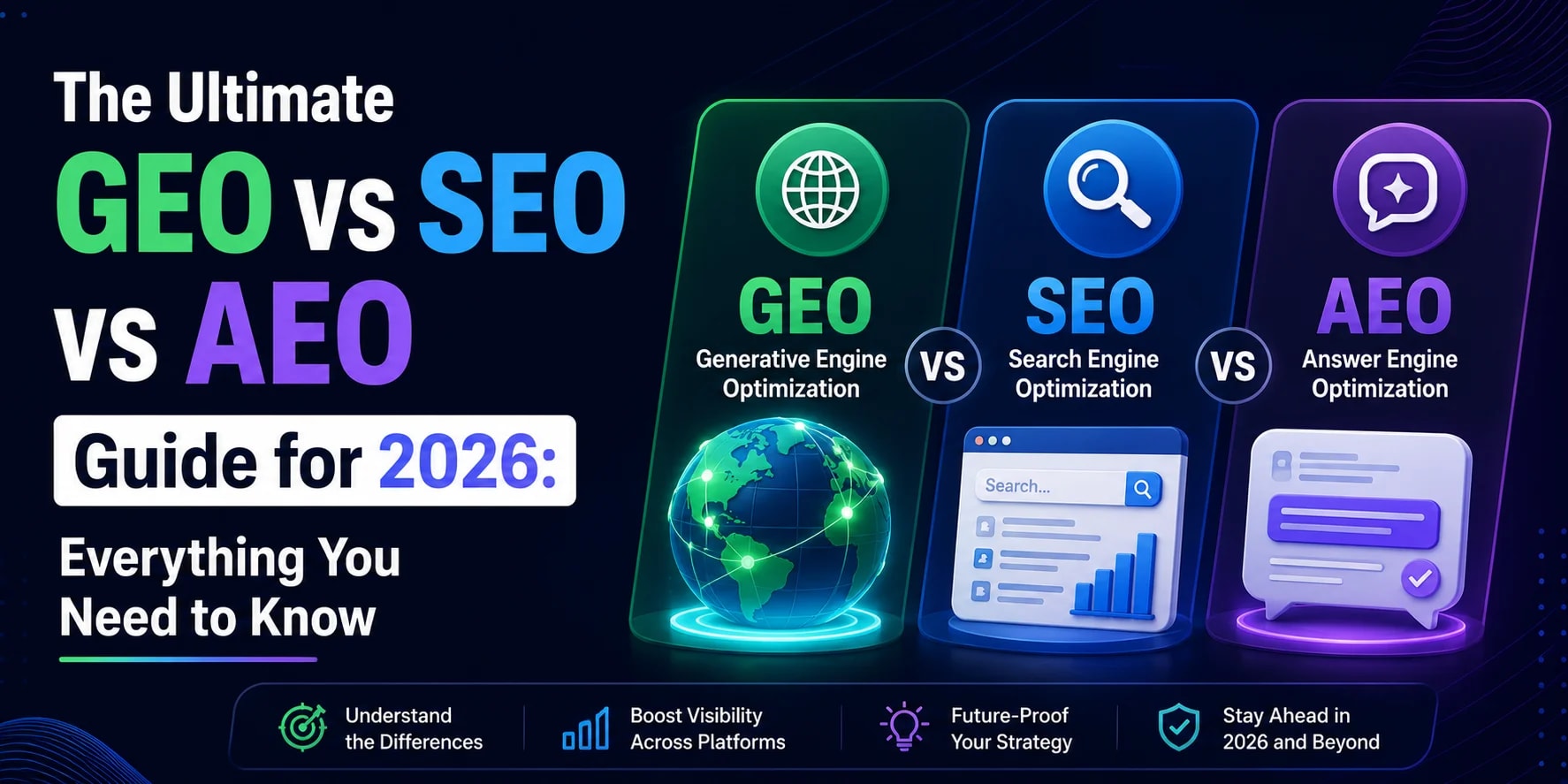
In short: SEO earns you a ranking. AEO earns you a direct answer box. GEO earns you a citation inside an AI-written summary. All three now coexist on the same results page.
Why GEO exists
Large language models don't "crawl and rank" the way classic search engines do. Many pull from retrieval systems that scan the live web, evaluate a set of candidate pages, and select passages that best answer the user's underlying intent. That selection process cares less about exact keyword density and far more about clarity, structure, factual accuracy, and how easily a passage can be lifted and reused without losing meaning. GEO is the response to that shift.
2. GEO vs SEO vs AEO explained
It helps to think of these three disciplines as three answers to the same underlying question: how do I make my content visible where people are actually searching? They share a foundation — technical health, credible content, real expertise — but they optimize for different outcomes.
| Dimension | SEO | AEO | GEO |
|---|---|---|---|
| Primary goal | Rank in organic search results | Win a direct answer box or voice response | Get cited inside an AI-generated summary |
| Optimizes for | Keywords, backlinks, site authority | Question-answer clarity, structured data | Semantic clarity, source trust, extractability |
| Format that wins | Comprehensive landing pages, blog posts | Concise Q&A blocks, FAQ schema | Well-structured, fact-dense, well-attributed content |
| Success metric | Ranking position, organic traffic | Snippet ownership, voice-answer share | Citation frequency, brand mentions in AI answers |
| Platforms | Google, Bing organic results | Featured snippets, Alexa, Siri, Google Assistant | AI Overviews, ChatGPT, Perplexity, Gemini, Copilot |
GEO vs SEO differences
The clearest GEO vs SEO differences come down to what's being evaluated and by whom. SEO is judged largely by algorithms that weigh links, on-page signals, and historical authority to produce a ranked list. GEO is judged by a language model deciding, query by query, which sources most efficiently answer the person's actual question — and that judgment leans heavily on how well-organized and self-contained your content is, not just how authoritative your domain looks on paper.
A page can rank on page one for SEO purposes and still never get cited in an AI Overview, because the model finds a competitor's page easier to extract a clean answer from. Conversely, a newer page with thin backlink history can earn a GEO citation if it states facts plainly, defines terms clearly, and answers the implicit question without fluff.
AEO vs SEO comparison
In an AEO vs SEO comparison, the key distinction is intent granularity. SEO typically targets broader topics and ranks a page for dozens or hundreds of related keywords. AEO narrows in on a single, specific question — "how much does X cost," "what is the difference between X and Y" — and structures a short, self-contained answer designed to be lifted verbatim into a snippet, a voice response, or a knowledge panel. AEO content is often a subset of a larger SEO page: think of the FAQ section at the bottom of a comprehensive guide.
- Most 2026 search results now blend organic links, answer boxes, and AI summaries on a single page.
- A typical generative AI answer or AI Overview cites two to five sources.
- The underlying goal across GEO, AEO, and SEO is the same: be the clearest, most trustworthy answer to a real question.
3. How to rank in Google AI Overviews
Understanding how to rank in Google AI Overviews starts with letting go of the idea that this is just SEO with extra steps. AI Overviews draw from a retrieval layer that favors pages already performing reasonably well organically, then re-evaluates those candidates for how cleanly they answer the query. That means solid SEO fundamentals remain the entry ticket, but they no longer guarantee a citation.
Signals that influence AI Overview citations
- Direct answer placement: State the core answer in the first sentence or two of a section, before adding nuance or context.
- Clear entity definitions: Explicitly name and define the people, products, or concepts you're discussing rather than relying on pronouns and implied context.
- Structured formatting: Use descriptive headings, short paragraphs, and lists that a model can parse as discrete, extractable units.
- Original data or perspective: Proprietary statistics, first-hand testing, or expert commentary are harder for a model to find elsewhere, which increases citation odds.
- Freshness and accuracy: Outdated or vague content is more likely to be skipped in favor of a source the model can trust as current.
Content structure that performs well
Pages that consistently earn AI Overview citations tend to follow a predictable shape: a short, direct summary near the top, followed by well-labeled sections that each fully resolve one sub-question, followed by supporting detail. This mirrors good user experience writing generally, which is part of why Google continues to describe this as helpful, people-first content rather than a separate technical discipline.
4. GEO best practices
These GEO best practices apply whether you're optimizing a blog post, a product page, or a knowledge base article.
- Answer the question in the first 40–60 words. Generative systems weigh early, unambiguous answers heavily when selecting passages to cite.
- Write in complete, self-contained statements. Avoid sentences that only make sense with prior context — a model may extract a single sentence out of sequence.
- Use precise numbers, dates, and named entities. Vague claims ("many businesses") are less citeable than specific ones ("62% of mid-size retailers").
- Structure with real headings, not visual styling. Semantic headings help both crawlers and language models segment your content correctly.
- Add comparison tables and lists where relevant. Structured formats are easier for models to parse and reuse accurately.
- Keep a single source of truth. Contradicting your own numbers across pages erodes the trust signals models use to select a citation.
- Maintain topical depth, not just breadth. A handful of thorough, well-linked pages outperform dozens of shallow ones for citation frequency.
GEO optimization checklist
Use this GEO optimization checklist as a pre-publish pass on any page you want AI systems to cite:
- Core question answered directly within the first two sentences of the section
- Every key term or entity defined on first use
- Descriptive, question-style headings throughout
- At least one comparison table or structured list
- Original data, examples, or first-hand insight included
- Facts and figures consistent with your other published pages
- No unresolved pronouns or context-dependent sentences
- Publish or update date clearly visible
- Author or organizational credibility signaled (bio, credentials, sourcing)
5. SEO for AI search engines
Adapting SEO for AI search engines doesn't mean abandoning classic fundamentals — it means layering GEO and AEO thinking on top of them. Technical health (fast load times, crawlability, mobile usability), strong internal linking, and topical authority still form the foundation every AI system implicitly relies on when deciding which sources to trust.
What changes is the writing layer above that foundation. Where old-school SEO sometimes rewarded keyword repetition and broad, sprawling pages built to capture many variations of a query, AI-era content rewards precision: fewer, better pages that resolve a topic completely and can be safely quoted without misrepresenting your position.
Structured data still matters
Schema markup — particularly FAQ, HowTo, and Article schema — continues to help both traditional snippets and generative systems understand the shape of your content. It won't guarantee a citation, but it removes ambiguity about what a page is actually claiming, which lowers the risk a model skips it in favor of a clearer competitor.
6. A practical AI search optimization guide for teams
If you're building a repeatable process rather than a one-off fix, this AI search optimization guide outlines a simple operating rhythm:
1. Audit by query type, not just by page
Group your target queries into informational, comparison, and transactional buckets. Informational and comparison queries are where GEO and AEO citations concentrate; transactional queries still lean heavily on traditional SEO and product-page optimization.
2. Rewrite for extractability
Go through existing high-traffic pages and rewrite the opening of each section so it answers the implicit question immediately, then expands. This single change often has the largest impact on both AEO snippet wins and GEO citations.
3. Monitor citations, not just rankings
Track how often your brand or domain appears inside AI Overviews and AI chat responses for your priority queries, in addition to your traditional rank tracking. This is becoming a core visibility metric alongside organic position.
4. Keep a consistent facts layer
Maintain one canonical page per key statistic, definition, or claim, and link to it from related content. This reduces the chance an AI system encounters conflicting numbers from your own domain and deprioritizes you as a source.
The bottom line
GEO, SEO, and AEO aren't competing strategies — they're three lenses on the same goal: being the clearest, most trustworthy answer available when someone has a question. Build content that states things plainly, backs claims with real data, and organizes itself for easy extraction, and you'll find it performs across all three surfaces at once. Treat this guide's checklist as a living document — the same content, structure, and strategies will keep evolving as generative engines mature, so revisit and update accordingly.
Frequently Asked Questions
Is GEO replacing SEO?
No. GEO builds on SEO fundamentals rather than replacing them. Sites with weak technical SEO or thin authority rarely earn AI citations, because generative systems still lean on established trust and crawlability signals.
Do I need separate content for GEO, AEO, and SEO?
Usually not. A well-structured page — clear headings, direct answers, supporting depth, and clean data — can satisfy all three simultaneously. The disciplines differ in emphasis, not in the underlying quality bar.
How do I measure GEO success?
Track brand and URL citations inside AI Overviews and AI chat tools for your priority queries, alongside referral traffic from AI platforms where available, in addition to standard organic rank tracking.
Does AEO still matter with AI Overviews everywhere?
Yes. Featured snippets, voice assistants, and knowledge panels remain high-visibility, zero-click placements that operate alongside AI Overviews rather than being replaced by them.