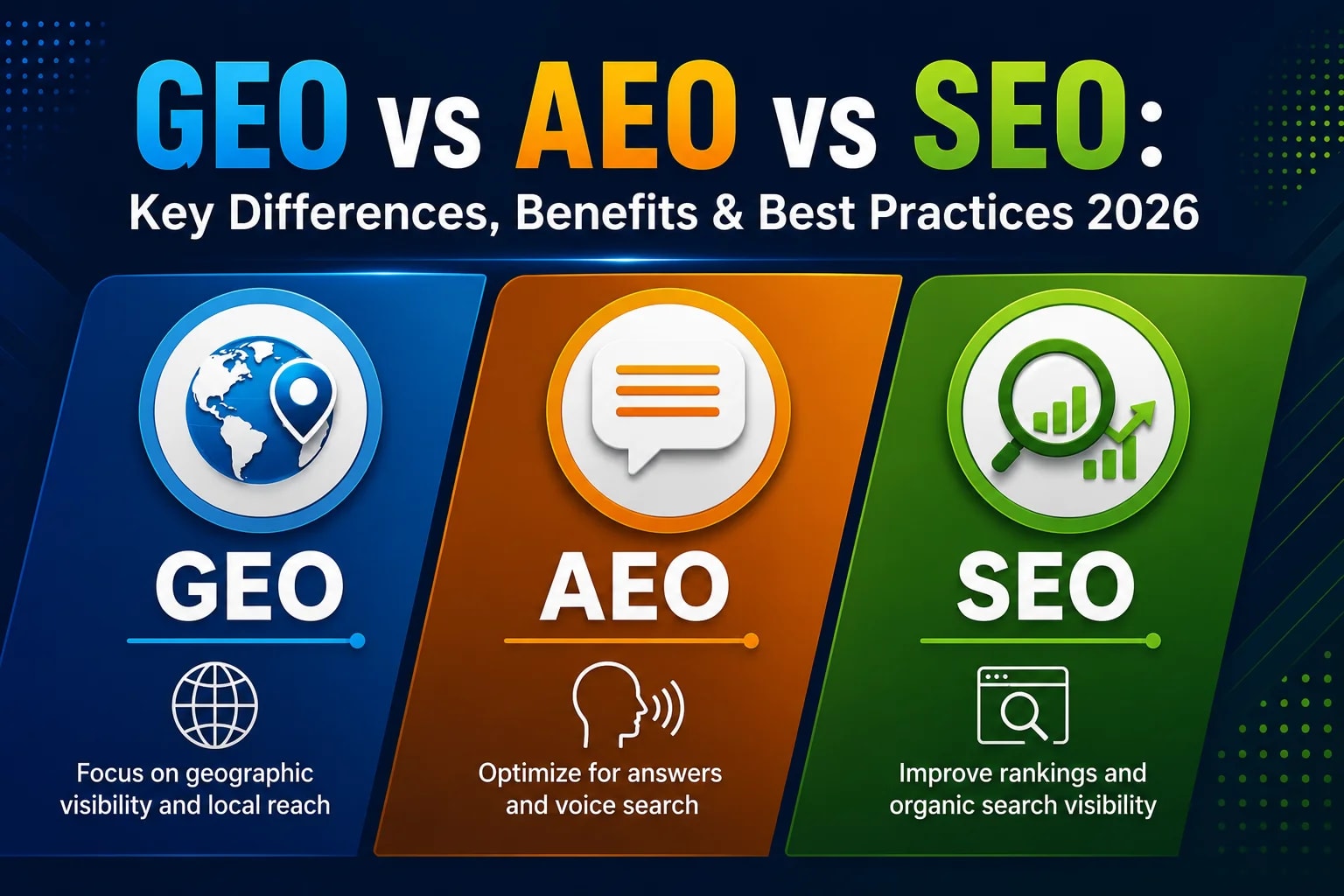
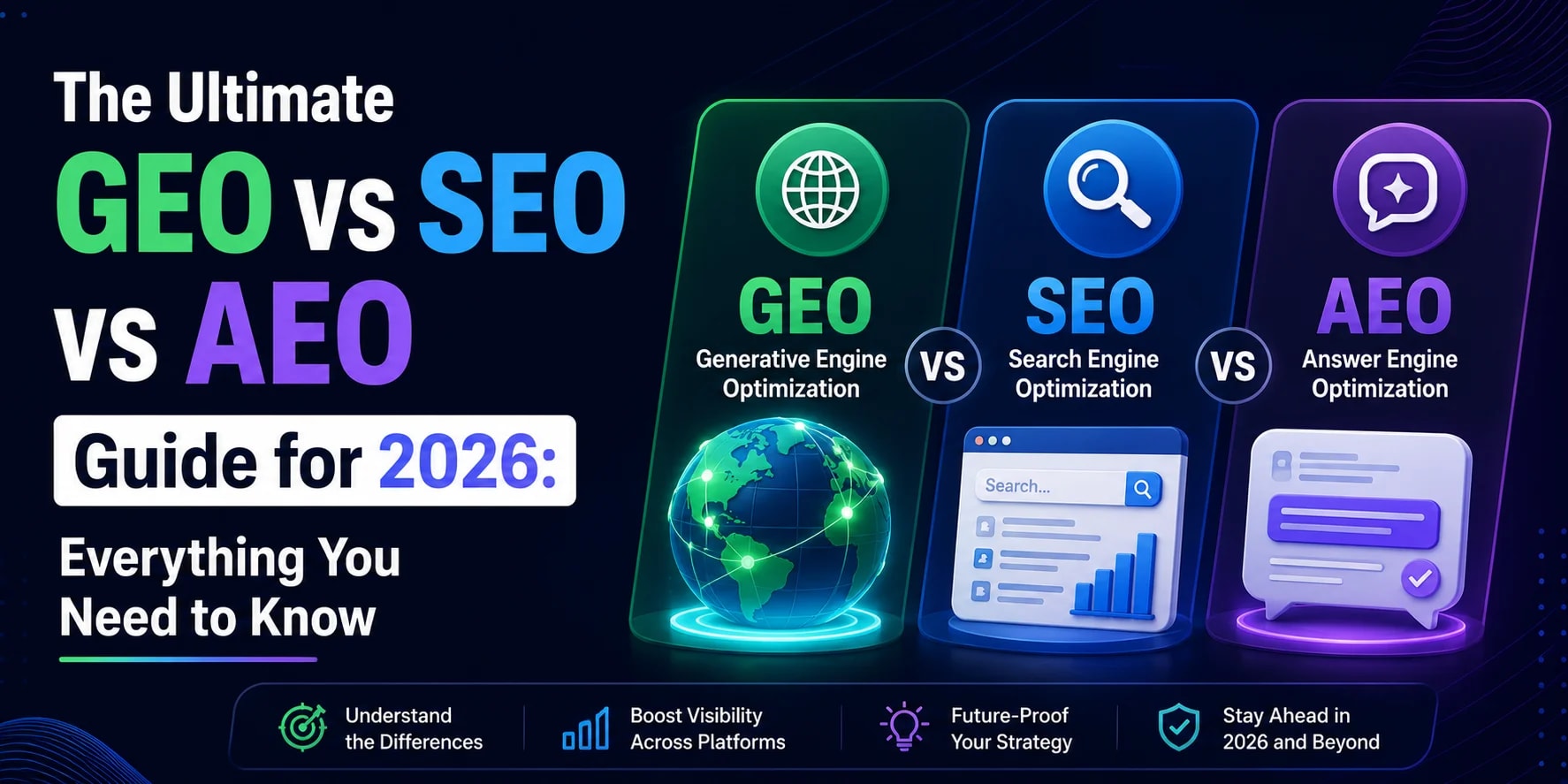
Generative Engine Optimization (GEO): GEO vs SEO vs AEO Explained – Complete Guide for 2026
Search is no longer just a list of blue links. Between AI Overviews, ChatGPT, Perplexity, Gemini, and Google Discover, people now get answers instead of links — and that shift has created three overlapping but distinct disciplines

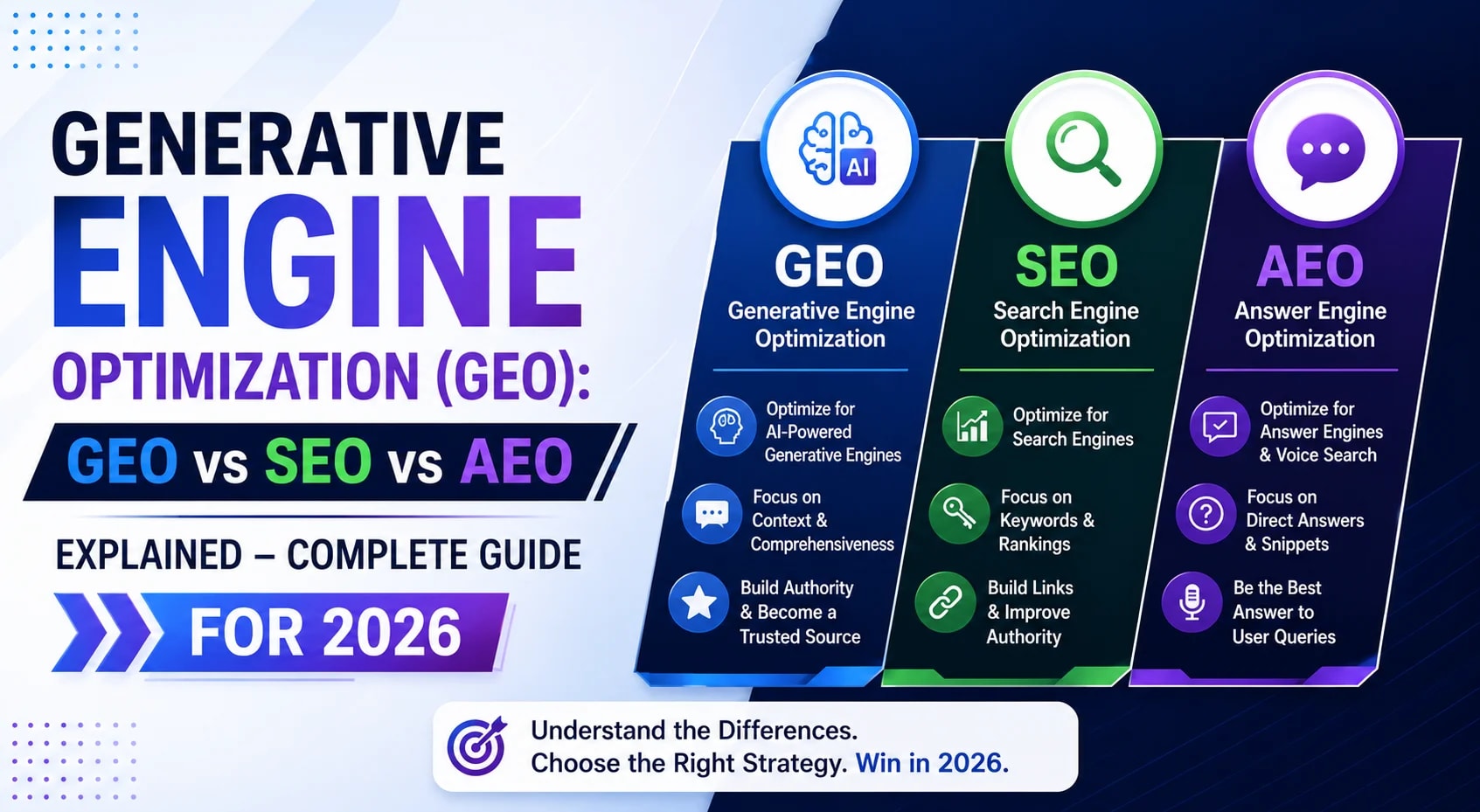
SEO, AEO, and GEO. This guide breaks down what each one means, how they differ, and exactly how to optimize your content so it gets found, cited, and recommended by both traditional search engines and generative AI systems in 2026.
In this guide
- What Is SEO?
- What Is AEO (Answer Engine Optimization)?
- What Is GEO (Generative Engine Optimization)?
- GEO vs SEO vs AEO: Side-by-Side Comparison
- Why GEO Matters in 2026
- How Generative Engines Actually Choose What to Cite
- Practical GEO Strategies You Can Apply Today
- Optimizing for Google Discover in the GEO Era
- Common Mistakes Brands Make with GEO
- Frequently Asked Questions
What Is SEO?
Search Engine Optimization (SEO) is the practice of improving a website so it ranks higher in traditional search engine results pages (SERPs), primarily Google and Bing. SEO has always been built around three pillars: technical health (site speed, crawlability, mobile-friendliness), on-page relevance (keywords, headings, internal linking), and off-page authority (backlinks, brand mentions, trust signals).
The goal of classic SEO is simple: earn a top-ranking position so a human clicks your link. It's a click-driven model — visibility is measured in rankings, impressions, and traffic.
Core Components of SEO
- Keyword research: Identifying what people type into search boxes.
- On-page optimization: Title tags, meta descriptions, header structure, and content depth.
- Technical SEO: Site architecture, page speed, structured data, and indexability.
- Link building: Earning backlinks from authoritative domains to signal trust.
- User experience (UX): Core Web Vitals, mobile responsiveness, and dwell time.
What Is AEO (Answer Engine Optimization)?
Answer Engine Optimization (AEO) emerged as voice search and featured snippets became mainstream. AEO focuses on structuring content so it can be pulled directly into a "position zero" answer box, a voice assistant response, or a snippet — without the user ever clicking through to a website.
Where SEO optimizes for rankings, AEO optimizes for extractability. It's about making your content easy for an algorithm to lift a concise, self-contained answer out of a page and present it as the direct response to a question.
Also CheckOut -> Ultimate GEO vs SEO vs AEO Guide for 2026
Core Components of AEO
- Question-based headings: Structuring H2s and H3s as direct questions users actually ask.
- Concise, front-loaded answers: Answering a question in the first one to three sentences after the heading.
- Structured data markup: FAQ schema, HowTo schema, and Q&A schema to help engines parse answers.
- Natural language optimization: Writing in the conversational phrasing people use with voice assistants.
What Is GEO (Generative Engine Optimization)?
Generative Engine Optimization (GEO) is the newest and broadest of the three. GEO is the practice of optimizing content so it gets referenced, summarized, or cited by generative AI systems such as ChatGPT, Google's AI Overviews, Gemini, Perplexity, Claude, and Copilot when they generate an answer in response to a user's prompt.
Unlike SEO, which competes for a ranking position, and AEO, which competes for a snippet slot, GEO competes for a mention inside an AI-generated response — often alongside several other sources synthesized into a single paragraph. There may be no traditional "ranking" at all; instead, the AI model decides which sources are credible, relevant, and well-structured enough to draw from and cite.
Core Components of GEO
- Topical authority and depth: Comprehensive coverage of a subject, not just a single keyword-targeted page.
- Clear, well-cited statements: Facts, statistics, and definitions that are easy for an AI to extract and attribute correctly.
- Original data and unique insight: AI models favor content that adds new information rather than reworded competitor content.
- Structured, machine-readable formatting: Clean headings, tables, lists, and schema markup that make content easy to parse.
- Brand consistency across the web: Mentions on forums, review sites, and third-party publications that reinforce credibility signals AI models pick up on.
- E-E-A-T signals: Experience, Expertise, Authoritativeness, and Trustworthiness — the same trust framework Google uses, now equally important to generative models.
GEO vs SEO vs AEO: Side-by-Side Comparison
| Factor | SEO | AEO | GEO |
|---|---|---|---|
| Primary Goal | Rank in SERPs | Win the featured snippet / voice answer | Get cited inside an AI-generated response |
| Target Platform | Google, Bing organic results | Featured snippets, voice assistants (Alexa, Siri, Google Assistant) | ChatGPT, AI Overviews, Gemini, Perplexity, Copilot, Claude |
| Success Metric | Rankings, organic traffic, click-through rate | Snippet ownership, voice-answer share | Citation frequency, brand mentions in AI answers |
| Content Style | Keyword-optimized, comprehensive pages | Direct, concise question-and-answer format | Authoritative, well-structured, data-rich, easily summarized |
| Key Signals | Backlinks, site speed, keyword relevance | Schema markup, clear answer formatting | Topical depth, originality, E-E-A-T, third-party mentions |
| User Behavior | User clicks a link | User reads/hears an extracted answer | User reads an AI-synthesized answer, may never click |
Why GEO Matters in 2026
By 2026, a growing share of informational searches are resolved entirely inside AI interfaces. Google's AI Overviews now appear across a large portion of search queries, and standalone AI assistants have become default research tools for millions of people. This has created what many marketers call "zero-click AI answers" — the generative equivalent of the old zero-click SERP problem, but at a much larger scale.
The practical implication is significant: a page can lose organic traffic even while gaining brand visibility, because the AI model is answering the question on the user's behalf and simply naming or linking your brand as the source. Businesses that ignore GEO risk becoming invisible in the layer of the internet that's increasingly where research and purchase decisions begin.
GEO Doesn't Replace SEO — It Extends It
It's a common misconception that GEO makes SEO obsolete. In reality, generative engines still rely heavily on crawled, indexed, and ranked web content as their training and retrieval sources. A technically sound, well-ranked site remains the foundation GEO is built on top of. Think of SEO as the plumbing, AEO as the framing for direct answers, and GEO as the finishing layer that determines whether AI systems trust and quote your content.
How Generative Engines Actually Choose What to Cite
Generative engines typically combine a retrieval step (pulling relevant, indexed web content) with a synthesis step (summarizing and rephrasing that content into a coherent answer). Understanding this two-step process explains most GEO best practices.
1. Retrieval: Getting Found in the First Place
Before an AI model can cite your content, it has to retrieve it. This still depends on classic technical SEO fundamentals — crawlability, indexation, structured data, and page authority. If a page isn't indexed or is buried behind poor technical architecture, it's invisible to both traditional search and generative retrieval systems.
2. Evaluation: Deciding What's Trustworthy
Once retrieved, the model evaluates which sources are credible enough to reference. This is where E-E-A-T-style signals matter: author credentials, citations to primary data, consistency with other trusted sources, and a lack of contradictory or manipulative language.
Visit here to know ->How to Get Your Content Cited by AI
3. Synthesis: Turning Content Into an Answer
Finally, the model extracts specific facts, numbers, or explanations and rewrites them into a natural-language answer. Content that is already structured in clear, standalone statements is far easier to extract accurately — which is why formatting matters just as much as the underlying facts.
Practical GEO Strategies You Can Apply Today
Write for Extraction, Not Just for Ranking
Break complex ideas into short, self-contained statements. Each paragraph should be able to stand alone and make sense if lifted out of context, since that's effectively what a generative model does when it summarizes your page.
Use Descriptive, Hierarchical Headings
Structure content with clear H1, H2, and H3 tags that describe exactly what the section covers. This helps both search crawlers and AI retrieval systems map the logical structure of your page and locate the most relevant section for a given query.
Add Original Data and Unique Perspective
Generative engines are trained to prioritize novelty. Original research, proprietary statistics, case studies, and expert commentary give a model a reason to cite you specifically rather than a generic competitor covering the same topic.
Strengthen Structured Data
Implement schema markup — Article, FAQ, HowTo, and Organization schema — to give machines explicit, unambiguous signals about your content's structure and authorship.
Build Cross-Platform Brand Presence
Generative models often draw on a broad mix of sources, including forums, review platforms, and third-party publications, not just your own website. Being mentioned accurately and positively across Reddit, industry publications, and review sites strengthens the overall trust signal a model associates with your brand.
Keep Facts Accurate and Consistent
Inconsistent claims across your own pages — different statistics, conflicting definitions — can reduce a model's confidence in citing you at all. Consistency across your site and any external mentions builds the kind of trust generative systems are tuned to reward.
Optimizing for Google Discover in the GEO Era
Google Discover is a personalized content feed that surfaces articles based on a user's interests and behavior, rather than an explicit search query. It sits somewhat apart from SEO, AEO, and GEO, but shares overlapping requirements — and increasingly interacts with AI-curated feeds as Google blends generative summarization into its discovery surfaces.
What Google Discover Rewards
- High-quality, original visuals: Large, compelling images significantly increase Discover click-through rates.
- Timely, evergreen relevance: Content tied to ongoing interests, trends, or seasonally relevant topics performs best.
- Strong E-E-A-T signals: Discover heavily favors content from sites with established topical authority and trust.
- Mobile-first experience: Since Discover is almost entirely a mobile surface, fast-loading, mobile-optimized pages are essential.
- Compelling, non-clickbait headlines: Titles that accurately reflect content perform more consistently over time than exaggerated hooks.
The overlap with GEO is clear: both reward genuinely helpful, well-structured, trustworthy content over content engineered narrowly around keyword density. In 2026, the winning content strategy treats SEO, AEO, GEO, and Discover optimization not as separate silos, but as different lenses on the same underlying goal — producing content so clear, credible, and useful that any system, human or AI, wants to surface it.
Common Mistakes Brands Make with GEO
- Treating GEO as a keyword exercise. Generative engines respond to depth, clarity, and trust signals, not keyword density.
- Ignoring technical SEO fundamentals. If a page can't be crawled and indexed, it can't be retrieved for generative synthesis either.
- Publishing thin, templated content. AI models are increasingly good at detecting generic, reworded content and deprioritizing it in favor of original sources.
- Neglecting structured data. Skipping schema markup makes it harder for both search engines and AI systems to parse your content accurately.
- Only tracking clicks. Citation frequency and brand-mention share in AI answers are becoming equally important metrics, even without a corresponding click.