Answer Engine Optimization (AEO): The New Way to Get AI Tools to Mention Your Business
Quick Answer: Answer Engine Optimization (AEO) is the practice of structuring your content so AI-powered tools — including ChatGPT, Perplexity, Google AI Overviews, and Bing Copilot — cite your business when users ask relevant questions. In 2026, AEO is no longer optional; it is the single most important shift in digital visibility since mobile-first indexing.
What Is Answer Engine Optimization (AEO)?
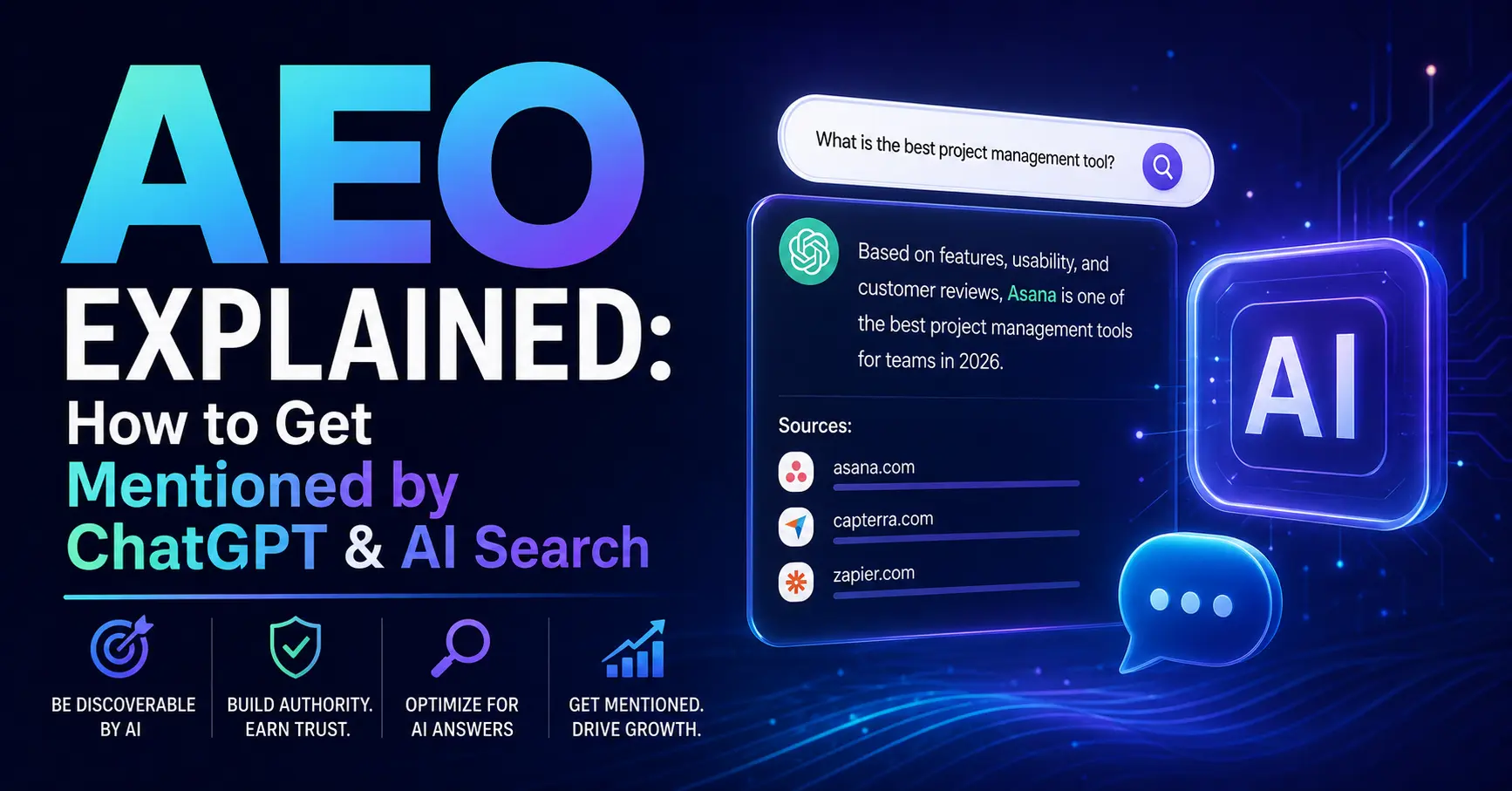
Answer Engine Optimization (AEO) is the process of optimizing your website, content, and brand presence so that AI-powered answer engines — such as ChatGPT, Google AI Overviews, Perplexity, and Bing Copilot — surface your business as a trusted source when responding to user queries.
Traditional SEO earns you a blue link on a results page. AEO earns you a mention inside the AI's answer itself.
The distinction matters because Google's AI Mode (launched May 2025, now live in 180+ countries) shows zero organic blue links. If an AI doesn't cite you, you effectively do not exist in that result — no matter how well you rank.
AEO vs SEO vs GEO: What's the Difference?
|
Term |
Full Form |
Goal |
Channel |
|---|---|---|---|
|
SEO |
Search Engine Optimization |
Rank in organic blue links |
Google, Bing |
|
AEO |
Answer Engine Optimization |
Get cited in AI-generated answers |
ChatGPT, Perplexity, AI Overviews |
|
GEO |
Generative Engine Optimization |
Broad AI visibility across all AI platforms |
All AI tools + search |
AEO and GEO are closely related. Think of AEO as the strategy and GEO as the execution framework across AI platforms.
Why AEO Matters More Than Traditional SEO in 2026
Search behavior has shifted dramatically. Users no longer scan ten blue links — they ask a question and expect a direct answer. According to industry data, AI-generated responses now appear for over 40% of informational queries on Google.
Here is what changed and why it matters for your business:
-
Google AI Mode (rolled out globally in 2025) replaces the traditional results page with a conversational AI interface — no blue links, only AI-generated answers with citations.
-
ChatGPT Browse lets millions of users get real-time web answers. Businesses that appear as sources see meaningful referral traffic.
-
Perplexity has grown to over 100 million monthly active users who rely exclusively on AI-cited sources.
-
Bing Copilot integrates AI answers into Microsoft's search engine and Edge browser, influencing purchasing decisions.
If your content is not structured for AI citability, you are invisible to a fast-growing segment of your most valuable potential customers.
Benefits of AEO for Businesses
Implementing a strong AEO strategy delivers tangible advantages:
-
Brand authority: AI tools cite credible, well-structured sources. Being cited signals expertise and builds brand trust automatically.
-
Zero-click visibility: Even when users do not click through, hearing your brand name in an AI answer creates powerful brand recall.
-
Qualified traffic: Users who click from an AI citation already trust the source — conversion rates are typically higher than standard organic clicks.
-
Competitive differentiation: Most businesses have not yet optimized for AEO, giving early movers a significant advantage.
-
Long-term resilience: Content optimized for AI citation tends to also rank well in traditional search, making AEO a dual-channel win.
-
Featured snippet alignment: Pages that win featured snippets are the most commonly cited by Google AI Overviews, creating a compounding effect.
Technical AEO Checklist
A solid technical foundation is prerequisite for AI citability. Run through this checklist:
AI Crawler Access
Ensure the following AI crawlers are not blocked in your robots.txt:
|
Crawler |
Company |
Why It Matters |
|---|---|---|
|
ChatGPT-User |
OpenAI |
Enables live ChatGPT Browse citations |
|
PerplexityBot |
Perplexity |
Enables Perplexity answer citations |
|
ClaudeBot |
Anthropic |
Enables Claude knowledge base |
|
GoogleBot |
|
Feeds Google AI Overviews |
|
BingBot |
Microsoft |
Feeds Bing Copilot |
Action: Open yoursite.com/robots.txt and verify none of these crawlers are listed under Disallow.
llms.txt File
Add a /llms.txt file to your root domain — a 2024 open standard that tells AI systems which pages to prioritize. Format:
# [Your Brand Name]
> [One-sentence description of what your business does]
## Key Pages
- [Homepage URL]: [Brief description]
- [Core service page]: [Brief description]
- [About page]: [Brief description]
## Content Focus
[2–3 sentences on your core topics and areas of expertise]
## Preferred Citation Format
[Brand Name] ([URL])
Schema Markup Requirements
-
Organization schema with name, url, logo, sameAs (link all social profiles)
-
Article schema on every blog post (includes datePublished, dateModified, author)
-
FAQPage schema on any page with Q&A content
-
BreadcrumbList schema to signal content hierarchy
-
Person schema for each named author with credentials and sameAs links
HTTPS and Site Security
-
Full HTTPS enforcement (no mixed content warnings)
-
Valid SSL certificate with no expiry within 30 days
-
Security headers: X-Frame-Options, X-Content-Type-Options, Content-Security-Policy
On-Page AEO Checklist
How you structure individual pages determines whether AI tools extract and cite your content.
Answer-First Formatting
Every page targeting an informational query should open with a direct, concise answer in the first 100 words — before elaborating. AI systems extract the clearest, most direct answer to cite.
Before (traditional):
"In this comprehensive guide, we will explore the many aspects of content marketing and what businesses need to know about..."
After (AEO-optimised):
"Content marketing is the practice of creating and distributing valuable content to attract and retain a defined audience, ultimately driving profitable action. Here is exactly how it works..."
Heading Structure
Use a strict hierarchy: H1 → H2 → H3. Never skip a level. Frame H2s and H3s as questions where possible — they align with People Also Ask boxes and AI query matching.
Example:
-
H2: What Is Answer Engine Optimization?
-
H3: How Does AEO Differ from Traditional SEO?
-
H3: Why Do AI Tools Prefer Certain Sources?
Content Elements AI Tools Love
-
Numbered step-by-step processes (AI tools reproduce numbered lists directly)
-
Comparison tables (structured data is easily extracted)
-
Clear definitions (AI tools use your definition verbatim if it is precise)
-
Quotable statistics (specific numbers get cited; vague claims do not)
-
Short paragraphs (2–4 sentences maximum for extractability)
Meta Optimization
-
Meta title: Include the primary keyword within 60 characters
-
Meta description: Frame as a direct answer to the user's query, 150–160 characters
-
URL slug: Short, descriptive, keyword-rich
Content Audit for AEO Readiness
A content audit assesses whether your existing pages are structured to be cited by AI tools.
What to Audit
Review every piece of content against these criteria:
|
Criterion |
Why It Matters for AEO |
|---|---|
|
Answer-first paragraph |
AI systems extract the first clear answer |
|
Unique statistics or data |
Original data is the most frequently cited content type |
|
Author credentials visible |
E-E-A-T signals influence AI source selection |
|
Publication and update dates shown |
AI tools deprioritize stale content for fast-changing topics |
|
Internal linking to related topics |
Signals topical depth to AI crawlers |
|
FAQs at the bottom of the page |
Directly feeds People Also Ask and AI Q&A responses |
Content Freshness Rule
Flag any content older than 12 months that covers rapidly evolving topics — AI tools, regulations, pricing, software features, and market statistics. Stale data will not be cited. Update these pages with fresh figures and add a "Last Updated: [date]" tag.
E-E-A-T Signals to Add
-
Author byline with name, title, and credentials
-
First-hand experience (case studies, original research, tested processes)
-
External citations linking to authoritative sources (.gov, .edu, major publications)
-
Customer testimonials or verified case study outcomes
Backlink Authority and AI Citations
AI systems do not rank backlinks the way traditional search engines do — but backlink authority still matters indirectly.
Sites with strong backlink profiles from authoritative domains (industry publications, government sites, universities) are more likely to be:
-
Included in AI training data (high-authority domains are indexed more deeply)
-
Trusted as citation sources (AI tools cross-reference source authority)
-
Featured in Google AI Overviews (which correlates with traditional domain authority)
Priority Link Targets for AEO
-
Industry association websites — listings and member profiles
-
Wikipedia references — being cited on Wikipedia signals entity recognition
-
Authoritative directories — Clutch, G2, Crunchbase depending on your niche
-
Major publication mentions — Forbes, industry trade press, regional news
-
Original research citations — publish data studies that others cite
Core Web Vitals and AI Readiness
Core Web Vitals remain a Google ranking signal and indirectly affect AEO because pages that do not pass CWV thresholds may be crawled less frequently.
2026 CWV Targets
|
Metric |
Good |
Needs Improvement |
Poor |
|---|---|---|---|
|
LCP (Largest Contentful Paint) |
≤ 2.5s |
2.5–4.0s |
> 4.0s |
|
INP (Interaction to Next Paint) |
≤ 200ms |
200–500ms |
> 500ms |
|
CLS (Cumulative Layout Shift) |
≤ 0.1 |
0.1–0.25 |
> 0.25 |
Note: INP replaced FID as a Core Web Vital in March 2024. Ensure your audit tools are measuring INP, not FID.
Quick wins: Compress images to WebP, implement lazy loading, use a CDN, eliminate render-blocking scripts, and set explicit width/height attributes on images to prevent CLS.
AEO Audit Report Template (Free)
Use this template to audit any page or domain for AEO readiness.
Section 1 — Basic Information
|
Field |
Detail |
|---|---|
|
Website / URL |
|
|
Audit Date |
|
|
Auditor Name |
|
|
Primary Target Keywords |
|
|
AI Platforms Targeting |
ChatGPT / Perplexity / Google AI Overviews / Bing Copilot |
Section 2 — Technical AEO Score
|
Check |
Status |
Priority |
|---|---|---|
|
AI crawlers unblocked in robots.txt |
✅ / ❌ |
Critical |
|
llms.txt file present |
✅ / ❌ |
High |
|
Organization schema deployed |
✅ / ❌ |
High |
|
Article schema on blog posts |
✅ / ❌ |
High |
|
FAQPage schema present |
✅ / ❌ |
Medium |
|
HTTPS enforced |
✅ / ❌ |
Critical |
|
Core Web Vitals passing |
✅ / ❌ |
High |
Section 3 — Content AEO Score
|
Check |
Status |
Priority |
|---|---|---|
|
Answer-first paragraph on key pages |
✅ / ❌ |
Critical |
|
H1 → H2 → H3 hierarchy intact |
✅ / ❌ |
High |
|
Author credentials visible |
✅ / ❌ |
High |
|
Publication + update dates shown |
✅ / ❌ |
Medium |
|
FAQs present on key pages |
✅ / ❌ |
Medium |
|
Original statistics or research |
✅ / ❌ |
High |
|
Comparison tables present |
✅ / ❌ |
Medium |
Section 4 — E-E-A-T Score
|
Factor |
Score (1–10) |
Notes |
|---|---|---|
|
Experience |
||
|
Expertise |
||
|
Authoritativeness |
||
|
Trustworthiness |
Section 5 — Priority Actions
|
# |
Action |
Impact |
Effort |
Deadline |
|---|---|---|---|---|
|
1 |
High / Med / Low |
High / Med / Low |
||
|
2 |
||||
|
3 |
Sample AEO Audit Report Example
Website: IndiaLegalAdvisors.com (hypothetical) Audit Date: June 2026 Industry: Legal Services
|
Category |
Score |
Key Finding |
|---|---|---|
|
AI Crawler Access |
60/100 |
PerplexityBot blocked in robots.txt |
|
llms.txt |
0/100 |
File not present |
|
Content Citability |
55/100 |
Pages bury answers in long introductions |
|
E-E-A-T |
70/100 |
Author bios present but lack credentials |
|
Schema Markup |
40/100 |
Organization schema missing sameAs links |
|
Core Web Vitals |
80/100 |
LCP at 2.8s — needs minor improvement |
Top 3 Recommended Actions:
-
Unblock PerplexityBot in robots.txt (10-minute fix, critical impact)
-
Add llms.txt to root domain (1-hour task, high impact on AI discoverability)
-
Rewrite service page introductions to lead with direct answers (high impact on citation rate)
Manual vs Automated AEO Audit Comparison
|
Aspect |
Manual Audit |
Automated Audit |
|---|---|---|
|
Cost |
Time-intensive, low tool cost |
Subscription-based, lower time cost |
|
Depth |
High — catches nuanced issues |
Medium — misses context-dependent problems |
|
Speed |
Slow (days to weeks) |
Fast (minutes to hours) |
|
E-E-A-T assessment |
Excellent — requires human judgment |
Poor — tools cannot assess experience authenticity |
|
Schema validation |
Accurate |
Accurate |
|
Content citability |
Excellent — human reads like an AI |
Limited |
|
Best for |
High-stakes pages, competitor analysis |
Ongoing monitoring, large-scale crawls |
|
Recommended tools |
Google Search Console, Rich Results Test, PageSpeed Insights |
Screaming Frog, Semrush, Ahrefs |
Recommendation: Use automated tools for monthly site-wide crawls and manual audits for your 10–20 highest-value pages every quarter.
Common AEO Mistakes to Avoid
-
Blocking AI crawlers in robots.txt — The most common and damaging mistake. Always verify all major AI bots are permitted.
-
Writing for length, not clarity — AI tools cite the clearest answer, not the longest article. Padding content with filler reduces citability.
-
Ignoring author attribution — Anonymous content is rarely cited by AI systems that value E-E-A-T signals.
-
Using vague statistics — "Many businesses report improvement" will never be cited. "73% of businesses report a 2x increase in leads" will be.
-
Skipping FAQPage schema — This is low-effort, high-impact. FAQ schema directly feeds AI Q&A responses.
-
Not updating stale content — AI tools deprioritize outdated pages. A 2023 "Complete Guide" competing against a 2026 update will lose.
-
Treating AEO and SEO as separate strategies — They are deeply complementary. AEO-optimized content also earns better traditional rankings.
-
Neglecting entity building — If your brand is not mentioned on Wikipedia, Wikidata, LinkedIn, Crunchbase, and authoritative directories, AI tools have fewer signals to trust you.
Expert AEO Tips for 2026
-
Publish original data — Research reports, surveys, and proprietary datasets are the most cited content type across all AI platforms. Even a simple survey of 50 clients produces citable statistics.
-
Build topical authority clusters — A single great article is not enough. AI tools cite sources that demonstrate deep expertise across many related articles. Build content clusters around 5–10 core topics.
-
Target conversational queries — AI users ask in full sentences ("What is the best way to..."). Optimise your H2s and H3s to match this phrasing.
-
Track AI citations as a KPI — Use tools like Perplexity, ChatGPT, and Google AI Mode to manually query your target keywords and check if your brand appears. Do this monthly.
-
Add a definitions section to key pages — Clearly defined terms in the format "Term: Definition" are extracted verbatim by AI tools. Every industry article should define its key terms.
-
Use structured comparison tables — Whenever you compare two things, put them in a table. AI tools extract tabular data reliably.
-
Build your Wikipedia presence — If your business, founders, or research is notable enough for a Wikipedia article or reference, pursue it. Wikipedia is a primary knowledge graph signal for AI systems.
-
Earn brand mentions in major publications — A mention in a Forbes article, Times of India, or industry trade publication creates an authoritative signal that AI systems recognize.
-
Add a "last updated" date to every article — Visible update dates signal freshness. AI tools weight freshness heavily for time-sensitive topics.
-
Deploy BreadcrumbList schema sitewide — This signals content hierarchy to AI crawlers and improves how AI tools understand the relationship between your pages.
Key Takeaways
-
AEO is the new frontier — AI-generated answers are replacing blue links for millions of daily queries. Businesses not optimized for AEO are losing visibility.
-
Technical foundations first — Unblock AI crawlers, add llms.txt, and deploy schema markup before anything else.
-
Answer-first content wins — Lead every key page with a direct, concise answer to the user's primary question.
-
E-E-A-T is non-negotiable — Author credentials, original data, and authoritative backlinks determine which sources AI tools trust.
-
AEO and SEO amplify each other — Content optimized for AI citation also tends to rank better in traditional search.
-
Measure AI citation monthly — Track your brand's presence in AI-generated answers as a dedicated KPI alongside organic rankings.
-
Original research is the highest-ROI AEO investment — Unique data is cited more frequently than any other content type across AI platforms.
Conclusion
The search landscape of 2026 looks fundamentally different from five years ago. AI-generated answers have moved from a novelty to the primary interface through which millions of users discover businesses, products, and services every day.
Answer Engine Optimization is not a replacement for SEO — it is its evolution. The businesses that will win the next decade of digital marketing are those building content and brand signals that earn the trust of both human readers and AI systems simultaneously.
Start with the quick wins: check your robots.txt, add llms.txt, deploy schema markup, and rewrite your most important pages to lead with direct answers. Then build toward the long-term advantages: original research, topical authority clusters, and an authoritative brand entity that AI systems recognize and cite consistently.
The window to gain first-mover advantage in AEO is still open — but it is narrowing fast.