GEO vs AEO vs SEO: Key Differences, Benefits & Best Practices 2026
Search behavior has changed faster in the last two years than in the previous decade. People still type queries into Google, but they also ask ChatGPT for recommendations, use Gemini inside their email, and get instant AI Overviews before they even click a link.

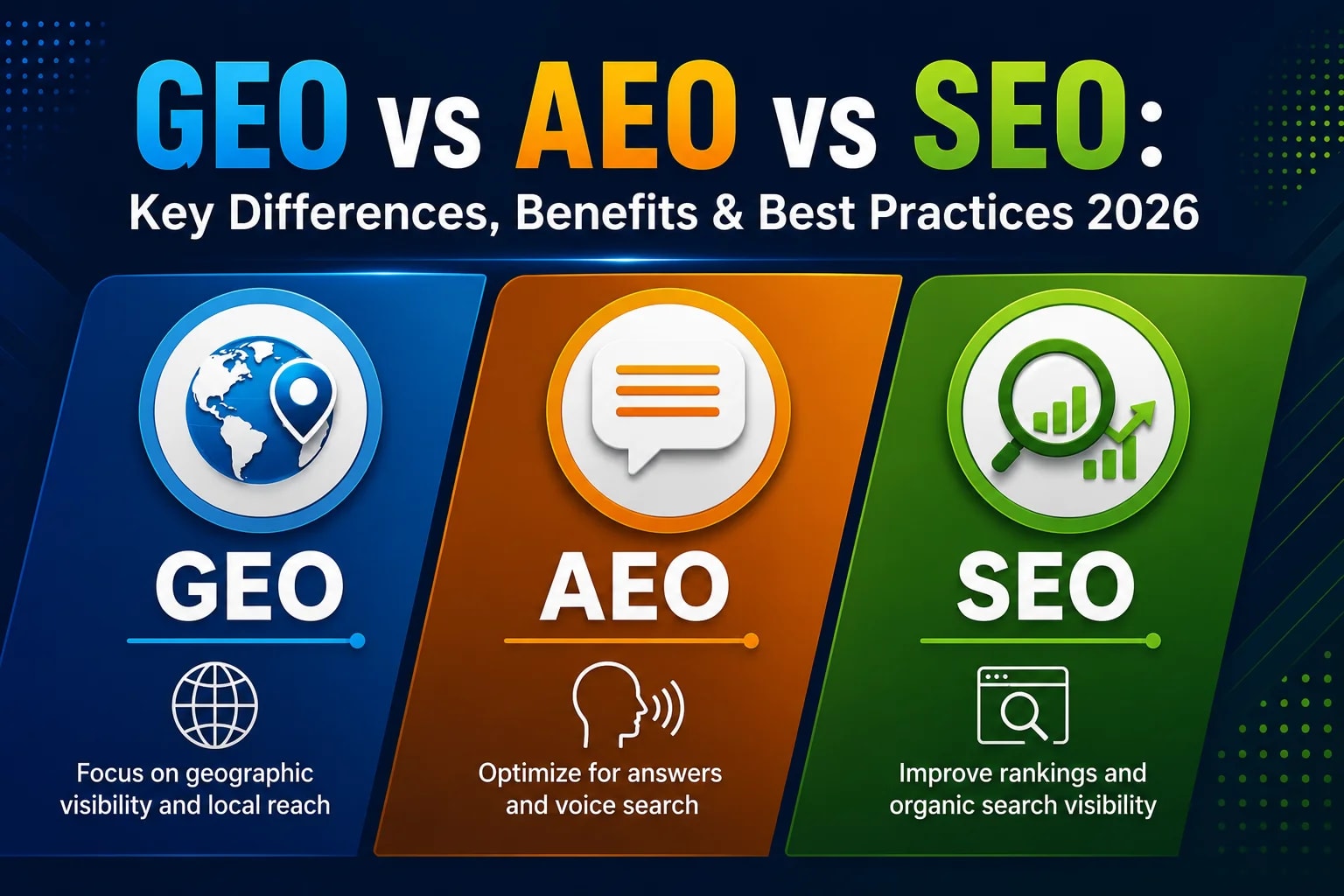
Search behavior has changed faster in the last two years than in the previous decade. People still type queries into Google, but they also ask ChatGPT for recommendations, use Gemini inside their email, and get instant AI Overviews before they even click a link. This shift has created three overlapping but distinct disciplines: SEO, AEO, and GEO. Understanding the difference between them — and knowing how to use all three together — is now essential for anyone who wants their content to be found in 2026.
In this guide, you'll learn exactly what SEO, AEO, and GEO mean, how each one works, the benefits they offer, and the best practices you need to stay visible across traditional search engines, answer boxes, and AI chatbots alike.
The Evolution of Search: From Links to Answers to AI Conversations
To understand why GEO and AEO exist at all, it helps to look at how search itself has evolved. For most of the internet's history, search meant typing a query and scrolling through a list of ten blue links. Google's job was to rank the most relevant pages, and SEO grew up around that model.
Then came featured snippets, knowledge panels, and voice assistants. Suddenly, many users got their answer directly on the results page, or spoken aloud through a smart speaker, without ever clicking a link. This shift gave rise to AEO, a discipline focused on winning that single, prominent answer spot rather than a ranked position among many.
Now we're in a third phase. Tools like ChatGPT, Gemini, and Perplexity don't just retrieve a link or read out a snippet — they generate an entirely new answer by synthesizing information from many sources at once. Google's own AI Overviews do the same thing directly inside search results. This is the world GEO was built for: a world where being cited as a trusted source inside an AI-written answer matters as much as ranking on page one.
What Is SEO (Search Engine Optimization)?
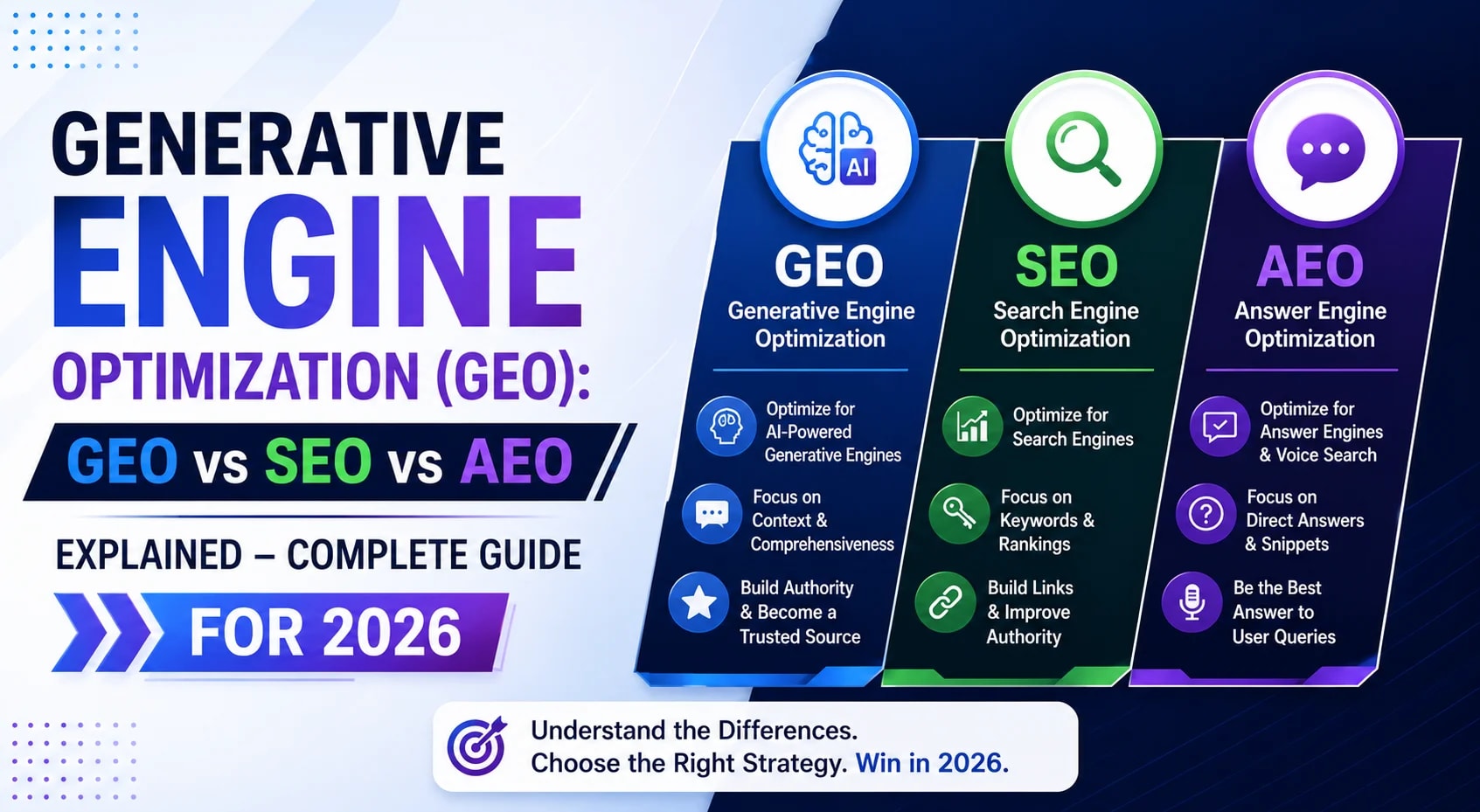
SEO, or Search Engine Optimization, is the long-standing practice of improving a website so it ranks higher in traditional search engine results pages (SERPs) like Google and Bing. The goal is simple: when someone searches for a relevant keyword, your page should appear as high as possible on page one.
Also CheckOut -> Benefits of Digital Marketing for Startups
SEO has existed since the late 1990s and remains the foundation of organic visibility online. It relies on a mix of technical optimization, content quality, and off-page authority signals such as backlinks.
How SEO Works in 2026
Modern SEO combines several layers working together:
- Keyword research to understand what people are searching for and why
- On-page optimization, including title tags, meta descriptions, headers, and internal linking
- Technical SEO such as site speed, mobile-friendliness, crawlability, and Core Web Vitals
- Off-page SEO, primarily backlinks from authoritative, relevant websites
- Content depth and originality, which Google's helpful content systems now weigh heavily
Core Benefits of SEO
- Drives consistent, long-term organic traffic without paying for every click
- Builds domain authority and brand credibility over time
- Offers measurable ROI through tools like Google Search Console and analytics platforms
- Supports every other channel, since AEO and GEO both build on a solid SEO foundation
What Is AEO (Answer Engine Optimization)?
AEO, or Answer Engine Optimization, focuses on getting your content chosen as the direct answer to a user's question. Instead of optimizing purely for rankings, AEO optimizes for featured snippets, People Also Ask boxes, voice search results, and knowledge panels.
Think of AEO as the bridge between classic SEO and the AI-driven search world. It became especially important as voice assistants like Alexa, Siri, and Google Assistant started reading out single answers instead of listing ten blue links.
How AEO Works
- Structuring content around clear, specific questions people actually ask
- Providing concise, direct answers within the first sentence or two of a section
- Using schema markup (FAQ, HowTo, Q&A) so search engines can easily extract answers
- Formatting content with numbered steps, bullet points, and short paragraphs that are easy to lift into a snippet
Core Benefits of AEO
- Increases visibility in zero-click searches and voice assistant responses
- Builds trust by positioning your brand as the definitive answer source
- Improves accessibility for users searching on mobile and smart speakers
- Often leads to higher click-through rates when a snippet links back to your full page
What Is GEO (Generative Engine Optimization)?
GEO, or Generative Engine Optimization, is the newest of the three and the fastest growing in 2026. It's the practice of optimizing content so that generative AI tools — ChatGPT, Google Gemini, Perplexity, and Google's AI Overviews — cite, reference, or recommend your brand when generating answers.
Unlike SEO, which competes for a ranked position, and AEO, which competes for a single snippet, GEO competes to be one of the trusted sources an AI model pulls from when writing its own synthesized response. There's no traditional ranking page to check; visibility is measured by whether and how often your brand shows up inside AI-generated text.
Visit her to know more about -> What Is SEO Social Bookmarking
How GEO Works
- Publishing clear, fact-based, well-structured content that AI models can easily parse and trust
- Strengthening entity recognition — making sure AI systems understand who you are, what you do, and why you're credible
- Earning mentions and citations across reputable third-party sites, since generative engines often cross-reference multiple sources
- Using original data, statistics, and expert insights that AI models find valuable enough to cite
- Keeping content updated, since generative engines favor current, accurate information over outdated pages
Core Benefits of GEO
- Positions your brand inside AI conversations that increasingly replace traditional search clicks
- Builds authority in an emerging channel before competitors catch up
- Increases brand recall, since users often trust AI-recommended sources without clicking through
- Future-proofs your content strategy as generative search adoption continues to grow
GEO vs AEO vs SEO: Key Differences at a Glance
The table below summarizes how these three strategies compare across the factors that matter most.
|
Factor |
SEO |
AEO |
GEO |
|
Primary Goal |
Rank high in search results |
Get selected as the direct answer |
Get cited inside AI-generated answers |
|
Target Platform |
Google, Bing, Yahoo |
Featured snippets, voice assistants, People Also Ask |
ChatGPT, Gemini, Perplexity, Google AI Overviews |
|
Content Format |
Long-form, keyword-optimized pages |
Concise, direct Q&A style answers |
Structured, fact-dense, well-cited content |
|
Success Metric |
Rankings, organic traffic, backlinks |
Snippet ownership, voice search share |
AI citation frequency, brand mentions in AI answers |
|
Key Skill |
Keyword research, link building |
Structured data, schema markup |
Authority signals, clear entity data |
Why All Three Matter Together in 2026
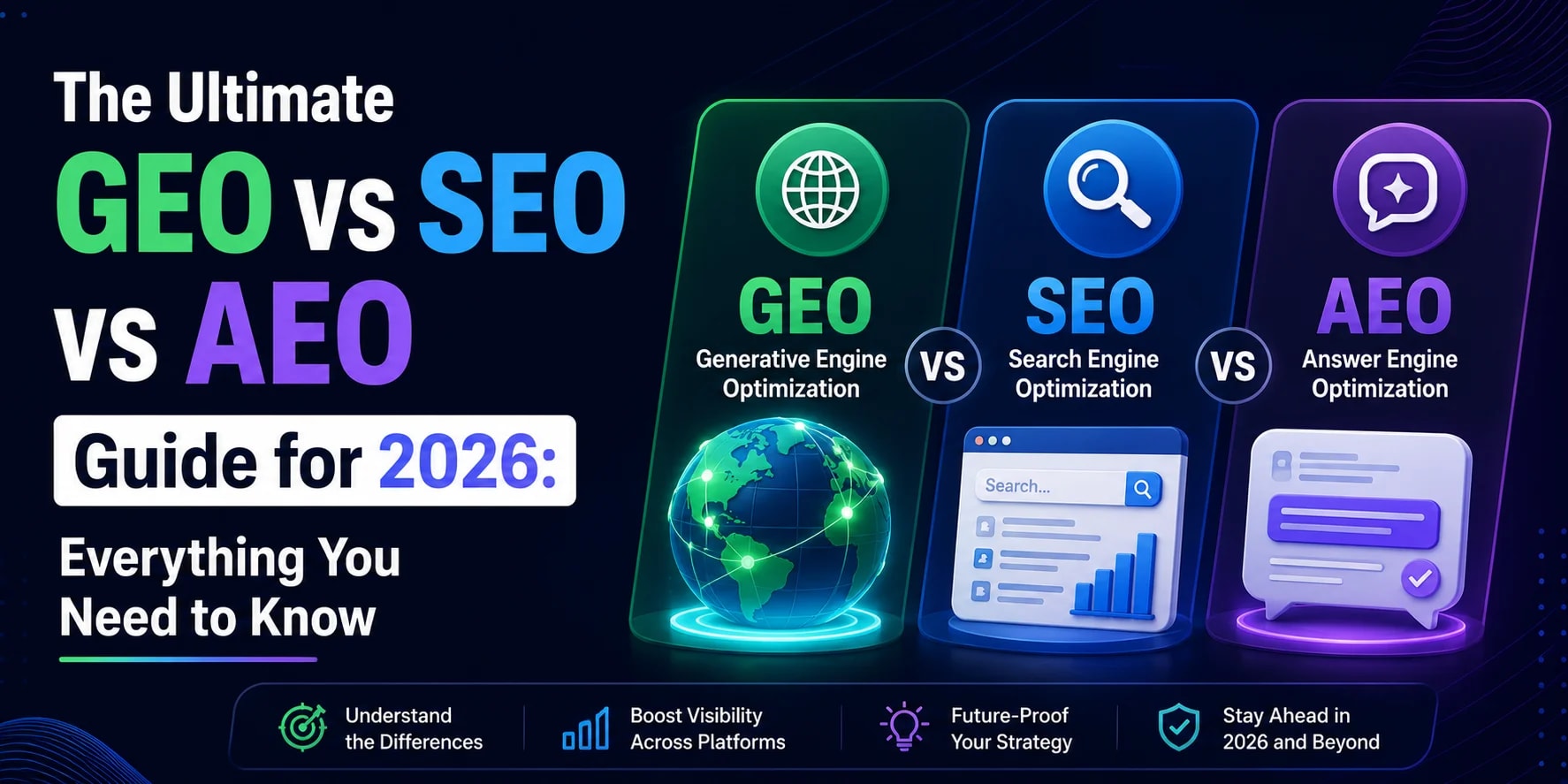
It's tempting to think of SEO, AEO, and GEO as competing strategies, but they actually reinforce one another. Strong SEO builds the technical and authority foundation. AEO takes that foundation and packages it for instant answers. GEO extends that same trusted content into the world of AI-generated responses.
A page that ranks well, answers questions clearly, and is structured with solid data and schema is far more likely to be picked up by both answer engines and generative AI models. In other words, GEO and AEO don't replace SEO — they're built on top of it.
Best Practices for SEO, AEO, and GEO in 2026
Best Practices for SEO
- Focus on genuine search intent, not just keyword density
- Prioritize helpful, experience-based content that reflects real expertise
- Keep Core Web Vitals and mobile performance strong
- Build backlinks naturally through partnerships, digital PR, and original research
- Refresh older content regularly instead of only publishing new pages
Best Practices for AEO
- Answer the core question within the first one to two sentences of each section
- Use FAQ, HowTo, and Q&A schema markup wherever relevant
- Write in a clear, conversational tone that matches how people actually speak and search
- Organize content with descriptive headers that mirror real user questions
Best Practices for GEO
- Include original statistics, studies, or expert quotes that AI tools can cite with confidence
- Build a consistent entity presence across your website, social profiles, and third-party mentions
- Structure pages with clear headings, summaries, and well-organized facts rather than dense prose
- Earn citations and mentions on high-authority third-party sites, since generative engines weigh cross-source consistency
- Monitor how AI tools describe your brand and correct inaccuracies where possible
Common Mistakes to Avoid
- Treating GEO and AEO as replacements for SEO instead of extensions of it
- Writing content stuffed with keywords but with no clear, direct answers
- Ignoring schema markup, which is now critical for both AEO and GEO visibility
- Publishing outdated statistics that generative engines are unlikely to trust or cite
- Focusing only on rankings while ignoring how your brand appears inside AI-generated summaries
How to Measure Success Across SEO, AEO, and GEO
Measuring SEO is well established: track rankings, organic traffic, and backlink growth through tools like Google Search Console and standard analytics platforms.
Measuring AEO involves tracking featured snippet ownership, voice search appearances, and People Also Ask visibility, often through specialized SERP tracking tools.
Measuring GEO is still evolving, but marketers in 2026 are increasingly using AI-visibility tracking tools that monitor how often a brand is mentioned or cited across tools like ChatGPT, Gemini, and Perplexity, along with manual prompt testing to see how these engines describe a brand.
A practical approach many teams use is to run the same set of industry questions through several AI tools every month, log whether their brand appears, and note which competitors are cited instead. Over time, this creates a simple but effective GEO scorecard that can sit alongside traditional SEO and AEO dashboards.
Building a Combined SEO, AEO, and GEO Content Strategy
Rather than running three separate content plans, most teams get better results by building a single strategy that satisfies all three disciplines at once. Start with topics based on genuine search intent and keyword research, the same way you would for classic SEO. Then structure each page so that key questions are answered clearly and concisely near the top, which supports AEO. Finally, back up every major claim with original data, clear sourcing, and up-to-date facts, which gives generative engines a reason to cite the page.
This layered approach means you are not creating extra work, you are simply raising the bar on how clearly and credibly each piece of content is written. A well-researched, clearly structured, regularly updated page tends to perform well across all three channels simultaneously, which is exactly why leading brands in 2026 no longer treat SEO, AEO, and GEO as separate teams or separate budgets.
Final Thoughts
SEO, AEO, and GEO aren't three separate battles — they're three layers of the same strategy. SEO gets you found. AEO gets you the direct answer. GEO gets you cited inside the AI conversation itself. Brands that invest in all three, built on a foundation of genuinely helpful, well-structured, and trustworthy content, will be the ones that stay visible no matter how people choose to search in 2026 and beyond.