The Future of Digital Marketing: Trends That Will Define the Next 5 Years
Digital marketing is changing faster than at any point in the last decade. Artificial intelligence has moved from a back-office automation tool to the strategic center of how campaigns are planned and run, privacy rules are reshaping how brands collect and use data, and the way people search for information is being rebuilt around AI answers rather than blue links. Over the next five years, marketers who understand these shifts — and adapt early — will pull decisively ahead.
This guide breaks down the trends that will define digital marketing through 2030, why each one matters, and what you can actually do about them.
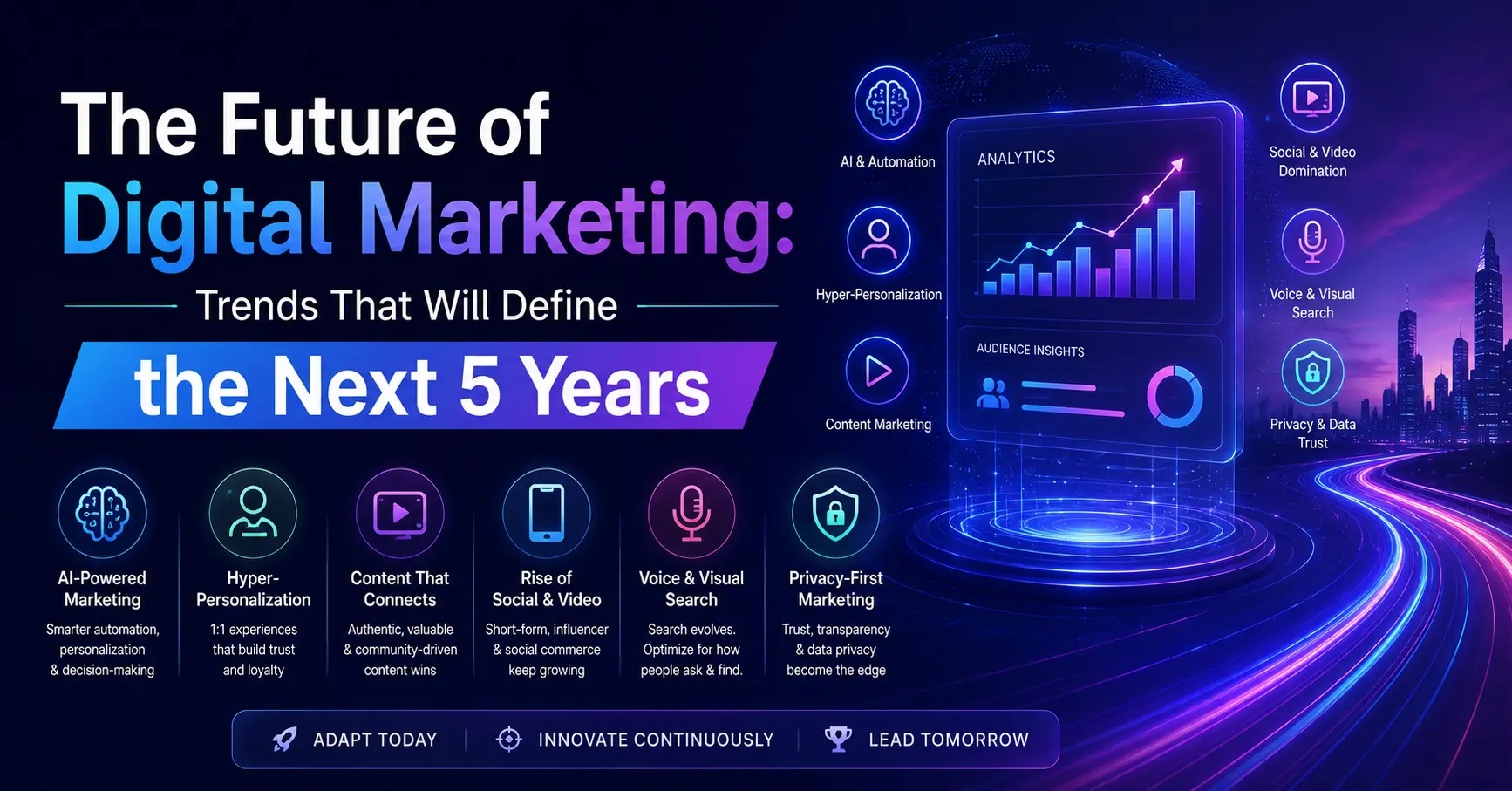
1. AI Becomes the Operating System of Marketing
The single biggest shift is that AI is no longer a feature bolted onto marketing — it's becoming the layer everything runs on. What began as simple automation has matured into a strategic capability supporting content creation, performance optimization, and customer targeting in real time.
Roughly 95% of marketing teams are now testing generative AI for creative production, yet many still describe their use as early-stage experimentation. In other words, 2026 is the year marketers shift from testing AI to trusting it.
The value is moving away from execution and toward direction. Anyone can ask an AI tool to write ten ad variations; the marketer who wins knows which audience to target, how to read the data, and when to override the machine. Strategic judgment, brand taste, and the ability to direct AI are becoming the most valuable skills in the industry.
What to do now: Build AI into the repetitive 80% — first drafts, variations, analysis, segmentation — and reinvest the time saved into strategy and creative direction AI can't replicate.
2. Search Is Being Rewritten: GEO and Zero-Click
If one trend keeps marketers awake at night, it's the collapse of traditional search traffic. AI Overviews, ChatGPT, Perplexity, Claude, and Gemini increasingly answer a user's question directly, so the user never clicks through.
The data is striking. By some measures around 60% of Google searches now end without a click, and on mobile that figure climbs higher. Gartner has projected traditional search volume could fall meaningfully by the end of 2026 as generative engines absorb more queries.
also check out -> AEO Explained: How to Get Mentioned by ChatGPT & AI Search
This has given rise to Generative Engine Optimization (GEO), sometimes called AI search optimization or Answer Engine Optimization. Where traditional SEO ranks you in a list, GEO aims to get your brand cited inside the AI's answer — a placement that carries enormous psychological weight, since the user sees your brand as hand-picked by the machine.
GEO's mechanics differ from classic SEO. AI models choose sources based on structure, authority, and information density rather than backlink counts. Effective tactics include:
- Expanding your semantic footprint: cover a topic exhaustively, not superficially.
- Increasing factual density: include concrete data and statistics throughout (roughly every 150–200 words).
- Using structured data: schema markup, FAQs, and tables make content easy for AI to parse and quote.
- Designing modular content: content built for reuse is easier for AI to surface.
What to do now: Run a dual strategy. Keep SEO for high-intent clicks, but layer GEO on top so your brand appears in the AI answers above the results. Track AI citations as a new KPI.
3. Hyper-Personalization at Scale
AI finally makes personalization achievable at scale. Around 75% of consumers say they're more likely to buy from brands delivering personalized content, and the gap between brands that personalize well and those that don't is widening.
The next five years move beyond "Hi, [First Name]" toward genuine one-to-one experiences: dynamic website content, real-time recommendations, and messaging timed to where someone actually is in their journey. AI predictive models let teams forecast performance and tailor experiences proactively.
The catch is trust. As AI-generated content floods every channel, consumers prize authenticity. Personalization that feels invasive backfires — the winning approach pairs depth with transparency about how data is used.
4. The Privacy-First, First-Party Data Era
The personalization revolution collides with a privacy revolution. With third-party cookies disappearing and regulations tightening, buying audience data from intermediaries is breaking down.
The strategic response is a decisive pivot to first-party data — information collected directly from your audience with consent: email subscribers, loyalty members, purchase history, on-site behavior, and zero-party data customers volunteer.
First-party data isn't just a compliance fallback; it's a competitive moat. It's more accurate, it's yours to keep, and it powers the personalization and AI models above. Brands that build direct relationships will be far less exposed to the next privacy shift.
What to do now: Audit where your data comes from. Invest in value exchanges — useful content, tools, rewards — that give people a reason to share data directly.
5. Video-First and Shoppable Content
Video continues its march to the center of marketing — and not just because audiences love it. AI systems increasingly prioritize video transcripts and metadata when selecting content to cite, so video now boosts discoverability in AI search too.
Two formats stand out:
- Short-form vertical video remains the dominant attention magnet, ideal for discovery and brand-building.
- Shoppable video is the bigger structural shift. Connected TV and streaming are evolving from passive awareness channels into direct-action ones, with the purchase funnel built right into the content — turning "watch" into "buy" without leaving the video.
The line between entertainment and storefront is dissolving. Plan for a world where every piece of video content is potentially transactional.
Vsit here -> AI Overviews Citation Strategy 2026
6. Retail Media and the Trillion-Dollar Ad Ecosystem
Global digital ad spend is on track to approach $1 trillion, and a fast-growing slice is retail media — advertising on and around retailer platforms. The appeal is closed-loop measurement that links ad exposure directly to verified purchases. Off-site retail networks are projected to grow roughly twice as fast as on-site spend, meaning the most accountable ad dollars increasingly flow through retail ecosystems rather than the open web.
7. Cross-Channel Measurement and the MMM Comeback
As channels fragment and privacy rules erode tracking, measuring the whole customer journey has become genuinely hard. The response is renewed investment in Marketing Mix Modeling (MMM) — a statistical, privacy-friendly way to understand what's driving results. Because it doesn't track individuals, MMM stays durable in a cookieless world, and AI is making it faster and accessible to mid-sized brands.
8. Authenticity, Trust, and Brand Values
Underneath the technology runs a human current: in a noisy, AI-saturated world, people increasingly decide based on trust. A majority of consumers now say social content, recommendations, and communities shape how they discover brands, with search used mainly to validate afterward. As synthetic content proliferates, brands that lead with clear values — and back them with visible action — earn the trust that converts.
Putting It Together: A Five-Year Action Plan
These trends reinforce each other. AI powers personalization; personalization depends on first-party data; that data is collected through trusted owned channels; those channels run on video; and all of it must be visible in AI-driven search and measured through privacy-safe modeling.
- Embed AI as your operating layer, freeing human time for strategy.
- Adopt a dual SEO + GEO strategy so you're cited in AI answers, not just ranked.
- Build a first-party data engine with genuine value exchanges.
- Personalize with transparency to deepen trust.
- Go video-first and shoppable, treating content and commerce as one.
- Shift measurement to cross-channel models like MMM.
- Lead with authenticity — the differentiator no algorithm can copy.
The Bottom Line
The next five years reward adaptability over expertise in any single channel. The marketers who thrive will treat AI as a partner, build direct and trusted relationships with their audiences, and stay visible wherever discovery happens next — a search bar, a feed, or an AI assistant's answer. The tools will keep changing; the fundamentals — understanding people, earning trust, delivering real value — won't.