List of Longest Serving Finance Minister of India Till 2026
Finance Minister of India plays a crucial role in shaping the country’s economic direction. From presenting the Union Budget to managing taxation, fiscal policy, and economic reforms, this constitutional post directly impacts India’s growth and governance.

The Finance Minister of India plays a crucial role in shaping the country’s economic direction. From presenting the Union Budget to managing taxation, fiscal policy, and economic reforms, this constitutional post directly impacts India’s growth and governance. For students preparing for UPSC, SSC, Banking, State PCS, Railways, and other competitive exams, questions related to Finance Ministers—especially longest serving ones—are frequently asked in GK, Polity, and Economy sections.
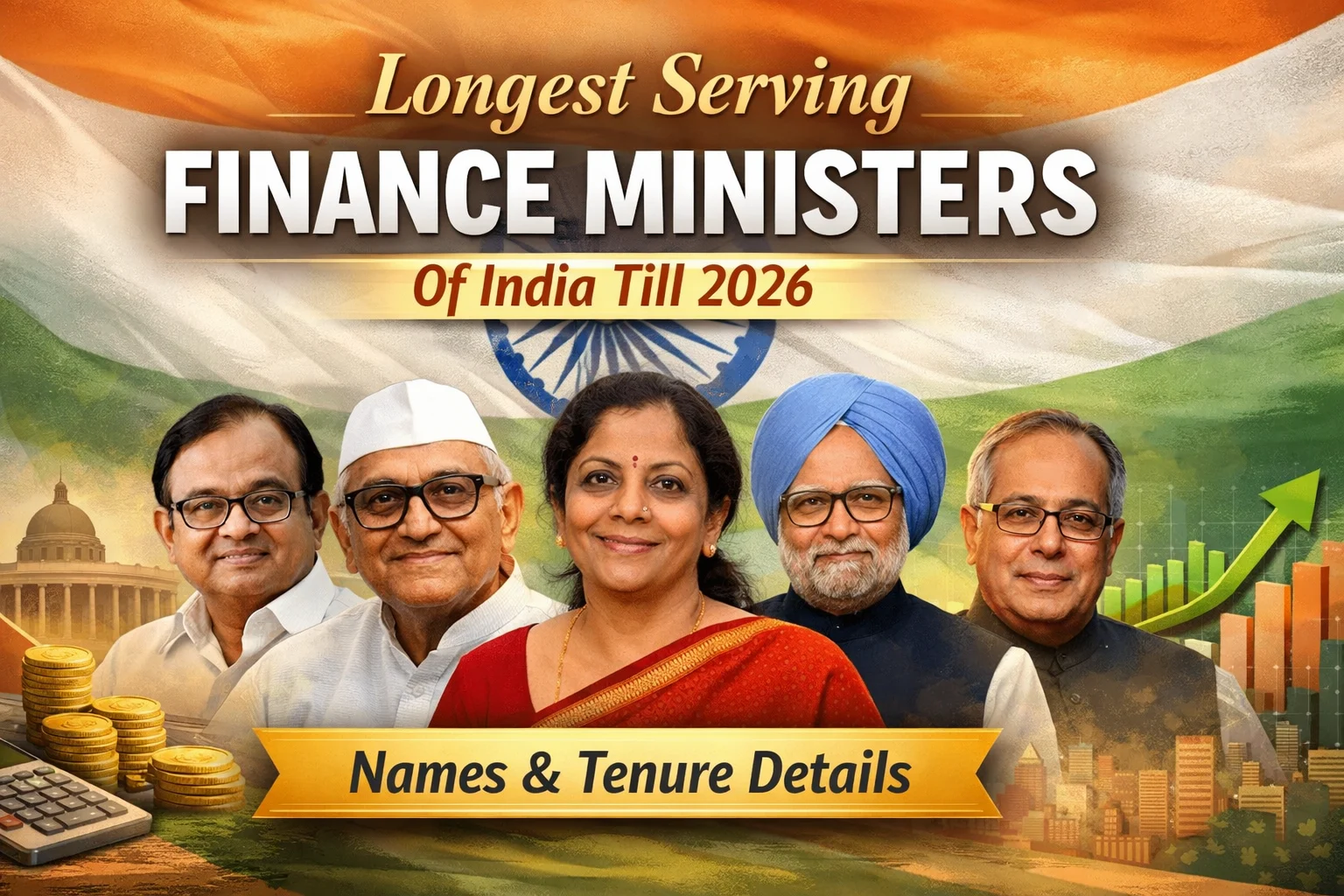
Over the years, several leaders have held the Finance Ministry, but only a few have served for extended periods, leaving a lasting imprint on India’s financial system. Understanding who served the longest, during which years, and under which Prime Ministers helps aspirants build strong static GK and current affairs linkages.
This article provides a verified and updated list of the longest serving Finance Ministers of India till 2026, along with their tenure duration, political background, and key contributions. To ensure exam relevance, the content is structured with tables, crisp facts, FAQs, and People Also Ask (PAA)-friendly answers, making it ideal for last-minute revision as well as concept clarity.
Who Is the Longest Serving Finance Minister of India?
As of 2026, the title of the longest serving Finance Minister of India is held by Morarji Desai, who served for more than 10 years across multiple terms.
List of Longest Serving Finance Ministers of India (Till 2026)
| Rank | Finance Minister | Tenure Period | Total Duration |
|---|---|---|---|
| 1 | Morarji Desai | 1958–1963, 1967–1969 | 10+ years |
| 2 | P. Chidambaram | 1996–1998, 2004–2014 | ~9 years |
| 3 | Nirmala Sitharaman | 2019–Present (2026) | ~7 years |
| 4 | Manmohan Singh | 1991–1996 | ~5.5 years |
| 5 | Pranab Mukherjee | 1982–1984, 2009–2012 | ~5 years |
| 6 | Arun Jaitley | 2014–2019 | ~4.5 years |
1. Morarji Desai – Longest Serving Finance Minister of India
-
Tenure: 1958–1963, 1967–1969
-
Total Duration: Over 10 years
-
Prime Ministers Served Under: Jawaharlal Nehru, Indira Gandhi
Morarji Desai holds the record as the longest serving Finance Minister in Indian history. Known for his strict financial discipline, he played a key role in strengthening fiscal control during India’s early planning years. His tenure is often cited in exams for questions related to post-independence economic administration.
2. P. Chidambaram – Architect of Modern Fiscal Reforms
-
Tenure: 1996–1998, 2004–2014
-
Total Duration: Around 9 years
P. Chidambaram served as Finance Minister under both United Front and UPA governments. He is widely remembered for introducing Direct Tax Code discussions, FRBM Act implementation, and expanding the tax base. His long tenure makes him a frequent mention in economy-based MCQs.
Also checkout - Budget 2026 Highlights
3. Nirmala Sitharaman – Longest Serving Woman Finance Minister
-
Tenure: 2019–Present (as of 2026)
-
Total Duration: Approximately 7 years
-
Government: NDA
Nirmala Sitharaman is the first full-time woman Finance Minister of India and one of the longest serving overall. She presented multiple Union Budgets, including COVID-19 recovery budgets, and led reforms in corporate taxation, infrastructure financing, and digital economy.
4. Manmohan Singh – Reformist Finance Minister
-
Tenure: 1991–1996
-
Total Duration: Around 5.5 years
Dr. Manmohan Singh is best known for introducing India’s Liberalization, Privatization, and Globalization (LPG) reforms in 1991. His tenure is considered a turning point in Indian economic history and is extremely important for UPSC and State PCS exams.
5. Pranab Mukherjee – Crisis Manager of the Economy
-
Tenure: 1982–1984, 2009–2012
-
Total Duration: Around 5 years
Pranab Mukherjee handled the Finance Ministry during challenging periods, including the post-2008 global financial crisis. His pragmatic approach helped stabilize India’s economy, making him a key figure in modern Indian polity.
6. Arun Jaitley – GST Era Finance Minister
-
Tenure: 2014–2019
-
Total Duration: Around 4.5 years
Arun Jaitley played a pivotal role in the implementation of Goods and Services Tax (GST) and reforms related to Insolvency and Bankruptcy Code (IBC). His tenure is often linked with structural economic reforms.
Frequently Asked Questions
Who is the longest serving Finance Minister of India till 2026?
Morarji Desai is the longest serving Finance Minister, with over 10 years in office.
Who is the longest serving woman Finance Minister of India?
Nirmala Sitharaman is the longest serving woman Finance Minister as of 2026.
Who introduced economic liberalization as Finance Minister?
Dr. Manmohan Singh introduced economic liberalization in 1991.
Is Nirmala Sitharaman still Finance Minister in 2026?
Yes, as of 2026, Nirmala Sitharaman continues to serve as India’s Finance Minister.