Budget 2026 Highlights: Summary, Key Points and Download PDF
The Union Budget 2026–27 was presented by Finance Minister Nirmala Sitharaman on 1 February 2026 in the Lok Sabha, marking her ninth successive budget presentation.

The Union Budget 2026–27 was presented by Finance Minister Nirmala Sitharaman on 1 February 2026 in the Lok Sabha, marking her ninth successive budget presentation. This annual financial blueprint outlines the government’s economic priorities, policy reforms, expenditure plans, and fiscal targets for the next financial year (FY 2026–27). It plays a crucial role in shaping India’s economic trajectory — from taxation and infrastructure to agriculture, manufacturing, and social development.
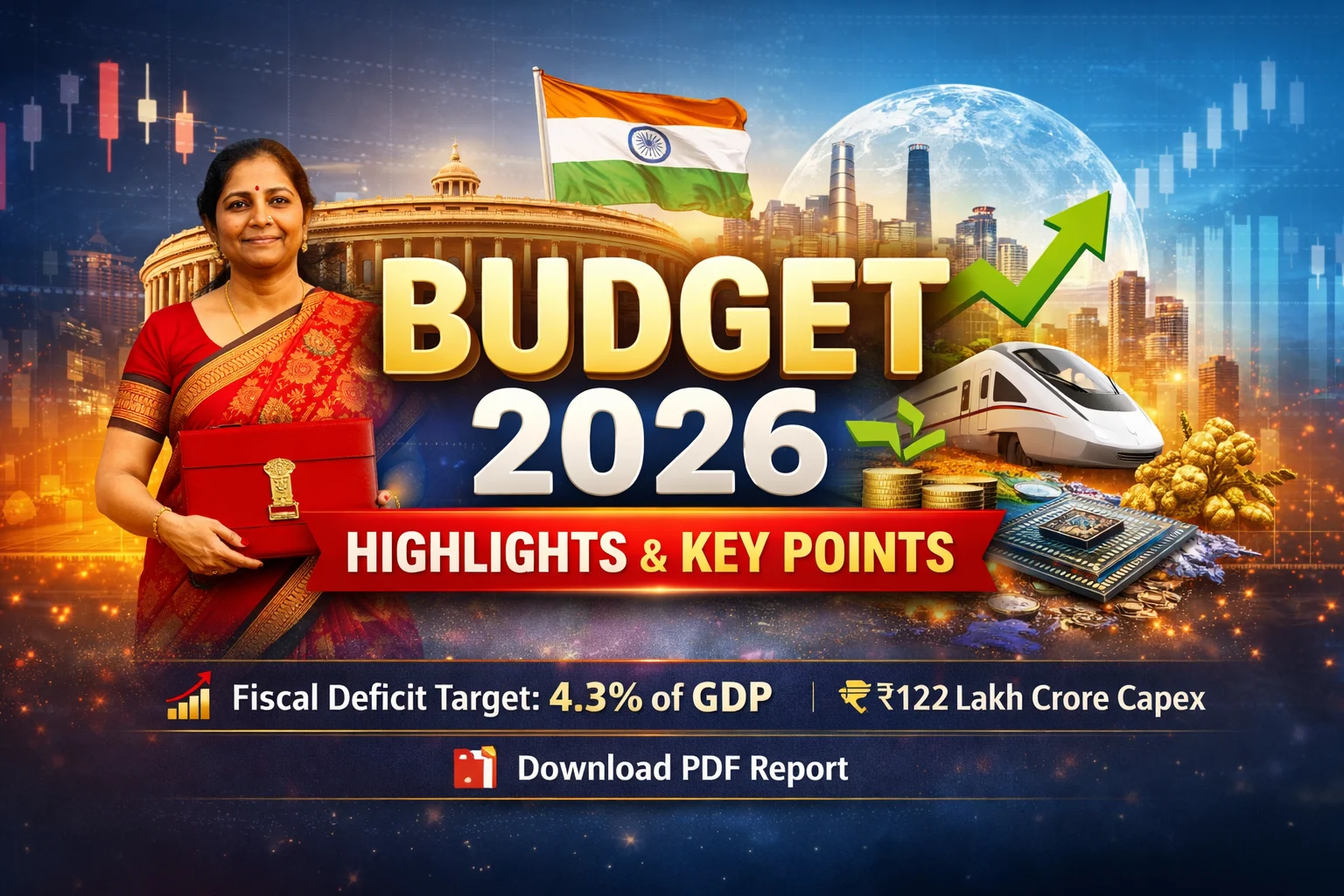
For competitive exam aspirants (UPSC, SSC, Bank, State PSC), understanding Budget highlights is vital for current affairs, economy, and governance sections. This article breaks down the Budget in a simple yet detailed way, providing major announcements, key schemes, sector-wise allocations, and official PDF download sources — all in one place.
Budget 2026 Key Highlights Overview
The Union Budget 2026 focuses on inclusive growth, self-reliance (Atmanirbharta), fiscal discipline, and future-ready reforms. It seeks to balance investment in infrastructure and cutting-edge manufacturing with measures that support job creation, MSMEs, healthcare, agriculture, and education.
Fiscal Targets and Macro Outlook
-
Fiscal Deficit Target: Set at 4.3% of GDP for FY 2026–27, reaffirming continued fiscal consolidation.
-
Debt-to-GDP Ratio: Around 55.6%, ensuring macroeconomic stability amid global uncertainties.
-
GDP Growth: India is projected to maintain strong growth, with estimates ranging between 6.8% and 7.4%.
This approach aims to sustain growth while maintaining sound public finances — a key theme for India’s long-term economic stability.
Infrastructure & Capital Expenditure (Capex)
Boost to Growth Sectors
-
Capital Expenditure: Increased to ₹12.2 lakh crore for FY 2026–27 — a record high — to accelerate infrastructure building.
-
High-Speed Rail Corridors: Seven corridors planned connecting major cities for sustainable mobility and economic linkages.
-
Waterways & Logistic Expansion: Emphasis on new national waterways and freight connectivity.
Why it matters: Capex is the backbone of job creation and supply-side growth — crucial for commerce, mobility, and industry.
Download Here -> Budget 2026 Highlights
Manufacturing & Strategic Sector Support
Key Announcements:
-
India Semiconductor Mission (ISM) 2.0: To strengthen the semiconductor and electronics ecosystem with ₹40,000 crore support.
-
BioPharma SHAKTI: A ₹10,000 crore mission to build a global biopharma hub.
-
Rare Earth Corridors: Dedicated corridors in states like Odisha, Kerala, Andhra Pradesh, and Tamil Nadu to secure critical minerals for tech industries.
-
Mega Textile Parks & Chemical Parks: To boost traditional and frontier manufacturing clusters.
Impact: These initiatives aim to reduce imports, enhance exports, and position India as a global manufacturing powerhouse.
Taxation & Regulatory Reforms
Tax-related Updates
-
Income Tax: No change in basic income tax slabs, offering relief to middle-class taxpayers.
-
TCS Reductions: Lowered TCS on overseas education, medical remittances, and tour packages to 2%.
-
STT Hike: Securities Transaction Tax on futures & options increased to enhance market revenue.
-
Custom Duty Exemptions: Some duties removed on essential medical drugs and materials to lower costs.
These tax provisions balance revenue needs with public and investor relief — an important nuance for exam aspirants.
Agriculture & Rural Development
-
Pradhan Mantri Dhan-Dhaanya Krishi Mission: Aimed at increasing productivity in key crop zones.
-
Extension of Kisan Credit Cards: Loan limits increased to support farm credit needs.
-
PM Goswamita Yojana (Animal Husbandry Support): To strengthen rural livelihoods.
These measures aim to bolster farm income, rural credit flow, and agritech linkages.
Also checkout -> List of Longest Serving Finance Minister of India
Education, Skills & Healthcare
-
AI & Tech in Education: Enhanced focus on AI centres of excellence and connectivity in primary & secondary schools.
-
Medical Education Expansion: Increase in medical seats and district cancer care centres.
-
Girls’ Hostels in Every District: To improve access for female students.
This strengthens human capital development, a key theme for India’s future workforce.
Conclusion
The Union Budget 2026 & 27 blends economic growth, fiscal prudence, sectoral reforms, and social inclusivity. From infrastructure and manufacturing to agriculture and education, it outlines India’s roadmap towards sustainable development and global competitiveness — key for both national progress and competitive exam preparation.