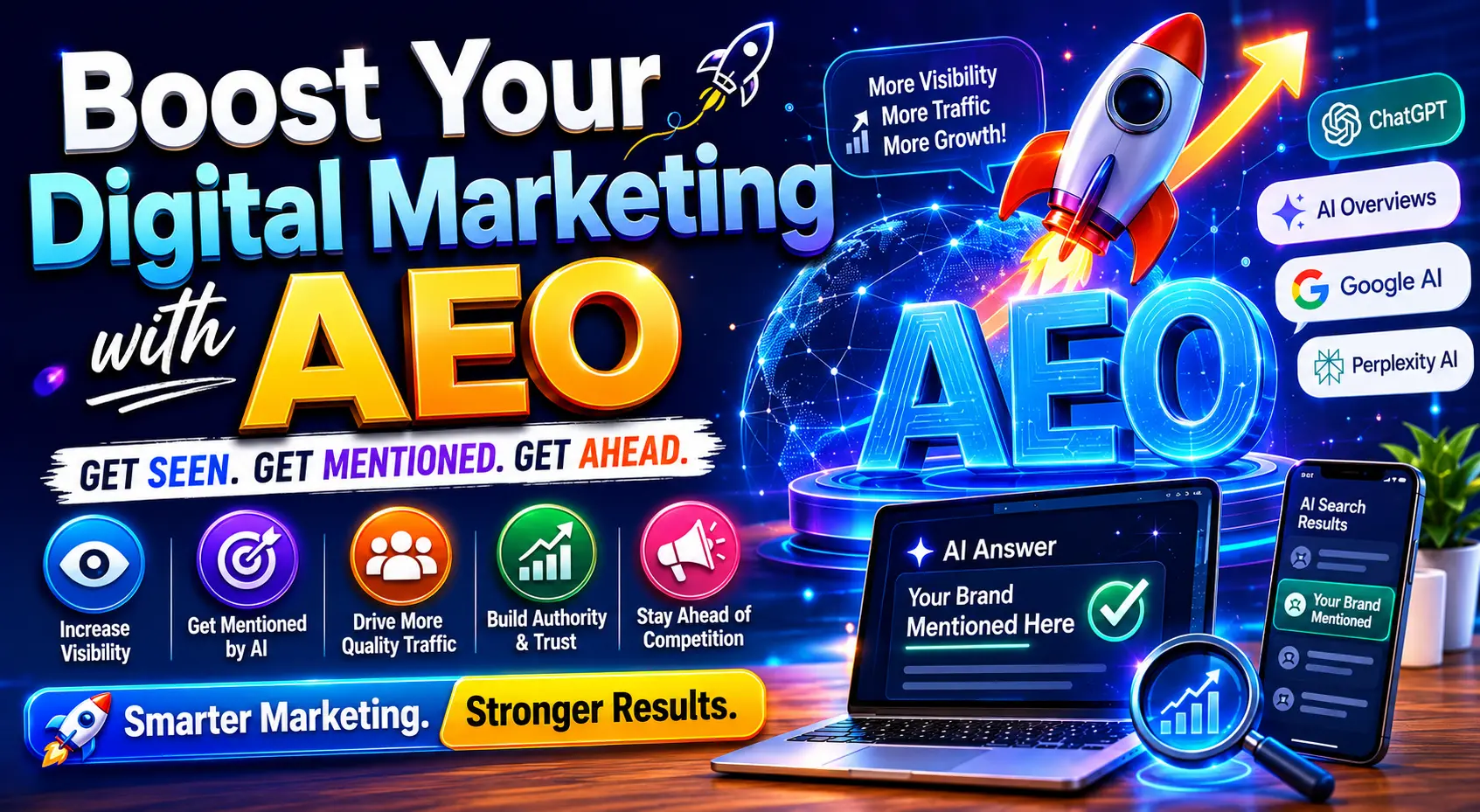
Boost Your Digital Marketing with AEO
Answer Engine Optimization (AEO) is the practice of structuring your content so search platforms, voice assistants, and AI tools can lift it directly as the answer to a user’s question. In 2026 it matters because roughly 60% of Google searches now end without a click, and AI assistants cite only a handful of sources per query. AEO is how you stay visible when there are fewer links to click.
In This Guide
For two decades, digital marketing meant one thing: climb the rankings and earn the click. That model is quietly breaking. Search engines have evolved from finders into answerers — Google’s AI Overviews, featured snippets, and voice assistants now resolve questions on the spot, often without sending anyone to a website at all. The discipline built for this new reality is Answer Engine Optimization (AEO), and if your 2026 marketing plan doesn’t include it, you risk ranking well while remaining invisible.
This guide breaks down exactly what AEO is, why it’s no longer optional, and how to win the two prizes that matter most right now: featured snippets and voice search.
1. What AEO Actually Is
Answer Engine Optimization is the process of structuring and refining content so engines can extract, understand, and present it as a direct, immediate answer. Where traditional SEO aims to make a page rank, AEO aims to make a specific answer win — whether that answer surfaces in a featured snippet, a spoken response from Alexa, or a citation inside an AI Overview or ChatGPT reply.
The shorthand circulating among marketers in 2026 captures it well: SEO gets you found. AEO gets you chosen. Both still matter, and a solid SEO foundation remains a prerequisite — but the standard for inclusion has risen. A single AI response can combine information from multiple pages, compare options, and route attention to only the few sources it deems genuinely useful. Publishing the most content no longer wins. Publishing the most usable content — usable for both people and machines — does.

Voice queries are longer and more conversational — and pull answers straight from structured content.
2. Why AEO Matters in 2026
The shift isn’t a forecast — it’s already here. A few numbers frame the stakes:
|
~60% of Google searches end without a click |
30% of web browsing now involves voice search |
25% projected drop in traditional search volume by 2026 (Gartner) |
Layered on top of zero-click behavior is the explosive adoption of AI assistants. ChatGPT now serves hundreds of millions of weekly users who ask questions and get answers without visiting a website. Google AI Overviews reach close to a billion searchers, and Perplexity processes millions of queries a day. Google’s worldwide market share even slipped below 90% for the first time since 2015 — a signal that attention is fragmenting across answer engines.
For marketers, the implication is blunt: the audience is still searching, but the destination is changing. If your content isn’t structured to be the answer, that traffic — and the brand exposure that comes with it — flows to whoever’s content is.
“Instead of competing for clicks, brands now compete to become the most trusted source of information.”
Also Visit -> AI Overviews Citation Strategy 2026
3. AEO vs. SEO: Complementary, Not Competing
AEO doesn’t replace SEO — it extends it. The two share infrastructure (fast, crawlable, trustworthy sites) but optimize for different end states.
|
Dimension |
Traditional SEO |
Answer Engine Optimization |
|---|---|---|
|
Goal |
Rank the page among blue links |
Be selected as the direct answer |
|
Query style |
Short keywords |
Full, conversational questions |
|
Surfaces |
Organic results page |
Snippets, voice, AI Overviews, chatbots |
|
Content shape |
Comprehensive long-form |
Answer-first, clearly structured |
|
Success metric |
Rankings & clicks |
Snippet wins & AI citations |
The healthiest 2026 strategy treats them as one motion: keep the SEO fundamentals strong, then layer AEO structure on top so the same content can win both a ranking and a citation.
4. Winning Featured Snippets
Featured snippets were the early preview of AEO — concise answers, strong structure, topic clarity — and they remain the single most actionable target because content that wins snippets tends to feed AI Overviews too. Here’s how to earn them.

The “position zero” snippet sits above the first organic result — and feeds voice and AI answers.
Lead with the answer
Place a tight, self-contained answer of roughly 40–60 words directly beneath the relevant heading, before you elaborate. Engines lift this block verbatim, so it must make sense on its own.
Match the snippet’s format
Snippets come in shapes: paragraph, numbered list, bulleted list, and table. Mirror the format the query implies — a numbered list for “how to” questions, a table for comparisons, a short paragraph for definitions.
Target question phrasing
Use real questions as your H2 and H3 headings — the ones people actually type or speak. Mining “People Also Ask” boxes is the fastest way to build a list of snippet-ready headings that also map to voice queries.
The 40-word rule. If you can’t answer your target question clearly in under 40 words, the question is probably too broad. Split it into narrower sub-questions — each becomes its own snippet opportunity and its own voice-search win.
5. Winning Voice Search
Voice and AEO share the same DNA. Assistants like Siri, Alexa, and Google Assistant don’t read lists of links aloud — they speak a single answer, usually pulled from a featured snippet or AI Overview. Win the snippet and you’ve largely won the voice result.
What makes voice distinct is how people phrase things. Nobody speaks in keywords. They ask, “What’s the best web designer near me?” rather than typing “San Francisco web designer.” Optimizing for voice means optimizing for these longer, natural, question-based phrases.
-
Write conversationally. Read your answers aloud. If they sound robotic spoken, rewrite them.
-
Own local intent. Voice skews heavily toward “near me” and geographic queries. Keep your Google Business Profile current and build location-specific pages.
-
Build a real FAQ section. Question-and-answer pairs map almost perfectly onto how voice queries are structured.
-
Prioritize speed and mobile. Voice results favor fast-loading, mobile-friendly pages — non-negotiable in 2026.
The commercial upside is real: voice now accounts for roughly 30% of web browsing activity, and voice commerce is projected to reach tens of billions of dollars annually. This is not a novelty channel anymore.
6. Structured Data: The Machine-Readable Layer

Schema markup is the translation layer that tells engines exactly what your content means.
Answer engines lean on three core technologies: natural language processing to interpret meaning, machine learning to predict intent, and knowledge graphs to map how concepts relate. Schema markup (structured data) is how you speak to all three directly. It removes ambiguity, telling an engine “this is a question, this is its answer, this is a step, this is a rating.”
Prioritize these schema types for AEO:
-
FAQPage — marks up question/answer pairs; the highest-leverage type for snippets and voice.
-
HowTo — structures step-by-step processes for “how do I” queries.
-
Article — signals authorship, dates, and content structure to Google.
-
Organization — defines your brand entity with sameAs links to social and authority profiles, helping AI build a clean entity graph around your business.
-
LocalBusiness — essential for local voice search.
7. The 8-Step AEO Playbook
A concrete sequence you can start this quarter:
-
Mine real questions. Pull from People Also Ask, your sales/support inbox, and tools that surface conversational queries in your niche.
-
Restructure to answer-first. Put a 40–60 word direct answer at the top of every key page or section.
-
Use question-format headings. Turn H2s and H3s into the exact questions users ask.
-
Add the right schema. Deploy FAQPage, HowTo, and Article markup, then validate it.
-
Build a deep FAQ hub. Group related questions into clusters that establish topical authority.
-
Optimize for AI crawlers. Don’t block ChatGPT-User or PerplexityBot in robots.txt if AI citations are a goal; consider adding an llms.txt file.
-
Strengthen E-E-A-T. Show author credentials, publish and update dates, cite sources, and surface original data — AI systems preferentially cite trustworthy, experienced sources.
-
Refresh relentlessly. AI deprioritizes stale content on fast-moving topics. Re-date and update high-value pages on a schedule.
Original data is your unfair advantage. Across every AI platform, the single most-cited content type is original research — proprietary statistics, surveys, and case studies. If you can publish one credible data point others must reference, you become a permanent source rather than a temporary result.
8. Measuring AEO Success
AEO needs different scorekeeping than legacy SEO, because winning often means fewer clicks, not more. Track the signals that actually reflect answer visibility:
-
Featured snippet count — how many “position zero” answers you own, and for which queries.
-
People Also Ask presence — how often your content populates PAA boxes.
-
AI citations — track mentions in ChatGPT, Perplexity, and Google AI Overviews as a standalone KPI.
-
Voice / assistant impressions — monitor conversational and “near me” query performance.
-
Brand mentions & assisted conversions — since clicks fall, weight downstream signals like direct visits, branded search lift, and inbound calls.
NerdWallet is a frequently cited example of this mindset working: by focusing on delivering expert answers across multiple platforms, it sustained revenue growth even as raw traffic numbers came under pressure. The lesson — measure visibility and trust, not just sessions.
The Takeaway: Become the Answer
The center of gravity in search has moved from links to answers. In 2026, the brands that thrive aren’t necessarily the ones publishing the most or ranking the highest — they’re the ones whose content is clear, structured, and trustworthy enough to be chosen as the answer by a snippet, a voice assistant, or an AI. Start with one high-value page: lead with the answer, phrase your headings as questions, add the schema, and prove your expertise. Do that consistently, and you won’t just be found — you’ll be the one being quoted.