 System Design › Low-Level Design
UML Class Diagrams for LLD Interviews (Quick Guide)
Just enough UML to ace a low-level design interview: the class box, the relationship arrows (inheritance, realization, composition, aggregation, association), and multiplicity — with a worked example.
 Java
What’s New in Java 21? Modern Features Explained (Beginner Guide)
A beginner-friendly tour of Java 21 (LTS) highlights: virtual threads, records, pattern matching and switch expressions, text blocks, and helpful NullPointerExceptions.
 Java
Common Java Errors and How to Fix Them (Beginner Cheat Sheet)
A quick-reference cheat sheet to the most common Java errors and their fixes: cannot find symbol, incompatible types, NullPointerException, ArrayIndexOutOfBounds, and silent logic bugs.
 System Design › Low-Level Design
SOLID Principles Explained (with Simple Examples)
The five SOLID principles made simple — Single Responsibility, Open/Closed, Liskov Substitution, Interface Segregation, Dependency Inversion — each with a plain example and why it makes code extensible and testable.
 Java
How to Fix ConcurrentModificationException in Java (Beginner Guide)
Fix the ConcurrentModificationException in Java: why it happens when you modify a collection while looping, and four correct fixes including removeIf and iterator.remove.
 System Design › Low-Level Design
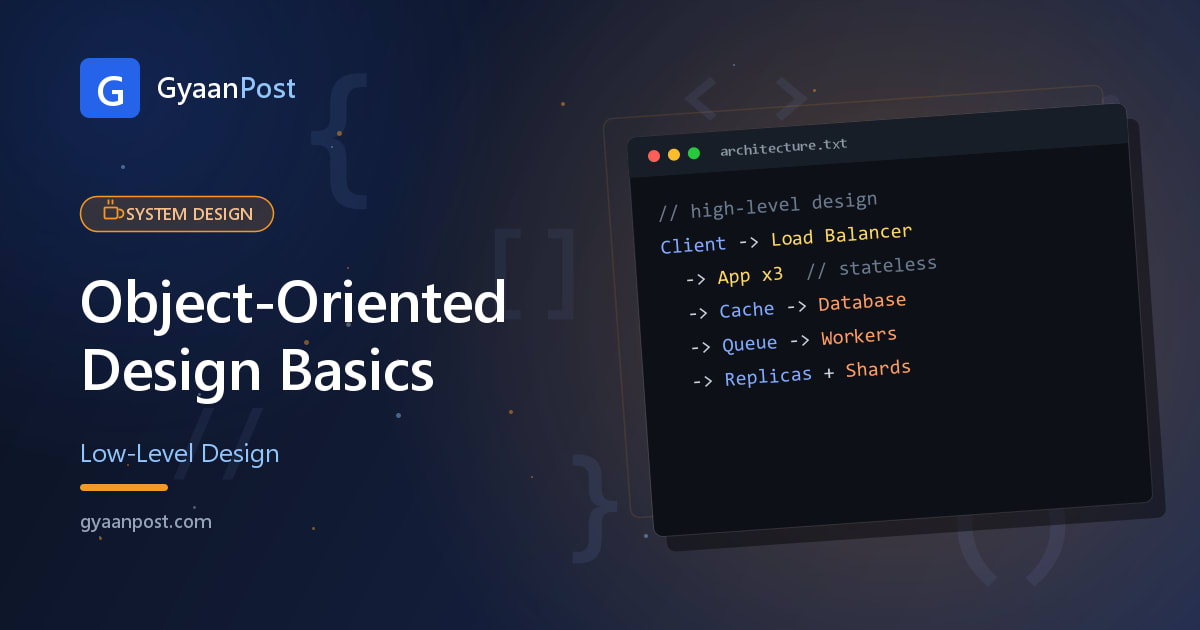
Object-Oriented Design Basics for LLD Interviews
The OOD foundation every low-level design interview needs: the four pillars of OOP, object relationships (association, aggregation, composition, inheritance), and why to favour composition over inheritance.
 Java
How to Fix NullPointerException in Java (Beginner Guide)
Fix and prevent the NullPointerException, Java’s most common error: what causes it, how to read the stack trace, and four proven fixes including null checks and Optional.
 Java
Spring vs Spring Boot: The Difference Explained (Beginner Guide)
Spring vs Spring Boot explained: they are partners, not rivals. Learn what each is, the kitchen analogy, auto-configuration and starters, and which to learn (hint: Spring Boot).
 System Design › High-Level Design
Design Ticketmaster / BookMyShow — System Design
Design a ticket booking system where the core challenge is concurrency: no double-booking under a flash-sale stampede. The reservation pattern, pessimistic vs optimistic locking, strong consistency, and virtual waiting rooms.
 Java
ArrayList vs LinkedList in Java: Which to Use? (Beginner Guide)
ArrayList vs LinkedList in Java compared: how each works, a full performance table (O(1) vs O(n)), the key insight, and why ArrayList is the sensible default for most cases.
 System Design › High-Level Design
Design Dropbox / Google Drive (File Sync) — System Design
Design a file sync and storage service end to end: chunking files into blocks, content-hash deduplication, block-level delta sync (only upload what changed), metadata vs block storage, notifications, conflicts, and versioning.
 Java
== vs .equals() in Java: The Difference Explained (Beginner Guide)
Understand == vs .equals() in Java and fix the most common beginner bug: reference vs content comparison, the String pool gotcha, the rule to memorise, and custom equals().