Start Here
 System Design › Start Here
Latency, Throughput & Availability: How We Measure Fast and Reliable
Latency, throughput and availability explained from scratch — what each measures, the highway analogy, why averages lie (p50 vs p99 tail latency), the availability nines table, and how these numbers drive every architecture decision.
 System Design › Start Here
Client, Server, Database & API: The 4 Words That Explain All Software
The four words behind every app — client, server, database and API — explained from zero with restaurant analogies, real API endpoints, JSON, and how they all talk to each other. The mental model that makes system design click.
 System Design › Start Here
How the Web Works: What Really Happens When You Type a URL
A beginner's tour of how the web works — DNS, IP addresses, TCP, HTTPS, HTTP requests and responses, status codes, and the full client-server round trip. The foundation for all of system design, in plain English.
 System Design › Start Here
What Is System Design? A Beginner's Guide (Plain English, Real Examples)
System design made simple. Learn what a 'system' really is, what happens when you open a website, functional vs non-functional requirements, HLD vs LLD, and how to actually start learning — in plain English with real examples and diagrams.
 System Design › Start Here
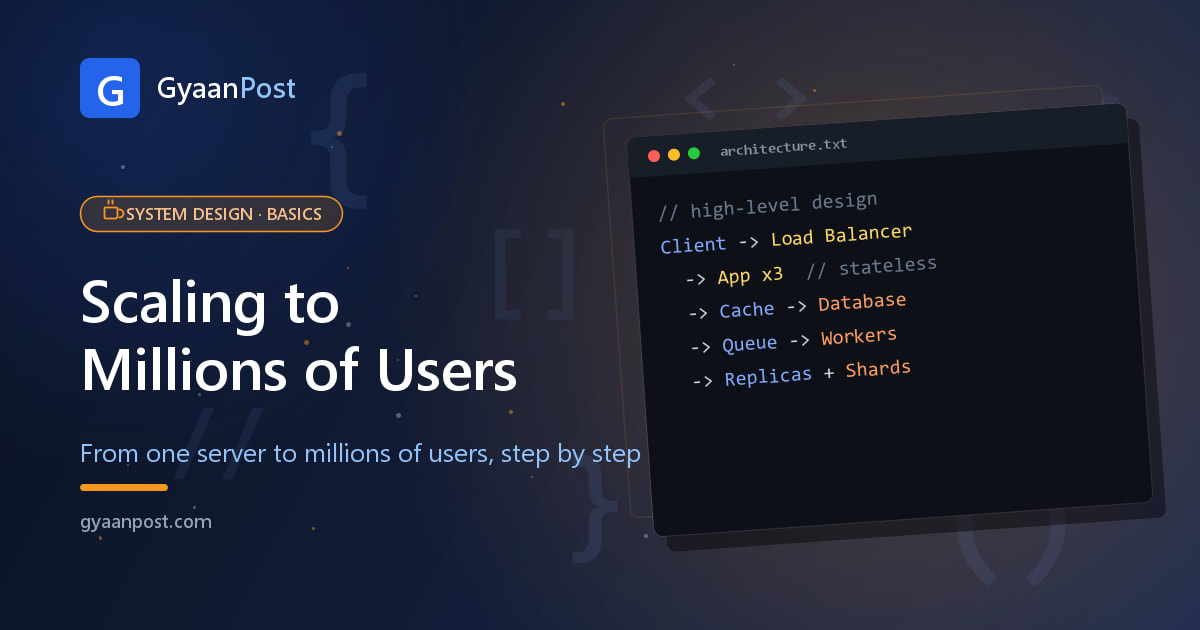
Scaling from Zero to Millions of Users: A Beginner’s Guide
How real systems scale from one server to millions of users, explained step by step for beginners: load balancers, caching, CDNs, database replication and sharding, message queues and microservices — each added only when the previous setup breaks.