Fundamentals
 System Design › Fundamentals
System Design Interview Study Plan (6 Weeks)
A 6-week System Design study plan that sequences every topic — foundations, data, distributed systems, HLD case studies, LLD and patterns, then mock interviews — into a day-by-day path from zero to interview-ready.
 System Design › Fundamentals
System Design Cheat Sheet (Quick Reference)
A one-page System Design cheat sheet: the 6-step interview framework, latency numbers to memorise, the scaling toolkit, and the key SQL-vs-NoSQL / CAP / REST-vs-gRPC decision rules — each linking to the full deep-dive.
 System Design › Fundamentals
Latency Numbers Every Engineer Should Know (with Intuition)
The famous latency numbers — cache, RAM, SSD, disk, and network round trips — explained by orders of magnitude, with a vivid mental model and how each one drives real system design decisions.
 System Design › Fundamentals
Resilience: Timeouts, Retries & Circuit Breakers Explained
How to keep a distributed system standing when one service fails. Timeouts, retries with backoff and jitter, the circuit breaker (closed/open/half-open), plus fallbacks and bulkheads — stopping cascading failures.
 System Design › Fundamentals
Object Storage & Blobs (S3): Where Files Really Live
Where do the world's images, videos, and backups live? Object storage like S3 — buckets, keys, durability, object vs file vs block storage, and the golden rule: store the URL, not the blob.
 System Design › Fundamentals
Bloom Filters Explained: The Space-Saving Magic Trick
A tiny structure that tells you an item is definitely not in a set using barely any memory. Bloom filters explained — bit arrays, hash functions, false positives, and why Cassandra and caches use them.
 System Design › Fundamentals
WebSockets vs Long Polling vs SSE: Real-Time on the Web
How does a server push live updates to the browser? The four real-time techniques — short polling, long polling, Server-Sent Events, and WebSockets — explained, with exactly when to pick each.
 System Design › Fundamentals
ACID & Database Isolation Levels Explained (with Anomalies)
ACID made simple — Atomicity, Consistency, Isolation, Durability — plus the four isolation levels, the anomalies they prevent (dirty, non-repeatable, phantom reads), and how MVCC softens the trade-off.
 System Design › Fundamentals
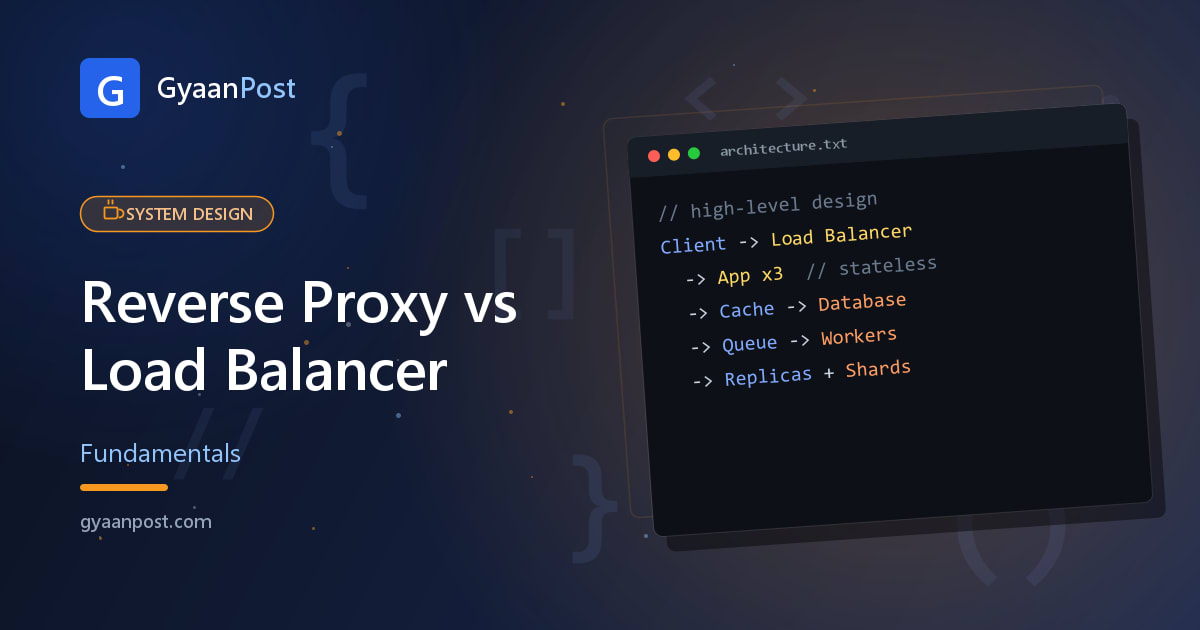
Reverse Proxy vs Load Balancer: What's the Difference?
A load balancer is a kind of reverse proxy — here's exactly how they relate. Forward vs reverse proxy, what each does (TLS, caching, routing, health checks), and L4 vs L7. Fresher to senior.