What is Java? A Simple Beginner's Guide (and Why Learn It in 2026)
New to programming? This beginner-friendly guide explains what Java is, how it works (JVM and bytecode), where it's used, and why it's worth learning in 2026 — with your very first Java program.

Welcome to the very first lesson of our Learn Java series! If you're a complete beginner wondering "what exactly is Java, and is it worth learning in 2026?" — you're in the right place. By the end of this lesson you'll understand what Java is, how it works, where it's used, and why it's still one of the smartest languages to learn for a career in software.
What is Java?
Java is a high-level, object-oriented programming language first released in 1995. Its founding idea was simple but powerful: "Write Once, Run Anywhere." That means you can write a Java program on a Windows laptop and run the exact same program, unchanged, on a Mac, a Linux server, or an Android phone. This portability is a big reason Java became — and remains — one of the most widely used languages in the world.
Java is known for being reliable, secure, and well-structured, which is why banks, e-commerce giants, and large enterprises trust it to run systems that must not fail.
How Java works (the magic of the JVM)
Most languages run directly on one type of machine. Java does something clever instead: your code is compiled into an intermediate form called bytecode, which then runs on the Java Virtual Machine (JVM). Because every operating system has its own JVM, the same bytecode runs everywhere.
You'll often hear three related terms:
- JDK (Java Development Kit) — everything you need to write and build Java programs.
- JRE (Java Runtime Environment) — what's needed to run Java programs.
- JVM (Java Virtual Machine) — the engine that actually executes the bytecode.
Don't worry about memorising these yet — we'll set them up hands-on in the next lesson.
Your first taste of Java
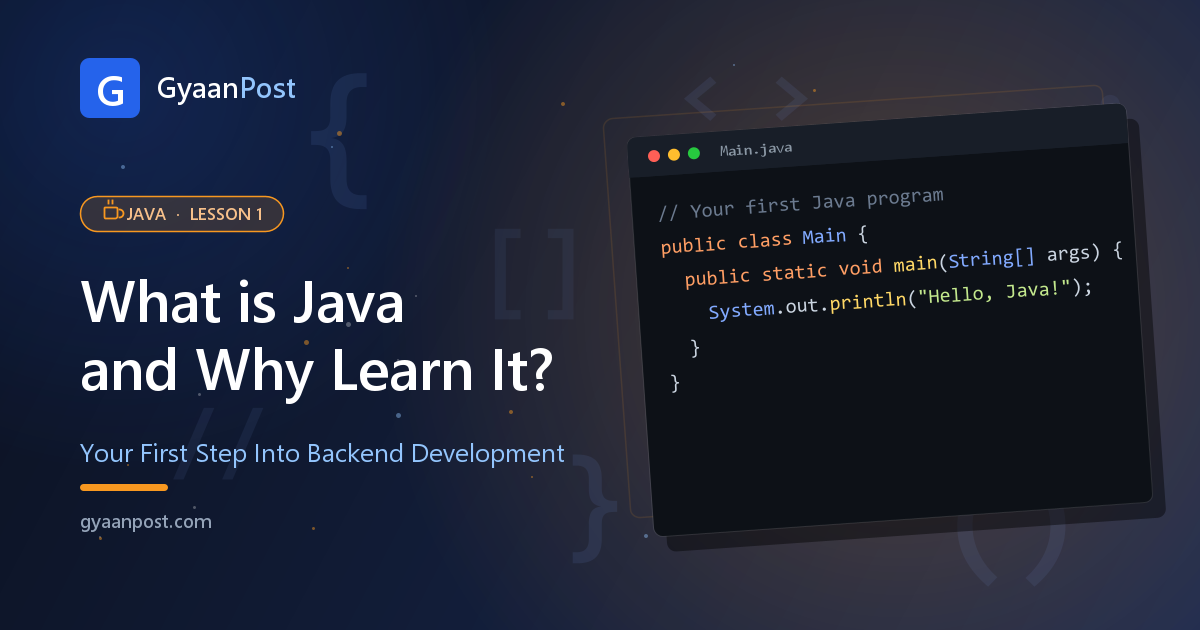
Here's the classic first Java program. You don't need to understand every word yet — just notice how it's structured:
// This is your first Java program
public class Main {
    public static void main(String[] args) {
        System.out.println("Hello, GyaanPost!");
    }
}
When you run this, it simply prints Hello, GyaanPost! to the screen. We'll break down exactly what each line means in later lessons.
Where is Java used?
Java isn't a toy language — it powers a huge part of the real world:
- Enterprise backends — banking, insurance, and large business systems (often with Spring Boot).
- Android apps — a large share of Android development uses Java (and Kotlin).
- Web applications — server-side systems handling millions of users.
- Big data — tools like Hadoop and Kafka are built on Java.
- Cloud & microservices — modern scalable systems.
Why learn Java in 2026?
- Strong job demand — Java remains one of the most in-demand skills, especially for backend and enterprise roles.
- Great for placements — it's a favourite for campus and mass-hiring interviews (and its structure makes you a better programmer).
- Spring Boot — the most popular framework for building real backend applications runs on Java.
- Stable and mature — decades of reliability, a massive ecosystem, and huge community support.
- Transferable skills — learning Java's strong fundamentals makes picking up other languages easier.
In short: Java opens doors to solid, well-paying backend careers, and the concepts you learn here carry over everywhere.
What you'll learn in this series
This is lesson 1 of a complete, beginner-to-advanced path. We'll go from your very first program all the way to building real applications with Spring Boot. You can always find every lesson on the Learn Java roadmap.
Fun fact to keep you motivated: this very website, GyaanPost, runs on Java and Spring Boot — so everything you're about to learn is exactly the kind of skill used to build real, production software that people use every day.
Key takeaways
- Java is a high-level, object-oriented language built around "Write Once, Run Anywhere."
- Java code compiles to bytecode, which the JVM runs on any operating system.
- It powers enterprise backends, Android apps, big data, and cloud systems.
- It's worth learning in 2026 for strong job demand, placements, and Spring Boot.
← Back to the Learn Java roadmap
Next: Lesson 2 — Install Java and Set Up Your First Program →
Frequently Asked Questions
What is Java in simple words?
Java is a high-level, object-oriented programming language known for its Write Once Run Anywhere portability - you write a Java program once and run it on Windows, Mac, Linux, or Android without changing the code. It is widely used for enterprise backends, Android apps, and large-scale systems.
How does Java work?
Java code is first compiled into an intermediate form called bytecode. That bytecode runs on the Java Virtual Machine (JVM), and because every operating system has its own JVM, the same bytecode runs everywhere. This is what makes Java portable across platforms.
Is Java worth learning in 2026?
Yes. Java remains one of the most in-demand programming languages, especially for backend and enterprise roles. It is a favourite in campus and mass-hiring interviews, powers the popular Spring Boot framework, and its strong fundamentals make learning other languages easier.
What is the difference between JDK, JRE and JVM?
The JDK (Java Development Kit) has everything you need to write and build Java programs. The JRE (Java Runtime Environment) is what is needed to run them. The JVM (Java Virtual Machine) is the engine inside the JRE that actually executes the bytecode.