What Is Digital Marketing? Key Concepts & Tips
Digital marketing is the practice of promoting products, services, and brands to people through digital channels — search engines, websites, email, social media, mobile apps, and online video — using data to reach the right audience and measure every result. Unlike traditional advertising on TV or billboards, digital marketing lets you target specific audiences, track exactly what they do, and adjust campaigns in real time. That measurability is why it now dominates how businesses grow: global digital ad spend reached roughly $740 billion in 2026, accounting for about 73% of all media spending worldwide, according to industry data compiled by Foursets and Statista.
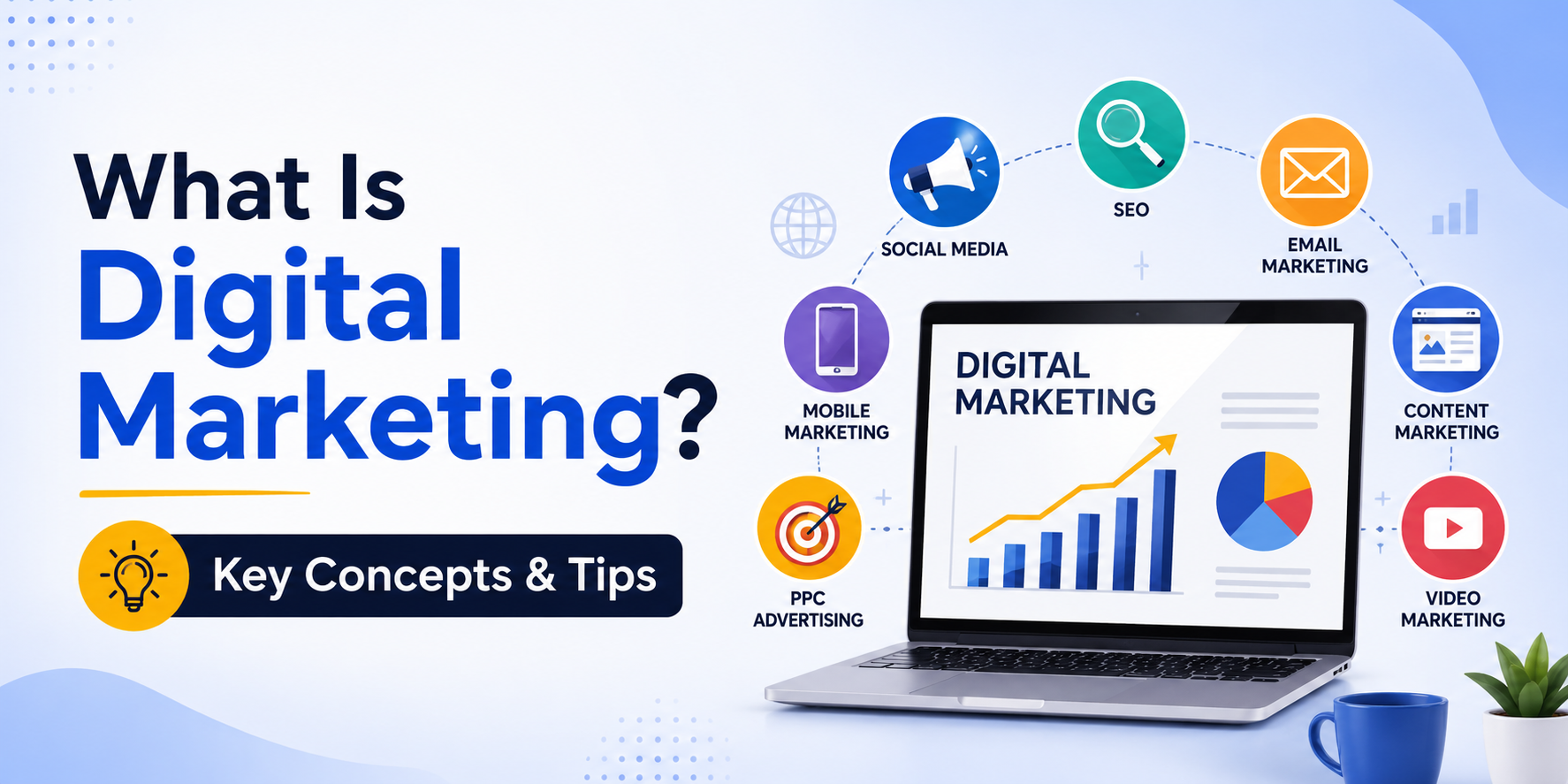
This guide breaks down what digital marketing actually is, the core channels that make it up, how to build a digital marketing strategy, and practical tips you can apply today — whether you run a business, work in marketing, or are exploring it as a career.
What Digital Marketing Means in Plain English
At its simplest, digital marketing is any marketing effort that uses an electronic device or the internet. When someone searches Google for "best running shoes" and clicks a result, reads a brand's blog, watches a product video, gets a promotional email, or sees an ad on Instagram — that's digital marketing in action.
The defining feature isn't the channel; it's the data loop. Every click, view, and purchase can be measured, attributed, and optimized. A bakery can learn that its Facebook ads drive store visits while its email newsletter drives online orders, then shift budget accordingly. Traditional marketing rarely offers that level of clarity.
Three traits separate digital marketing from older forms of advertising:
-
Targeting — You can reach people by location, age, interests, search behavior, and even past purchases.
-
Measurability — Tools like Google Analytics show exactly which efforts produce sales.
-
Interactivity — Audiences can comment, share, click, and respond, turning a one-way message into a conversation.
The Core Channels of Digital Marketing
Digital marketing isn't one thing — it's a set of channels that work best together. Here are the main ones and what each does.
|
Channel |
What it does |
Best for |
|
Search Engine Optimization (SEO) |
Earns free ("organic") traffic by ranking on Google |
Long-term, compounding visibility |
|
Pay-Per-Click (PPC) / Paid Search |
Buys ads on search results, pay only on clicks |
Fast, intent-driven traffic |
|
Content Marketing |
Blogs, guides, and videos that attract and educate |
Trust, authority, and SEO fuel |
|
Social Media Marketing |
Builds audience and brand on platforms like Instagram, TikTok, LinkedIn |
Awareness and community |
|
Email Marketing |
Direct messages to subscribers |
Retention and high ROI |
|
Affiliate & Influencer Marketing |
Partners promote your product for a commission or fee |
Reach and social proof |
|
Mobile Marketing |
Reaches users on smartphones via apps, SMS, and mobile ads |
Meeting customers where they are |
A few numbers show why these channels matter. SEO drives an estimated 53% of all website traffic (BrightEdge), email marketing returns about $36 for every $1 spent (Foursets), and content marketing generates roughly three times more leads than outbound methods while costing 62% less. There are also around 5.42 billion social media users worldwide — close to 59% of the global population — making social one of the largest audiences in human history.
SEO: Earning Visibility for Free
SEO is the work of helping your pages rank higher in unpaid search results. It covers three areas: on-page (quality content and keywords), technical (site speed, mobile-friendliness, crawlability), and off-page (links and mentions from other sites). With Google processing more than 16 billion searches per day, ranking for the right terms is one of the most valuable assets a business can build.
Paid Advertising: Buying Attention Instantly
Where SEO is a long game, paid search and social ads deliver traffic immediately. The trade-off is that visibility stops the moment you stop paying. The average Google Ads click-through rate sits around 6.66% with an average cost per click near $5.26, so smart targeting and strong landing pages matter enormously.
Content and Social: Building Trust at Scale
Content marketing — helpful blogs, how-to videos, newsletters — is the engine behind almost every other channel. It gives SEO something to rank, social media something to share, and email something to send. Paired with social platforms, it turns strangers into followers and followers into customers.
What Is a Digital Marketing Strategy?
A digital marketing strategy is a documented plan that connects your business goals to specific channels, messages, and metrics. Without one, you end up doing random acts of marketing — a post here, an ad there — with no way to know what's working.
A strong digital marketing strategy answers five questions:
-
Who is your audience? Define your ideal customer with as much detail as possible.
-
What are your goals? Sales, leads, sign-ups, awareness — pick measurable targets.
-
Which channels fit? A B2B software firm leans on LinkedIn and search; a fashion brand leans on Instagram and TikTok.
-
What's your message? The core value you offer, expressed clearly for each channel.
-
How will you measure success? Define KPIs like conversion rate, cost per acquisition, and return on ad spend before you start.
A useful rule: build your strategy around your customer's journey — awareness, consideration, and decision. Use content and social to create awareness, SEO and email to nurture consideration, and PPC and landing pages to drive the decision. Only 61% of marketers believe their current strategy is effective, so a clear, documented plan is itself a competitive advantage.
Digital Marketing Services: What Agencies and Freelancers Offer
If you don't want to run everything in-house, digital marketing services are available from agencies, freelancers, and consultants. These typically include:
-
SEO services — audits, content optimization, and link building
-
PPC management — setting up and optimizing Google and social ad campaigns
-
Social media management — content calendars, posting, and community engagement
-
Content creation — blogs, video, graphics, and email copy
-
Analytics and reporting — tracking performance and proving ROI
-
Web design and conversion optimization — turning visitors into customers
When choosing a provider, look for transparent reporting, relevant case studies, and clarity on which metrics they're accountable for. The best digital marketing services tie their work to revenue outcomes — leads and sales — not just vanity metrics like impressions or follower counts.
Want to Learn It? Choosing a Digital Marketing Course
Demand for skilled marketers has made structured learning more popular than ever. A good digital marketing course gives you a foundation across channels plus hands-on practice with real tools. When evaluating options, prioritize courses that offer:
-
Practical projects, not just theory — building a real campaign teaches more than any lecture
-
Recognized certifications (Google, Meta, HubSpot offer free, credible ones)
-
Up-to-date material that covers current tools, including AI-assisted workflows
-
Analytics training, since interpreting data is the skill that separates good marketers from great ones
You don't necessarily need a degree to enter the field — many professionals build their careers through certifications, a strong portfolio, and self-directed learning. Starting with a free Google or HubSpot certification, then specializing in one channel like SEO or paid media, is a proven path.
Digital Marketing Jobs: Careers and Outlook
The career outlook is strong. Digital marketing jobs are projected to grow about 16% in the U.S. between 2024 and 2034 — much faster than the average for all occupations — creating an estimated 100,000+ new roles, according to U.S. Bureau of Labor Statistics forecasts cited by Research.com.
Common digital marketing jobs include:
|
Role |
Typical U.S. mid-level salary |
Focus |
|
Digital Marketing Specialist |
~$69,000 |
Multi-channel campaigns |
|
SEO Specialist |
~$60,000–$75,000 |
Organic search growth |
|
Paid Media / PPC Manager |
~$70,000–$90,000 |
Ad campaign performance |
|
Content/Social Strategist |
~$65,000–$85,000 |
Brand and engagement |
|
Email Marketing Specialist |
~$65,000 |
Retention and automation |
|
AI Marketing Manager |
~$105,000–$155,000 |
AI-driven optimization |
Salary ranges are approximate U.S. figures drawn from Robert Half, Research.com, and DigitalApplied 2026 data; actual pay varies by location, experience, and skills.
One clear trend: AI proficiency now adds roughly 15–22% to base salaries across marketing roles, making it the largest pay differentiator outside seniority and geography. Marketers who pair channel expertise with comfort using AI tools are the most in demand.
7 Practical Digital Marketing Tips
Whether you're starting out or sharpening an existing program, these tips deliver outsized results:
-
Start with one channel and master it. Spreading thin across every platform produces mediocre results everywhere. Pick the channel where your audience already spends time.
-
Make everything mobile-first. Smartphones now drive the majority of web traffic and around 77% of retail website visits. If your site is slow or clunky on a phone, you lose customers before they ever see your offer.
-
Lead with helpful content. Answer the real questions your audience is searching for. This builds trust, fuels SEO, and gives every other channel something worth sharing.
-
Build an email list from day one. Email consistently delivers the highest ROI of any channel and is the one audience you actually own — no algorithm can take it away.
-
Track the metrics that map to money. Focus on conversions, cost per acquisition, and return on ad spend rather than likes and impressions.
-
Test, don't guess. Run small experiments — different headlines, images, or audiences — and let the data pick the winner.
-
Use AI as a force multiplier, not a replacement. AI tools speed up research, drafting, and optimization, but human judgment on strategy and brand still wins.
The Bottom Line
Digital marketing is how modern businesses get found, build trust, and grow — by reaching people through search, content, social, email, and ads, then using data to keep improving. The field rewards those who start focused, stay helpful to their audience, measure what matters, and keep learning as tools evolve. Whether you're marketing a business, hiring digital marketing services, taking a digital marketing course, or pursuing one of the fast-growing digital marketing jobs, the same foundation applies: meet people where they are, give them real value, and let the data guide you.