5 Engineering Skills That Translate Directly Into Startup Success
Every year, thousands of engineers leave stable, well-paying jobs at established companies to take a chance on a startup, either by joining an early-stage team or by founding one themselves.

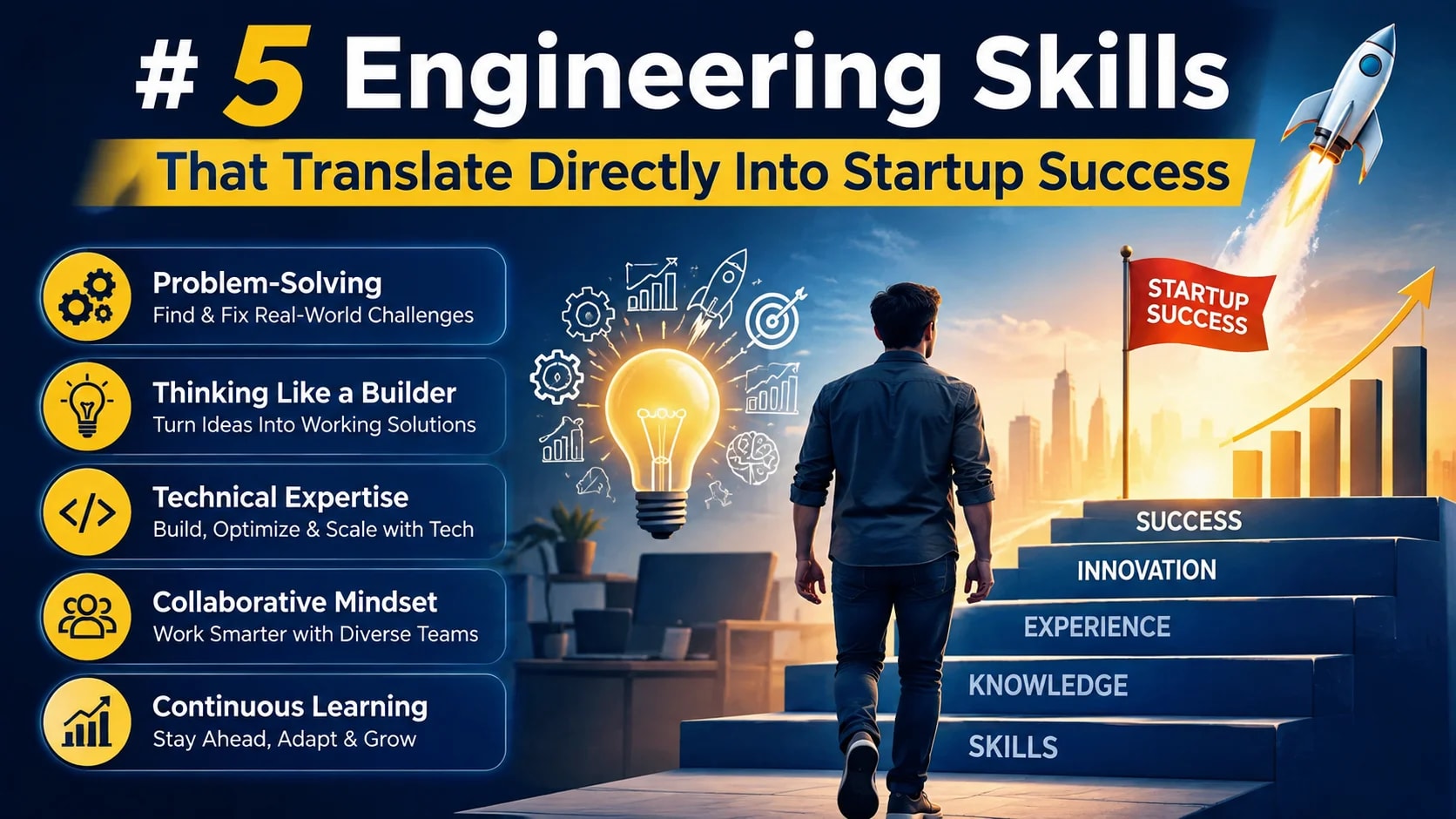
Every year, thousands of engineers leave stable, well-paying jobs at established companies to take a chance on a startup, either by joining an early-stage team or by founding one themselves. On the surface, this looks like a leap into the unknown. Startups run on chaos, ambiguity, and constant change, while engineering, at least as it is often taught, seems to be about precision, structure, and predictable outcomes. Yet some of the most successful startup builders in the world are not marketing experts or seasoned executives. They are engineers who discovered that the discipline they learned while debugging code, designing systems, and shipping products maps almost perfectly onto the discipline required to build a company from nothing.
This is not a coincidence. Engineering trains a very specific way of thinking, one that treats problems as solvable, complexity as something to be broken down rather than feared, and failure as information rather than defeat. Startups need exactly this mindset to survive their earliest, most fragile years. In this article, we will explore five core engineering skills that translate directly into startup success, why each one matters so much in an early-stage environment, and how engineers can consciously lean into these strengths as they move from writing code to building companies.
1. Systems Thinking: Seeing the Whole Machine, Not Just One Part
Good engineers rarely look at a single function or component in isolation. They think in systems, understanding how a change in one part of a codebase might ripple through a database, an API, a user interface, and eventually a customer's experience. This habit of mapping cause and effect across an entire system is one of the most valuable mental models an engineer can bring into a startup.
Why This Matters in a Startup
A startup is, at its core, a system made up of interconnected parts: product, pricing, marketing, sales, support, and finance all influence one another constantly. A founder who understands systems thinking will notice, for example, that a pricing change does not just affect revenue, it also affects the type of customer who signs up, the support burden that follows, and the churn rate three months later. Engineers who are used to tracing bugs through layers of a system naturally apply that same tracing instinct to business problems, which helps them avoid the common trap of solving one issue while accidentally creating three new ones elsewhere.
How to Apply It
Engineers moving into startup roles can lean into systems thinking by:
• Mapping out how a business decision affects each downstream team before committing to it
• Treating the company itself as an evolving architecture that needs occasional refactoring
• Looking for root causes behind recurring problems instead of repeatedly patching symptoms
• Documenting dependencies between teams the same way you would document a codebase
2. Debugging Mindset: Treating Problems as Puzzles, Not Emergencies
Every engineer knows the feeling of staring at a production system that is throwing errors at three in the morning. Panic is tempting, but experienced engineers know that panic rarely fixes anything. Instead, they isolate variables, form hypotheses, test them one at a time, and methodically narrow down the cause. This calm, structured approach to chaos is exactly what startups need when things inevitably go wrong, and in a startup, something always eventually goes wrong.
Why This Matters in a Startup
Startups face a constant stream of fires: a key customer churns unexpectedly, a marketing channel suddenly stops converting, a co-founder disagreement threatens to derail a launch. Founders without a debugging mindset often react emotionally, jumping to conclusions or making sweeping changes based on incomplete information. Engineers, on the other hand, are trained to resist that urge. They ask what actually changed, gather evidence, and rule out possibilities systematically before deciding on a fix. This drastically reduces the number of wasted pivots and panic-driven decisions that sink otherwise promising startups.
How to Apply It
When something breaks in the business, whether it is growth, retention, or team dynamics, apply the same process you would to a production incident:
1. Identify exactly what changed and when the problem first appeared
2. Form a small number of specific, testable hypotheses rather than vague guesses
3. Test one variable at a time so you know what actually caused the improvement or decline
4. Document the root cause and the fix so the same issue does not resurface later
3. Iterative Building: Shipping Small and Learning Fast
Modern software engineering is built around iteration. Rather than spending months designing a perfect system in isolation, good engineering teams ship small, testable increments, gather feedback, and adjust course quickly. This habit, often reinforced through agile workflows and continuous deployment, is directly transferable to how successful startups build products and even entire business models.
Why This Matters in a Startup
The startups that survive are rarely the ones with the most polished initial idea. They are the ones that learn fastest. Engineers who are comfortable shipping a minimum viable version of something, watching how real users respond, and iterating based on that feedback tend to avoid the classic founder trap of building in a vacuum for a year only to discover nobody wants the finished product. The engineering habit of small, frequent releases becomes, in a startup context, a habit of small, frequent experiments across product, messaging, and even business model.
How to Apply It
Treat every major business assumption the way you would treat an untested feature. Build the smallest version that lets you learn something real, put it in front of actual customers, and let their behavior, not your assumptions, guide the next iteration. This applies just as much to a landing page or a pricing page as it does to a new feature in your product.
4. Resourcefulness Under Constraints
Engineers regularly work within tight constraints, whether it is limited server budget, a strict deadline, or legacy code that cannot easily be rewritten. Good engineers learn to build clever, effective solutions within these limitations rather than waiting for ideal conditions that may never arrive. This exact skill, doing more with less, is arguably the single most important survival trait for an early-stage startup.
Why This Matters in a Startup
Startups almost never have enough money, people, or time. Founders who wait for perfect conditions before taking action often watch their runway disappear while competitors ship faster with far fewer resources. Engineers are uniquely well suited to this environment because they are trained to find the smallest, cheapest, most effective solution to a problem rather than the most elegant or complete one. Knowing when a duct-taped solution is good enough, and when it genuinely needs to be rebuilt properly, is a judgment call engineers practice constantly, and it is exactly the judgment early-stage founders need to make every single week.
How to Apply It
Bring the same constraint-driven creativity from engineering into every part of the business:
• Ask what the simplest version of a solution looks like before reaching for the expensive option
• Use existing tools and no-code solutions for non-core problems instead of building everything from scratch
• Reserve deep engineering effort for the parts of the product that are truly your competitive advantage
• Regularly reassess which shortcuts are safe to keep and which ones have become genuine risks
5. Clear Technical Communication
Contrary to the stereotype of engineers as poor communicators, the best ones are exceptionally good at translating complex, technical ideas into language that non-technical stakeholders can understand and act on. Writing clear documentation, explaining a tricky bug to a product manager, or presenting an architecture decision to leadership all require a specific kind of communication discipline: clarity without oversimplification.
Why This Matters in a Startup
Founders need to explain their product to investors who may know nothing about the underlying technology, to early customers who care only about the outcome, and to new hires who need to get up to speed quickly. Engineers who have practiced writing clear pull request descriptions, technical specs, and post-mortems already have the muscle memory for breaking down complexity into digestible pieces. This skill becomes the foundation for effective fundraising pitches, customer conversations, and internal team alignment, all of which are critical during a startup's earliest and most uncertain stages.
How to Apply It
Practice explaining your product and your reasoning to someone with zero technical background, and pay attention to which parts confuse them. Treat investor updates, customer emails, and internal memos with the same care you would give to a well-written technical specification: structured, honest about trade-offs, and free of unnecessary jargon.
Bringing These Skills Together
None of these five skills work in isolation. Systems thinking helps you see where a problem actually lives. A debugging mindset keeps you calm and methodical once you find it. Iterative building lets you test a fix quickly and cheaply. Resourcefulness ensures you can execute that fix without needing resources you do not have. And clear communication ensures your team, your customers, and your investors understand why the decision was made in the first place. Together, these habits form a kind of operating system for founders, one that many engineers already carry with them without fully realizing how valuable it is outside of a codebase.
Common Pitfalls to Watch For
While these engineering habits are powerful, they can also become liabilities if applied without balance. Watch out for these common traps:
• Over-engineering early product decisions that should have stayed simple and scrappy
• Treating every business problem as purely technical when human and market factors matter just as much
• Spending too long perfecting internal systems instead of talking to customers
• Assuming clear logic alone will persuade investors or customers without also building genuine relationships
The engineers who succeed as founders are usually the ones who recognize when to apply their technical instincts and when to deliberately step outside of them, staying curious about sales, marketing, and human psychology rather than assuming engineering rigor alone will carry the company forward.
Frequently Asked Questions
Do I need a technical co-founder to build a successful startup?
Not necessarily, but having someone on the founding team who thinks in systems, debugs methodically, and builds iteratively gives a startup a significant early advantage. If you do not have a technical co-founder, it is worth deliberately studying and adopting these same habits yourself, since they are mindsets as much as they are technical skills.
Can non-engineers develop these same skills?
Absolutely. While engineers often develop these habits through years of writing and debugging code, none of the five skills described here require a technical background at their core. Systems thinking, structured problem solving, iterative learning, resourcefulness, and clear communication can all be practiced deliberately by founders from any professional background.
What is the biggest mistake engineers make when transitioning into startup founders?
The most common mistake is over-applying engineering rigor to problems that are actually about people, not systems. Spending weeks perfecting an internal tool while ignoring customer conversations, or assuming a logically sound pitch will automatically win over investors, are classic examples of engineering strengths being misapplied outside their natural domain.
How long does it take for an engineer to adjust to a founder mindset?
There is no fixed timeline, but most engineers who make a conscious effort to apply their existing skills to business problems, while staying open to the parts of company-building that feel unfamiliar, start seeing meaningful progress within the first few months. The key is treating the transition itself as an iterative process, with the same patience and curiosity you would bring to learning any new system.
The Engineer's Advantage
Building a startup and building software have more in common than most people realize. Both require breaking enormous, overwhelming problems into smaller, solvable pieces. Both demand a calm, structured response to constant failure. Both reward people who can ship something small, learn from it, and improve quickly rather than waiting for perfect conditions. And both ultimately depend on the ability to explain complex ideas simply enough that other people want to get on board.
Engineers who step into startup life are not starting from zero. They are bringing years of hard-won problem-solving instincts into a new arena, one where those same instincts, systems thinking, methodical debugging, iterative building, resourcefulness, and clear communication, often turn out to be exactly what separates a startup that survives from one that quietly fades away. The code changes, but the underlying discipline does not, and that discipline may be the most valuable asset any engineer-turned-founder brings to the table.