GATE 2027 Syllabus Released? Check Latest Updates & Exam Details
If you're searching for the GATE 2026 syllabus, here's the most important thing to know first: GATE 2026 is already over. The exam was held in February 2026 and results have been declared.

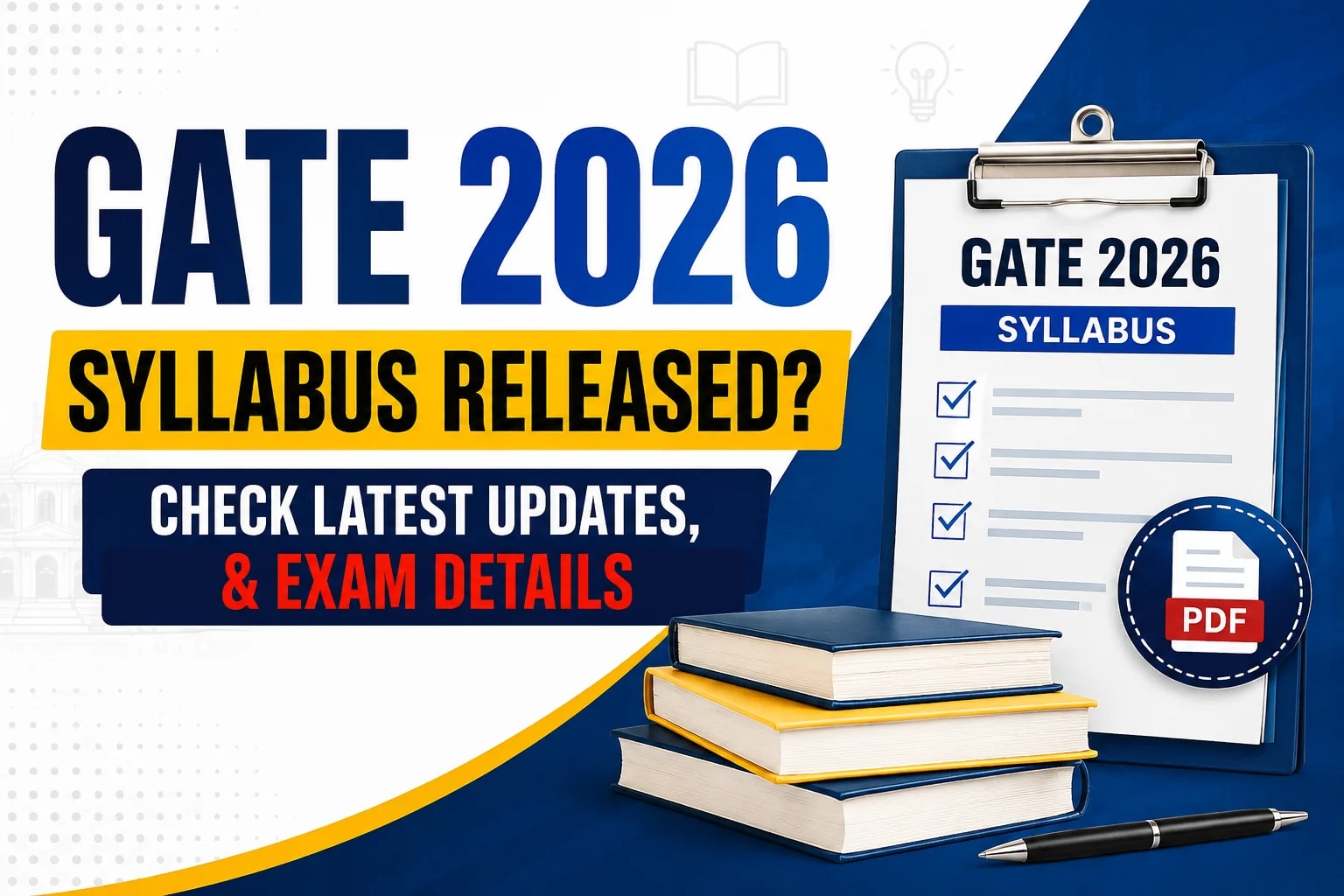
If you're searching for the GATE 2026 syllabus, here's the most important thing to know first: GATE 2026 is already over. The exam was held in February 2026 and results have been declared. The exam cycle that matters for your preparation right now is GATE 2027, and yes — the syllabus for GATE 2027 has been officially released. This guide walks you through exactly what's new, where to download the official syllabus PDF, how the paper-wise topics are structured, the latest exam pattern, and how to plan your preparation from here.
Has the GATE 2027 Syllabus Been Released? (Quick Answer)
Yes. The Indian Institute of Technology (IIT) Madras, the organizing institute for GATE 2027, officially released the GATE 2027 syllabus along with the Information Brochure on July 20, 2026, on the official website gate2027.iitm.ac.in. This is the first major revision to the GATE syllabus in five years, so even repeat candidates should not assume the topics are unchanged from GATE 2026.
Here are the key facts, verified against the official website and IIT Madras's notification:
● Conducting institute: IIT Madras
● Official website: gate2027.iitm.ac.in
● Syllabus release date: July 20, 2026 (Information Brochure Version 1.0)
● Registration opens: August 27, 2026
● Registration closes: September 27, 2026
● Exam dates: February 6, 7, 13, 14, 20 and 21, 2027
● Total papers: 30 test papers, including the newly introduced Robotics and Automation (RA) paper
What's New in the GATE 2027 Syllabus
IIT Madras has revised the GATE syllabus for the first time in five years to reflect changes in academic curricula and industry needs. If you studied from GATE 2026 material, don't skip this section — some of these changes directly affect which topics you need to prepare.
1. A New Paper: Robotics and Automation (RA)
GATE 2027 introduces Robotics and Automation as a brand-new discipline. It is open to candidates from Mechanical, Electrical, Electronics, Computer Science, Robotics, and Mechatronics backgrounds, reflecting the growing demand for automation and robotics skills in industry and research.
2. Textile Engineering Restructured
Textile Engineering and Fibre Science (TF) is no longer a standalone paper. It has been moved and restructured as a sectional paper under Engineering Sciences (XE).
3. Section Code Changes in XE, XH and XL
The section/paper codes within the multi-section papers — Engineering Sciences (XE), Humanities and Social Sciences (XH), and Life Sciences (XL) — have been revised. Double-check your specific section code on the official brochure before filling out your application form.
4. Core Subject Updates (CSE, ECE, ME, CE, EE, DA)
A few examples of what's changed in popular papers:
● Computer Science (CS): Secondary Storage/Magnetic Disk has been removed from Computer Organization and Architecture, and the list of protocols under Computer Networks has been trimmed.
● Electronics and Communication (EC): Around 90% of the syllabus is unchanged; Electromagnetics and Digital Circuits sections remain the same, with minor additions and deletions elsewhere.
● Civil Engineering (CE): The syllabus now has 8 sections instead of 7. Construction Materials and Management, earlier a sub-topic under Structural Engineering, is now a standalone section.
Because these changes vary by paper, the safest approach is to open your specific subject's official PDF rather than relying on a general summary — including this one.
How to Download the Official GATE 2027 Syllabus PDF
Follow these steps to get the verified syllabus directly from the source:
● Go to the official GATE 2027 website: gate2027.iitm.ac.in.
● Click on "Information Brochure" or the "Syllabus" tab in the site's navigation menu.
● Select your paper code from the list of 30 papers (for example, CS, ME, EC, CE, EE, DA, or RA).
● Open the PDF and scroll to your paper's syllabus section.
● Save the file to your device using Ctrl+S (Windows) or Cmd+S (Mac) for offline reference.
● Check the version number printed at the top of the brochure. Always use the latest version (Version 1.1, dated July 23, 2026, was the most recent as of this writing) since IIT Madras may issue corrections.
Tip: Avoid downloading syllabus PDFs from unofficial or third-party sites. Cross-check any PDF you find elsewhere against the version hosted on gate2027.iitm.ac.in, since coaching sites sometimes host outdated files.
Paper-Wise Syllabus Structure
Every GATE 2027 paper is built around three broad components, though the exact weightage differs by subject:
● General Aptitude (GA): Common to all 30 papers, covering Verbal Aptitude, Quantitative Aptitude, Analytical Aptitude and Spatial Aptitude.
● Engineering Mathematics: Included in most engineering papers (topics such as Linear Algebra, Calculus, and Probability & Statistics). It is excluded from papers like AR, CY, DA, EY, GE, GG, MA, PH, RA, ST, XH and XL, where it does not apply.
● Core Subject Topics: Discipline-specific topics unique to your chosen paper — this is the largest portion of the syllabus.
Overview of a Few Popular Papers
|
Paper |
Code |
Core Sections (Examples) |
|
Computer Science & IT |
CS |
Digital Logic, Programming & Data Structures, Algorithms, Theory of Computation, Compiler Design, Operating Systems, Databases, Computer Networks |
|
Mechanical Engineering |
ME |
Engineering Mechanics, Strength of Materials, Theory of Machines, Thermodynamics, Fluid Mechanics, Manufacturing Engineering |
|
Electronics & Comm. |
EC |
Networks, Signals & Systems, Electronic Devices, Analog & Digital Circuits, Control Systems, Communications, Electromagnetics |
|
Civil Engineering |
CE |
Structural Engineering, Geotechnical Engineering, Water Resources, Environmental Engineering, Transportation, Geomatics, Construction Materials & Management |
|
Electrical Engineering |
EE |
Electric Circuits, Electromagnetic Fields, Signals & Systems, Electrical Machines, Power Systems, Control Systems, Power Electronics |
|
Data Science & AI |
DA |
Probability & Statistics, Linear Algebra, Calculus & Optimization, Programming, Machine Learning |
|
Robotics & Automation |
RA |
New paper for 2027 — bridges Mechanical, Electronics and Computing fundamentals with robotics-specific topics |
This table is a quick overview only. Always refer to your paper's full official PDF for the complete, section-wise topic list before you begin preparation.
GATE 2027 Exam Pattern
Understanding the exam pattern alongside the syllabus helps you prepare strategically rather than just topic by topic.
|
Particular |
Details |
|
Mode of Exam |
Computer-Based Test (CBT), online |
|
Duration |
3 hours (180 minutes) |
|
Total Questions |
65 |
|
Total Marks |
100 |
|
Section Split |
General Aptitude: 10 questions (15 marks); Core Subject / Engineering Mathematics: 55 questions (85 marks) |
|
Question Types |
Multiple Choice Questions (MCQ), Multiple Select Questions (MSQ), Numerical Answer Type (NAT) |
|
Marks per Question |
1 mark or 2 marks |
|
Medium |
English |
Marking Scheme and Negative Marking
● MCQ (1 mark): 1/3 mark deducted for a wrong answer.
● MCQ (2 marks): 2/3 mark deducted for a wrong answer.
● MSQ: No negative marking, but no partial credit — you must select all correct options and no incorrect ones to score.
● NAT: No negative marking; candidates type in a numerical answer using a virtual keypad, with an online scientific calculator available on screen.
Since MSQ and NAT questions carry no penalty for a wrong attempt, it's generally worth attempting them even under partial uncertainty — but be cautious with MCQs unless you can eliminate at least a couple of options.
How to Prepare: A Practical Study Plan
1. Start With the Syllabus, Not the Books
Download your paper's official syllabus PDF first and use it as a checklist. GATE only tests what's listed in the syllabus — treat it as the single source of truth for what to study and what to skip.
2. Map Out a Section-Wise Timeline
Break your subject into sections (as shown in the syllabus PDF) and assign realistic weekly targets. Most serious aspirants spend 6 to 12 months on preparation, factoring in revision and mock tests.
3. Prioritize by Weightage, Not Just Interest
Engineering Mathematics typically contributes around 13% of the total marks in most technical papers, and General Aptitude another 15%. Together that's roughly a quarter of your score from sections that are often easier to master quickly — don't neglect them in favor of only the core subject.
4. Practice With Previous Years' Papers
Solve at least the last 8 to 10 years of GATE question papers for your subject. This helps you recognize recurring question patterns and identify which topics are consistently tested, even as the exact syllabus wording evolves.
5. Take Regular Timed Mock Tests
Simulate the real 3-hour CBT environment regularly. This builds speed, helps you get comfortable with the MCQ/MSQ/NAT format, and highlights weak areas early enough to fix them.
6. Revise the New Topics Carefully
If you're a repeat candidate who studied for GATE 2026, specifically cross-check the added and removed topics in your paper's GATE 2027 syllabus so you don't waste time on deleted content or miss newly added topics.
7. Keep Checking the Official Website
IIT Madras may issue corrigenda or brochure updates before the exam. Bookmark gate2027.iitm.ac.in and check it periodically, especially close to the registration deadline and admit card release.
Conclusion
To sum up: the GATE 2026 syllabus is no longer the one to worry about, since that exam cycle has already concluded. What matters now is the GATE 2027 syllabus, officially released by IIT Madras on July 20, 2026, at gate2027.iitm.ac.in. It brings the first major revision in five years, including a new Robotics and Automation paper and updated core topics across several disciplines. Download the official PDF for your specific paper, map it against the exam pattern and marking scheme covered above, and build your study plan around the actual, verified syllabus rather than second-hand summaries. Staying close to the official website through registration, admit card release, and exam day will help you avoid last-minute surprises and prepare with confidence.