Distance MBA vs Regular MBA in India (2026): Fees, Salary & ROI Compared
Distance, Online or Regular MBA? Compare fees in ₹, salary in LPA, placements, UGC/AICTE recognition and ROI to pick the right MBA in India in 2026.

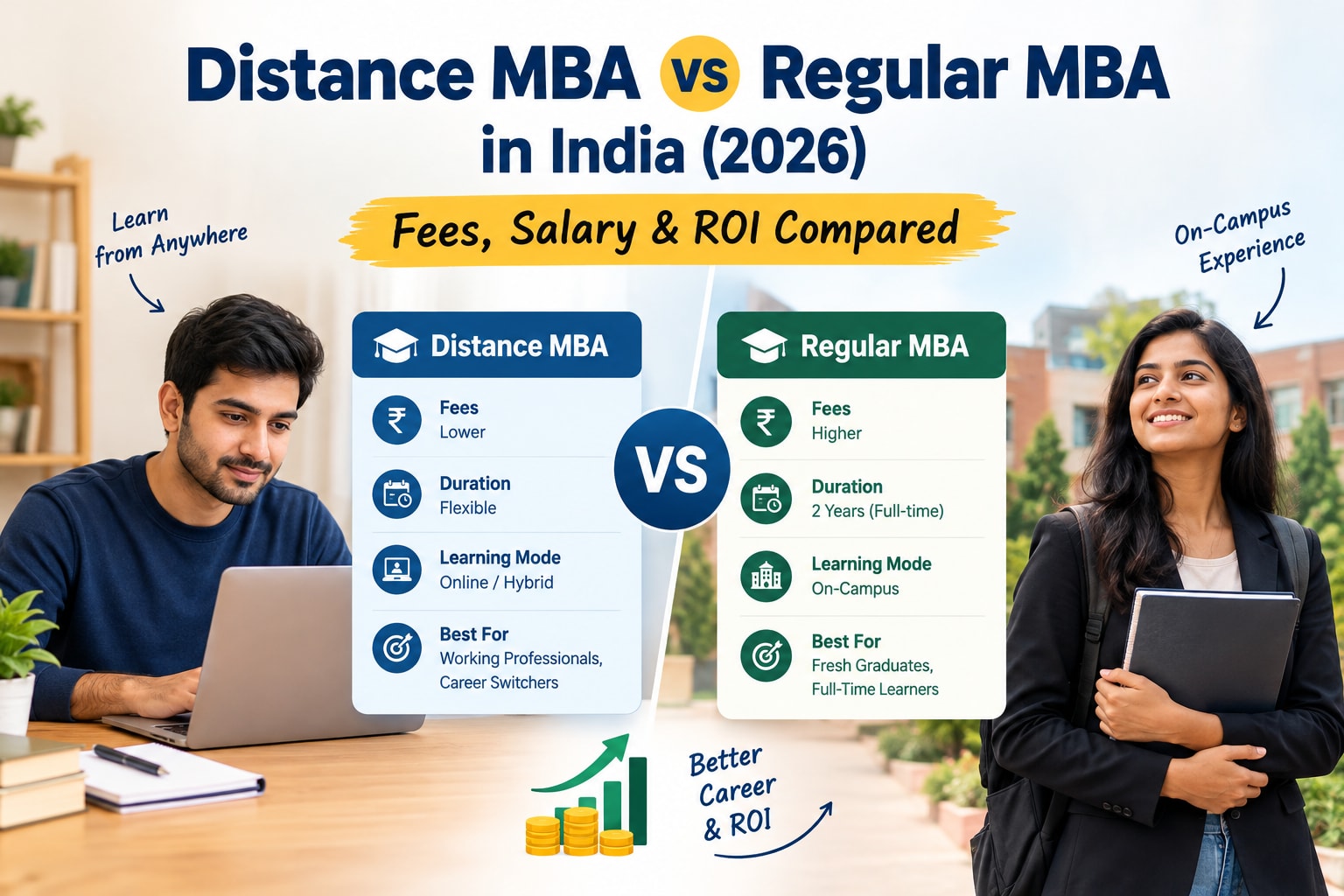
An MBA is one of the most popular postgraduate degrees in India. Today, students can pursue it in three ways: Regular (Full-Time) MBA, Distance MBA and Online MBA. Each format suits a different type of learner.
The right choice depends on your career stage, budget, work experience, university recognition, placement expectations, flexibility needs and long-term goals. In this article, we compare Distance and Regular MBA on fees, salary, placements and ROI for 2026.
Note: All fee and salary figures here are indicative. They vary by institution, specialization and city, and none of them is guaranteed.
Distance MBA vs Regular MBA: Quick Comparison
| Factor | Distance/Online MBA | Regular MBA |
|---|---|---|
| Typical Duration | 2 years (longer completion window allowed) | 2 years full-time |
| Approx. Fees in India | ₹30,000–₹2.5 lakh (premium Online MBAs: ₹3–4+ lakh) | ₹1–3 lakh (some govt/state), ₹5–15 lakh (private), ₹20 lakh+ (top B-schools) |
| Learning Mode | Study material, live/recorded classes, assignments | Daily classroom teaching, case studies, projects |
| Flexibility | High | Low |
| Campus Experience | Limited or none | Full campus life |
| Networking | Moderate | Strong |
| Internships | Usually none or self-arranged | Structured summer internships |
| Placement Support | Varies by university | Campus placements; depends on the college |
| Salary Potential | Depends on your profile and experience | Wide range; very high at top B-schools |
| Work Experience | Most students are working | Freshers to 5+ years |
| Opportunity Cost | Low (you keep earning) | High (2 years of lost salary) |
| ROI | Potentially high for working professionals | Potentially high for strong B-schools |
| Best For | Working professionals, budget-conscious learners | Freshers, career switchers |
What Is a Distance MBA in India?
A Distance MBA (Open and Distance Learning, or ODL) is a postgraduate management degree where students learn mostly from study material, assignments and periodic exams, without attending daily classes.
Distance MBA vs Online MBA
The two are not always the same.
- Distance MBA: self-paced, with study material, assignments and exams.
- Online MBA: more interactive, with live classes, recorded lectures and online assessments.
A university may be approved for ODL mode but not Online mode, or the other way round. Always check the exact programme and mode before enrolling.
Key highlights
- Duration: usually 2 years (four semesters)
- Eligibility: bachelor's degree from a recognised university, often with 50% marks (relaxation for reserved categories)
- Admission: merit-based, interview or university-specific test; requirements vary by university, and not every programme offers direct admission
- Exams: assignments, projects and semester-end exams (online or at exam centres)
- Popular specializations: Finance, Marketing, HR, Business Analytics, Operations, IT, International Business, Supply Chain
Who should consider it?
- Working professionals
- Entrepreneurs and family business owners
- Students in smaller towns
- Candidates with a limited budget
Advantages and limitations
| Advantages | Limitations |
|---|---|
| Lower fees | Less campus exposure |
| Study while working | Needs self-discipline |
| No relocation | Placement support varies |
| Flexible schedule | Brand value differs by university |
What Is a Regular MBA in India?
A Regular MBA is a full-time, classroom-based programme, usually spread over two years. Year one covers core subjects. Year two focuses on specialization, followed by campus placements.
What it offers
- Internships: summer internships, often leading to pre-placement offers
- Campus placements: companies visit the campus to hire
- Industry exposure: guest lectures, live projects, industry visits
- Networking: batchmates, alumni and faculty
- Student clubs: finance, marketing, consulting, HR clubs and case competitions
- Career services: resume workshops, mock interviews and recruiter engagement
Eligibility
A bachelor's degree in any stream from a recognised university, usually with a minimum aggregate of 50% (relaxation for reserved categories).
Common MBA entrance exams
- CAT: for IIMs and many top B-schools
- XAT: for XLRI and several other institutes
- CMAT: accepted by many AICTE-approved institutes
- MAT: accepted by several private colleges
- GMAT: relevant for selected institutes
- State/university exams: such as MAH-CET, TANCET, KMAT and others
Note: Not every MBA college accepts all these exams. Check the admission criteria of each institute. Many colleges also hold GD, PI and WAT rounds.
Distance MBA vs Regular MBA: Fees in India
Fees differ widely. A government university's regular MBA can cost less than a premium Online MBA. Total cost depends on tuition, exam fees, study material, hostel, travel, food, laptop and internet costs, and opportunity cost (the salary you give up).
| Expense | Distance/Online MBA | Regular MBA |
|---|---|---|
| Tuition | ₹30,000–₹2.5 lakh | ₹1–3 lakh (govt/state); ₹5–15 lakh (private); ₹20 lakh+ (top) |
| Study Materials | ₹0–₹10,000 | ₹10,000–₹50,000 |
| Hostel/Living | ₹0 (stay at home) | ₹1.5–5 lakh (2 years) |
| Travel | ₹0–₹20,000 | ₹20,000–₹1.5 lakh |
| Opportunity Cost | ₹0 if you keep working | ₹6–30 lakh+ |
| Estimated Total (excl. opportunity cost) | ~₹0.4–3 lakh | ~₹2.5–25 lakh+ |
Fees vary significantly by institution, programme, specialization and location. Ask for the complete fee schedule before you pay.
Distance MBA vs Regular MBA: Salary in India
Factors that affect MBA salary
- College/university reputation
- Previous work experience
- Specialization
- Industry and job role
- Location
- Skills
- Interview performance
- Hiring company
- Career history
Career areas
Popular MBA career areas in India include Finance, Marketing, HR, Business Analytics, Operations, Sales, Consulting, Product Management, IT Management and Supply Chain Management. Consulting and investment banking roles mostly recruit from top regular B-schools. In areas like HR, operations, IT management and analytics, experience plus an MBA can work well in either format.
Indicative salary comparison
| Candidate Profile | Distance/Online MBA | Regular MBA |
|---|---|---|
| Fresher | ₹3–6 LPA | ₹5–10 LPA (mid-tier); ₹15–30+ LPA (top-tier) |
| 2–5 Years Experience | ₹5–12 LPA | ₹8–20 LPA |
| 5+ Years Experience | ₹10–25 LPA | ₹15–40+ LPA |
These are not guaranteed salaries. MBA format alone does not determine salary. Skills, experience and the institute's recruiter access matter just as much.
Distance MBA vs Regular MBA: ROI in India
ROI = (Financial Gain from MBA − Total MBA Cost) ÷ Total MBA Cost × 100
"Financial gain" means the extra salary you earn because of the MBA. "Total cost" should include fees, living costs and lost salary.
Example 1: Working professional
Priya earns ₹6 LPA as a marketing executive and does an Online MBA while working.
- Total cost: ₹1.5 lakh
- After MBA: promoted to ₹8.5 LPA (gain of ₹2.5 lakh per year)
- Gain over 3 years: ₹7.5 lakh
- ROI = (7.5 − 1.5) ÷ 1.5 × 100 = 400%
Example 2: Full-time MBA student
Rohan, a fresher, joins a private B-school.
- Tuition ₹12 lakh + living ₹3 lakh = ₹15 lakh
- Post-MBA salary ₹10 LPA vs ₹4.5 LPA without MBA (gain of ₹5.5 lakh per year)
- Gain over 5 years: ₹27.5 lakh
- ROI on direct cost ≈ 83%
- If you add 2 years of lost salary (₹9 lakh), total cost is ₹24 lakh and ROI ≈ 15%
Example 3: Career switcher
Ananya earns ₹12 LPA and leaves her job for a full-time MBA.
- Tuition ₹18 lakh + living ₹4 lakh + lost salary ₹24 lakh = ₹46 lakh
- Post-MBA salary ₹24 LPA vs ₹15 LPA if she had stayed (gain of ₹9 lakh per year)
- Break-even: about 5 years
- ROI after 7 years: about 37%
Opportunity cost at a glance
| Current Salary | Lost Salary over 2 Years |
|---|---|
| ₹6 LPA | ₹12 lakh |
| ₹10 LPA | ₹20 lakh |
| ₹15 LPA | ₹30 lakh |
| ₹25 LPA | ₹50 lakh |
These examples are hypothetical and ignore taxes, hikes and bonuses.
Distance MBA vs Regular MBA: Placement Opportunities in India
Understand the difference between these routes:
- Campus placements: companies hire directly from the campus
- Off-campus recruitment: you apply on your own through portals and referrals
- University placement assistance: resume help, job portals, occasional drives
- Internships: common in regular MBA, rare in distance/online formats
- Career services: counselling and mock interviews; quality varies
- Self-driven job search: the main route for most distance/online students
Do not assume every Regular or Distance MBA offers the same placements. Check the institute's latest placement report, the names of recruiting companies, the median salary and the percentage of students placed. Be careful with claims like "100% placement" that come without data.
Recognition and Regulation in India
Before paying any fee, check the recognition status of the university and the programme.
UGC and UGC-DEB
An online MBA is generally valid when a UGC-recognised university offers it and the programme is UGC-DEB entitled for Online or ODL delivery in the relevant academic year. UGC also publishes updated lists every year. For example, 101 universities and 20 category-1 institutions were listed for ODL in 2025-26, along with institutions approved for online courses. Check the list for the year in which you plan to enrol.
AICTE
AICTE rules depend on the type of institution. Central, state or private universities don't need prior AICTE approval, but deemed universities need an AICTE NOC to offer management programmes in online or ODL mode. For standalone institutes and PGDM providers, AICTE approval is important.
Other checks
- NAAC accreditation: an indicator of institutional quality
- NIRF ranking: helpful for comparing institutions
- Programme-specific recognition: the exact programme and mode should be listed
- No franchise delivery: UGC rules say entitled institutions should not offer online programmes under any franchise arrangement.
- Validity for jobs and higher studies: check the rules of the employer, government body or university you are targeting
Verify the current official status of the institution and programme on the UGC-DEB portal (deb.ugc.ac.in), UGC, AICTE, NAAC and NIRF websites before paying fees.
Entrance Exams vs Direct Admission
Regular MBA
- CAT, XAT, CMAT, MAT, GMAT (where applicable)
- State or university-level exams
- GD/PI/WAT rounds for many colleges
Distance/Online MBA
Admission rules differ by university. Some admit based on graduation marks. Others may need an interview, their own test or work experience. Not every Distance/Online MBA offers direct admission, so read the prospectus carefully.
Best MBA Specializations in India
| Specialization | Career Scope | Format That May Suit |
|---|---|---|
| Finance | Banking, corporate finance, equity research | Regular for investment banking; Distance/Online for working finance professionals |
| Marketing | Brand management, digital marketing, sales strategy | Regular for FMCG brand roles; Distance/Online for existing marketers |
| HR | HRBP, talent acquisition, L&D | Both |
| Business Analytics | Data and BI roles | Both; skills matter most |
| Operations | Manufacturing, logistics, process management | Both |
| IT | IT project and programme management | Distance/Online for working technologists |
| International Business | Exports, global trade | Regular, for exposure and networking |
| Supply Chain Management | E-commerce, logistics, procurement | Both |
Distance/Online MBA vs Regular MBA for Working Professionals
A Distance/Online MBA can help working professionals because they can:
- Continue earning
- Avoid career breaks
- Study around work schedules
- Reduce living expenses
- Build qualifications while employed
A full-time MBA may give greater value if you want a major career transition (for example, engineering to consulting) and can get into a B-school with a proven placement record.
Distance/Online MBA vs Regular MBA for Freshers
Fresh graduates often value a regular MBA for:
- Campus placements
- Internships
- Peer networking
- Faculty interaction
- Student clubs
- Corporate exposure
- Structured learning
A Distance/Online MBA may make sense for a fresher who is already working, runs a family business, has budget limits or cannot relocate. Such students should build experience through internships, certifications and networking.
Distance MBA vs Regular MBA: Pros and Cons
Distance/Online MBA
| Pros | Cons |
|---|---|
| Lower overall cost | Less campus exposure |
| Flexibility | Networking needs more effort |
| Continue working | Placement support varies |
| Lower opportunity cost | Requires self-discipline |
| Location independence |
Regular MBA
| Pros | Cons |
|---|---|
| Campus experience | Higher total cost |
| Networking | Relocation may be needed |
| Internships | Career break |
| Structured learning | Hostel/living expenses |
| Potential campus placements | Less flexibility |
Which MBA Is Better in India?
This is a general framework, not a universal rule.
Choose Distance/Online MBA if:
- You are already working
- You want to continue earning
- You need flexibility
- Your budget is limited
- You want to avoid a career break
- You already have relevant professional experience
Choose Regular MBA if:
- You are a fresh graduate
- You want campus placements
- You want internships and industry exposure
- Networking is important
- You want a structured full-time experience
- You are targeting a career transition
Distance Learning vs Regular MBA: ROI Comparison
| Factor | Distance/Online MBA | Regular MBA |
|---|---|---|
| Course Cost | Lower | Usually higher |
| Opportunity Cost | Lower | Higher |
| Flexibility | High | Low |
| Campus Experience | Limited/None | High |
| Networking | Moderate | Strong |
| Placement Access | Varies | Often stronger at established B-schools |
| Career Continuity | High | Lower |
| Salary Growth | Depends on profile | Depends heavily on institution/profile |
| ROI | Potentially high for working professionals | Potentially high for strong B-schools |
| Best Use Case | Working professionals | Freshers/career switchers |
How to Calculate Your Own MBA ROI
Follow these steps:
- Note your current annual salary
- Estimate your expected post-MBA salary (be realistic)
- Add up the total MBA fees
- Add living/hostel expenses
- Calculate lost salary during the MBA
- Add loan interest, if any
- Estimate salary growth you would have had without the MBA
- Divide total cost by yearly salary gain to find the payback time
Example
Karan earns ₹8 LPA and plans a full-time MBA.
| Item | Amount |
|---|---|
| Tuition | ₹10 lakh |
| Living/hostel | ₹2 lakh |
| Lost salary (2 years) | ₹16 lakh |
| Loan interest | ₹2 lakh |
| Total cost | ₹30 lakh |
- Post-MBA salary: ₹16 LPA vs ₹9.5 LPA without MBA
- Yearly gain: ₹6.5 lakh
- Payback time ≈ 4.6 years
- ROI after 5 years ≈ 8%; after 7 years ≈ 52%
Final Verdict
- Distance/Online MBA: Better suited to many working professionals who prioritise flexibility, lower cost and career continuity.
- Regular MBA: Often more suitable for freshers and career switchers seeking campus exposure, internships, networking and placements at strong B-schools.
Whichever format you choose, verify UGC/AICTE status, study the placement record and calculate your own ROI before paying the fees.
Frequently Asked Questions
Is a Distance MBA valid in India?
Yes, if the programme is offered by a UGC-recognised university that is entitled to offer ODL in that academic year. Always check the current UGC-DEB list for the specific programme and mode.
Is an Online MBA better than a Distance MBA?
Not automatically. Online MBAs are usually more interactive (live classes, digital platforms), while distance programmes are often more self-paced and typically cheaper. "Better" depends on your learning style, budget and the university's reputation and entitlement status.
Which is better: Distance MBA or Regular MBA?
Neither is universally better. A Distance/Online MBA often suits working professionals who value flexibility and cost. A Regular MBA often suits freshers and career switchers who want campus placements and networking.
Which MBA has higher salary in India?
On average, regular MBAs from top-tier B-schools produce the highest salaries. However, salary depends on institution, experience, specialization, industry, role and city. A Distance/Online MBA can still lead to strong salary growth for experienced professionals.
Is Distance MBA cheaper than Regular MBA?
Generally yes, in both tuition and total cost (no relocation, hostel or lost salary). Premium Online MBAs from private universities may cost more than some government regular MBAs, so compare actual fee schedules.
Can I do an MBA while working in India?
Yes. Distance and Online MBAs are designed for this, and some institutes also offer part-time or executive MBA formats. Check the schedule, workload and recognition status.
Is Distance MBA recognized by UGC?
Only if the specific university and programme are entitled by UGC-DEB for ODL in that academic year. Verify on the official UGC-DEB portal.
Is AICTE approval required for an Online or Distance MBA?
It depends on the institution. Central, state and private universities generally don't need prior AICTE approval, while deemed universities need an AICTE NOC for management programmes in online or ODL mode. Standalone PGDM providers fall under AICTE. Check the latest rules on the official AICTE and UGC websites.
Which MBA is better for freshers in India?
A Regular MBA from a reputed institute is often preferable for freshers due to campus placements, internships and networking. A Distance/Online MBA can work if you are already employed or have budget or location limits.
Which MBA has better ROI in India?
For working professionals, Distance/Online MBAs often show stronger ROI due to lower cost and no income loss. For freshers and career switchers, a regular MBA from a strong B-school can offer excellent ROI, but average colleges with high fees may not. Calculate ROI using your own numbers.