Final-Year Engineering Projects to D2C Startups: Why Student Projects Can Become Successful Businesses
Every final-year engineering student faces the same fork in the road: write a research paper that a handful of examiners will read, or build a working project that solves a real problem for real people.

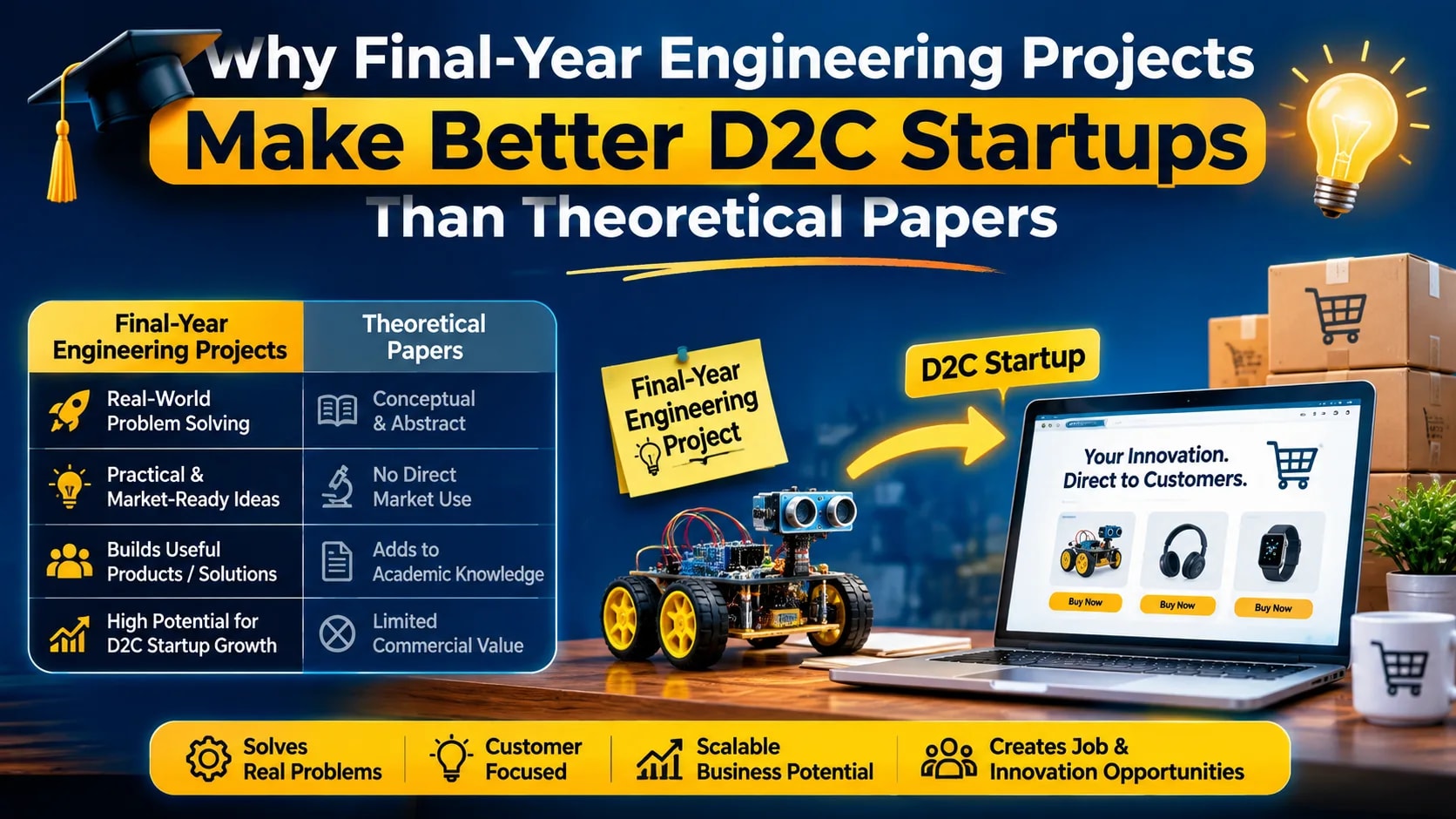
Every final-year engineering student faces the same fork in the road: write a research paper that a handful of examiners will read, or build a working project that solves a real problem for real people. For students who want to start a direct-to-consumer (D2C) brand after graduation, the choice isn't close. A final-year project — especially one grounded in a working prototype — is a far stronger foundation for a D2C startup than a theoretical paper will ever be. Here's why, and how to make the transition without wasting the work you've already done.
The Real Problem With Theoretical Final-Year Papers
Papers Optimize for Grades, Not Users
A theoretical paper is written for an audience of one: the evaluator. Its success criteria are academic rigor, citation count, and novelty within a narrow literature review. None of that maps to what a startup needs, which is a product someone is willing to pay for. Students who spend eight months polishing a paper often finish with a strong grade and nothing they can show a customer.
No Market Feedback Loop
A paper is reviewed once, by people who already know the field. It never gets tested against a market that doesn't care about your methodology and only cares about whether the thing works, looks good, and is worth the price. That feedback loop — build, show a real user, get told you're wrong, fix it — is exactly what a D2C founder needs to practice early, and a project-based final year gives you dozens of chances to run it before you graduate.
What Makes a Final-Year Project D2C-Ready
You Already Have a Working Prototype
Most final-year engineering projects — whether in mechanical, electronics, computer science, or biomedical streams — end in a demonstrable prototype. That single artifact is worth more to a startup than any paper, because it's the thing you can photograph, film, put in front of a potential customer, and iterate on. Investors and early adopters both respond to something tangible far more than they respond to a well-cited abstract.
You've Solved a Real Problem
Good final-year projects usually start from an observed problem — a household chore that takes too long, a health monitoring gap, an inefficiency in a local process. That problem-first framing is precisely how strong D2C products get built. A paper, by contrast, often starts from a gap in the literature, which is a very different (and much less commercially useful) starting point.
You Understand Your Own Tech Stack Deeply
Building something end-to-end forces you to understand sourcing, cost, manufacturability, and failure modes in a way that reading and summarizing other people's work never will. That hands-on knowledge becomes your unfair advantage when you're negotiating with suppliers, debugging returns, or explaining your product to a customer who doesn't care about the underlying engineering.
From Project Report to Product: The Transition Path
Turning a final-year project into a D2C brand is not automatic. A prototype built to satisfy a professor and a product built to satisfy a paying customer are different things, and the gap between them is where most student projects stall. The path below is the order most successful transitions actually follow.
1. Validate Before You Build More
Before investing more time in the product, confirm the problem is one people will actually pay to solve. A working prototype makes this easier than most student ventures, because you can demonstrate it live instead of describing it.
2. Talk to 20 Real Users Outside Your Campus
Classmates and faculty are not your market. Find twenty people who fit your actual target customer profile, show them the prototype, and pay close attention to what confuses them, what they'd pay for, and what they'd cut.
3. Simplify for Manufacturing and Delivery
Lab prototypes are usually over-engineered for a classroom demo and under-engineered for repeat manufacturing. Strip out components that exist only to impress an evaluator, and redesign around parts and processes that can be sourced repeatedly and affordably.
4. Build a Minimum Lovable Product, Not a Feature-Complete One
Resist the urge to add every feature from your project report. Launch with the smallest version that still delivers the core value your validation interviews confirmed people wanted, then expand based on actual usage.
Common Mistakes When Converting a Project Into a Startup
• Ignoring unit economics: A prototype's cost doesn't need to make sense at one unit. A product's does — factor in raw materials, packaging, shipping, returns, and payment gateway fees before you price anything.
• Skipping certification and compliance: Depending on your category (electronics, food-adjacent, wearables, appliances), you may need safety or quality certifications before you can legally sell. Check this early, not after you've taken pre-orders.
• Not testing willingness to pay: Interest is not the same as intent to buy. Run a small pre-order or waitlist-with-deposit test before committing to a full production run.
• Treating the project report as the business plan: A project report explains what you built. A business plan explains who buys it, at what price, and how you reach them. You need both, and they are not the same document.
Practical Preparation Tips for Turning Your Project Into a D2C Brand
1. Document your build process as you go, not after the fact — it becomes your manufacturing SOP later.
2. Get comfortable with basic costing: bill of materials, per-unit cost, and target retail price, even as a rough spreadsheet.
3. Ask your college's incubation or innovation cell what support exists for converting a project into a registered venture — many institutions offer this and students don't ask.
4. Set up a simple landing page and collect email sign-ups while you're still finishing the academic version of the project — early demand data strengthens both your startup case and your final evaluation.
5. Keep your academic guide informed — many are willing to continue advising informally, and their domain expertise doesn't expire at graduation.
Conclusion
Theoretical papers are built to satisfy an evaluator; final-year engineering projects, when approached with intent, are built to satisfy a real problem. That difference — a working prototype, an actual user feedback loop, and hands-on understanding of your own build — is exactly what a D2C startup needs on day one. If you're weighing how to spend your final year, treat your project as the first version of a product, not just an academic requirement, and start talking to real users well before graduation.