What Is SEO Social Bookmarking? A Complete, Practical Guide for 2026
Understanding what is SEO social bookmarking is one of the first practical steps every digital marketer and SEO professional takes—and for good reason. Despite algorithm updates and the rise of AI-generated search results, social bookmarking continues to play a measurable role in content discovery, link profile diversification, and brand signal building.
The SEO landscape has changed dramatically. Google's Helpful Content updates, AI Overviews, and entity-based ranking have shifted the goalposts. Yet off-page signals—especially those that mirror natural content distribution—remain core to how pages earn authority. Social bookmarking sits squarely in this space.
This guide explains social bookmarking from the ground up: how it works, why it still matters, what a real implementation looks like in 2026, and how it connects to other off-page techniques like digital marketing as a whole. Whether you are preparing for SEO interview questions as a fresher or running campaigns for clients, you will find actionable detail here.
What Is SEO Social Bookmarking?
Social bookmarking in SEO is the practice of saving and sharing web page URLs on public bookmarking platforms so that search engines and real users can find that content more easily. Think of it as a public library card catalogue: instead of storing a bookmark privately in your browser, you publish it where others—and search crawlers—can discover it.
These platforms allow users to tag content, organise links by topic, write short descriptions, and share resources with communities. From an SEO perspective, each submission creates a citation pointing back to your site. When the platform carries strong domain authority, that citation carries weight.
Platforms commonly used for bookmarking in SEO include Reddit, Pinterest, Mix, Diigo, Pocket, Scoop.it, Pearltrees, and Flipboard. Each has different community rules, domain authority levels, and link attributes (do-follow vs. no-follow), which affects how they contribute to your overall link profile.
How Social Bookmarking Works
The mechanics are straightforward. You create an account on a bookmarking platform, submit your URL, add a descriptive title and tags, and post it to a relevant community or category. The platform indexes that entry publicly. Search crawlers visit these platforms regularly and discover the links you have submitted.
The Crawl and Index Pathway
High-authority platforms like Reddit receive Googlebot visits multiple times per day. When your URL appears in a post or comment on such a platform, it enters the crawl queue rapidly—often within a few hours. This is why social bookmarking is one of the fastest indexing triggers available without using Google Search Console's URL Inspection tool.
Link Signals Passed to Your Site
Depending on the platform's link policy, each bookmark passes either a do-follow or no-follow signal. Do-follow links pass PageRank equity directly. No-follow links still generate referral traffic and act as brand mentions, which Google's systems acknowledge as part of link diversity. Google's link best practices documentation confirms that natural link profiles contain both link types.
Why Social Bookmarking Matters for SEO
Social bookmarking serves four distinct functions in a modern SEO strategy. Understanding each one helps you use it purposefully rather than mechanically.
-
Faster indexing: New content gets discovered by crawlers much sooner when it appears on high-DA bookmarking platforms.
-
Link profile diversification: A backlink profile made up only of guest posts and editorial links looks unnatural. Bookmarks add variety.
-
Referral traffic: Active communities on Reddit, Flipboard, or Scoop.it send real visitors who engage with content—reducing bounce rate signals over time.
-
Brand signal reinforcement: Consistent mentions of your brand name and URL across trusted platforms build entity associations that AI search engines and knowledge graphs recognise.
According to Ahrefs' off-page SEO research, pages with diversified backlink profiles consistently outrank those with homogeneous link sources, even when raw domain authority scores are similar.
Benefits of Social Bookmarking
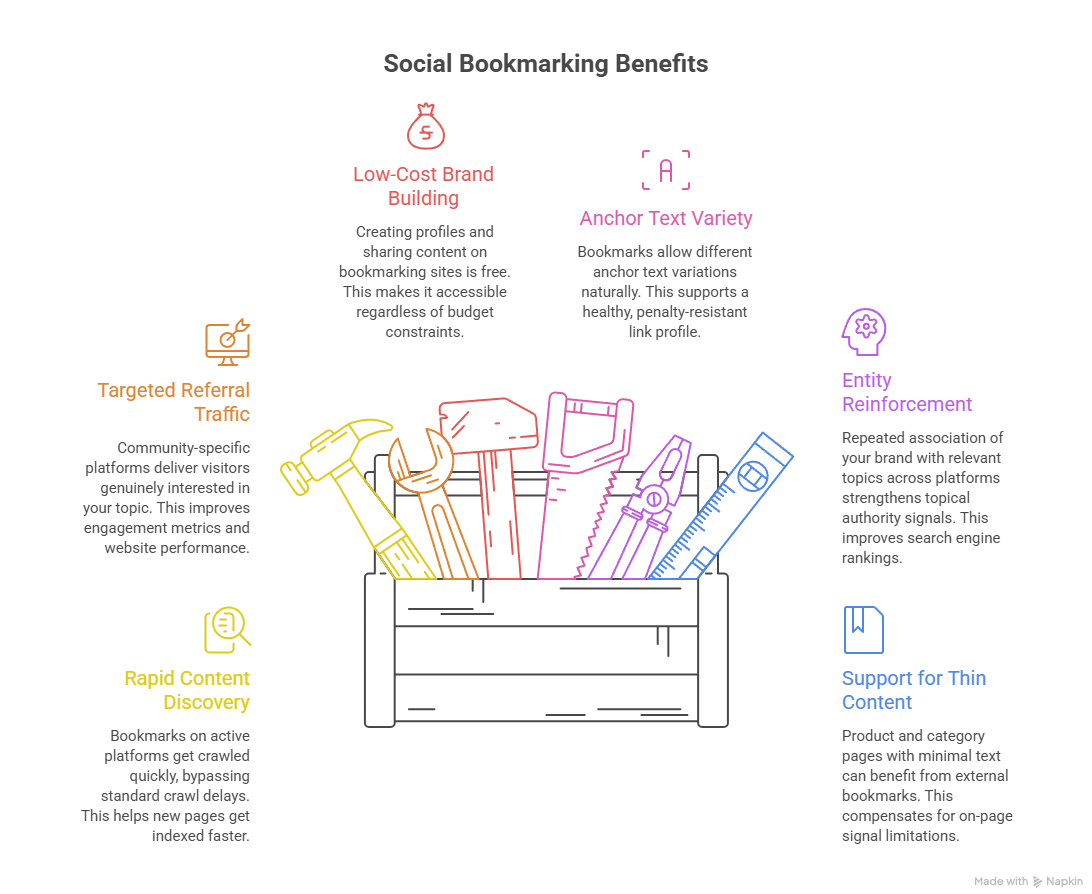
In practical SEO campaigns, the benefits that show up most reliably are the following:
Rapid Content Discovery
Bookmarks on active platforms get crawled within hours, bypassing the standard crawl delay for new pages.
Targeted Referral Traffic
Community-specific platforms deliver visitors genuinely interested in your topic—improving engagement metrics.
Low-Cost Brand Building
Creating profiles and sharing content on bookmarking sites is free, making it accessible regardless of SEO cost per month in India or global budget constraints.
Anchor Text Variety
Bookmarks allow different anchor text variations naturally, supporting a healthy, penalty-resistant link profile.
Entity Reinforcement
Repeated association of your brand with relevant topics across multiple platforms strengthens topical authority signals.
Support for Thin Content Pages
Product and category pages with minimal text can benefit from external bookmarks pointing at them, compensating for on-page signal limitations.
Does Social Bookmarking Still Work in 2026?
At some point, every SEO professional is asked this question. The answer isn't a simple yes or no: backlinks still matter, but they no longer work the way they did in 2012.
Mass submission to hundreds of low-quality directories is ineffective and potentially harmful. Google's Spam Policies explicitly flag manipulative link schemes, which includes automated bulk bookmarking. However, selective, manual submissions to relevant, high-authority communities still deliver measurable outcomes.
Industry experts recommend treating social bookmarking as a content amplification layer rather than a primary link-building tactic. When paired with strong content, it accelerates reach. When used in isolation with thin content, it adds little value.
Expert Insight: SEO professionals who work on pay-per-performance SEO models consistently report that social bookmarking contributes to faster ranking timelines for newly published content—but only when the content is genuinely useful and the bookmarking is done on topic-relevant platforms.
Step-by-Step Social Bookmarking Process
Here is the workflow SEO professionals use in real campaigns, not a generic checklist.
-
Audit your content: Only bookmark pages that deserve attention—well-researched posts, product pages solving real problems, original data. Bookmarking thin or duplicate content accelerates penalties, not rankings.
-
Select platforms strategically: Choose 10–20 platforms with domain authority above 50 and active user bases. Avoid platforms with zero traffic or that have been flagged for spam in Moz's Domain Authority metrics.
-
Create complete SEO profiles: Fill out every field on your bookmarking profile—bio, website URL, social links. A complete SEO profile on these platforms strengthens entity association between your brand and your domain.
-
Write unique descriptions: Each bookmark should have a unique, human-written description using your primary keyword naturally. Duplicate descriptions across platforms are a quality signal to avoid.
-
Use varied anchor text: Rotate between branded anchors ("GyaanPost"), partial match ("social bookmarking guide"), and URL-only anchors to maintain natural variation.
-
Tag content precisely: Use specific, topic-relevant tags. Avoid over-tagging. Precise tagging helps the platform's algorithm surface your bookmark to the right audience.
-
Engage authentically: On community-driven platforms like Reddit, upvoting others, commenting, and contributing before self-promoting dramatically improves the acceptance of your submissions.
-
Track and measure: Monitor referral traffic from each platform in Google Analytics. Check indexation status of bookmarked URLs using Search Console. Review which platforms drive real engagement and double down on those.
Best Practices for Social Bookmarking
Following community rules is the single most important practice. Every platform has submission guidelines. Violating them—through self-promotion without engagement, keyword-stuffed descriptions, or bulk account creation—gets your submissions removed and your account flagged.
Prioritise platforms where your target audience actually spends time. Bookmarking a B2B software article on a general consumer platform generates low-quality signals. Bookmarking it in a relevant Reddit community or a professional network like Diigo generates real traffic and meaningful engagement.
Space submissions over time. SEO professionals commonly use a weekly schedule: 5 to 10 quality bookmarks per week, spread across different platforms and targeting different pages on your site. Sudden spikes of 100 bookmarks in a day look manipulative to algorithms.
Moz's link building guide reinforces that link velocity matters—natural link acquisition happens gradually, and social bookmarking should mirror that pattern.
Common Mistakes to Avoid
-
Using automation tools for bulk submission: Tools that submit to 500 sites overnight are link scheme violations. Google's systems detect velocity anomalies.
-
Targeting DA10 or lower platforms: Low-authority bookmarking sites add no value and can dilute your backlink quality score.
-
Exact match anchor text on every bookmark: Repeating "best SEO services India" as anchor text on every submission creates an unnatural pattern. Vary your anchors.
-
Ignoring community norms: Dropping links in Reddit threads without adding value gets downvoted and removed—the opposite of the intended effect.
-
Bookmarking the same URL repeatedly: Multiple bookmarks of the same page on the same platform look spammy. Bookmark once, distribute across different platforms.
-
Skipping profile completion: An empty SEO profile on a bookmarking site reduces the trust signal your submission sends.
Real SEO Use Cases
Ecommerce SEO
For ecommerce SEO services in India, social bookmarking is used primarily to amplify new product launch pages and seasonal sale content. Pinterest is particularly effective here—product pins generate both referral traffic and image discovery. In our experience, bookmarking a well-photographed product page on Pinterest with accurate structured data can drive sustained referral traffic for months after the initial submission.
Local and Mobile SEO
For mobile SEO services, bookmarking local business content—neighbourhood guides, service area pages, local event roundups—on geo-specific communities drives both local citations and direct traffic. Platforms like Nextdoor and local subreddits work well here because their audiences are inherently location-specific.
Content Marketing Amplification
SEO professionals commonly use Flipboard and Scoop.it to create branded content magazines. A curated collection of bookmarks around a single topic—"ecommerce marketing," for instance—builds a branded entity hub that AI search engines can discover and attribute to your brand, supporting topical authority over time.
Social Bookmarking vs Other Off-Page SEO Techniques
Social bookmarking works best as part of a diversified off-page strategy. Understanding how it compares to related techniques clarifies where to invest effort.
|
Technique |
Primary Benefit |
Link Quality |
Traffic Potential |
Time Investment |
Risk Level |
|
Social Bookmarking |
Fast indexing, brand signals |
Low–Medium |
Medium |
Low |
Low (if manual) |
|
Article Submission Sites in SEO |
Content syndication, contextual links |
Medium |
Low–Medium |
Medium |
Low–Medium |
|
Guest Posting |
High-authority editorial links |
High |
Medium |
High |
Medium (if overused) |
|
Classified Submission in SEO |
Local signals, commercial intent traffic |
Low |
Low–Medium |
Low |
Low |
|
Image Submission in SEO |
Visual search, image backlinks |
Low–Medium |
Low (growing) |
Medium |
Low |
|
Digital PR / Link Earning |
High-authority editorial mentions |
Very High |
High |
Very High |
Low |
|
Forum Participation |
Community trust, niche authority |
Low–Medium |
Medium |
High |
Low |
Companion Off-Page Techniques That Work Alongside Bookmarking
Article Submission and Article Posting Sites for SEO
Article submission sites like EzineArticles, Medium, and LinkedIn Articles allow you to publish long-form content with links back to your primary site. These function as content syndication platforms. When paired with social bookmarking—where you bookmark your Medium article, which itself links to your main site—you create a two-layer link signal that is more natural than a direct bookmark alone.
Image Submission in SEO
Image submission involves uploading original graphics, infographics, and branded visuals to platforms like Imgur, Flickr, Pinterest, and 500px with keyword-rich alt text, descriptions, and backlinks. This technique increasingly supports AI image search and visual AI Overviews. Infographics about your core topics, when bookmarked and shared, generate both image backlinks and textual citations.
Classified Submission in SEO
Classified submission on platforms like OLX, Quikr, and Sulekha is primarily a local SEO tactic. It sends geo-relevance signals and drives commercial intent traffic, particularly for service businesses. While classified links are low authority, they complement bookmarking by filling in local entity signals that bookmarking platforms alone do not provide.
SEO Profile Creation
Building complete SEO profiles on authoritative platforms—Crunchbase, About.me, Gravatar, and professional directories—creates a web of brand mentions and backlinks. Each profile reinforces name-address-website consistency, which supports local SEO and entity disambiguation in knowledge graphs.
Social Bookmarking and AI Search
The emergence of AI search—Google's AI Overviews, Perplexity, ChatGPT Search, and others—has introduced a new dimension to off-page SEO. These systems do not simply rank pages; they build knowledge graphs, extract entities, and cite sources they deem trustworthy. Social bookmarking contributes to this ecosystem in several ways.
First, consistent mentions of your brand across multiple platforms create entity associations. When AI systems encounter your brand name, URL, and topic cluster repeatedly across bookmarking sites, article submission platforms, and image repositories, they begin associating that brand with specific subject areas. This topical authority signal influences AI Overviews citation decisions.
Second, bookmarks on platforms that AI systems crawl—Reddit, Quora, Flipboard—give your content entry points into the training and retrieval pipelines of these AI tools. Content that is widely bookmarked, discussed, and referenced is more likely to surface in ChatGPT SEO and answer engine results.
Third, the AEO (Answer Engine Optimisation) framework increasingly values entity clarity. Social bookmarking that consistently uses your brand name, links to your canonical URLs, and positions your content within specific topic clusters makes it easier for AI systems to understand what your brand is, what it covers, and why it should be cited.
According to Search Engine Land's research on AI search signals, brand entity building through consistent cross-platform presence is one of the strongest off-page factors influencing AI citation frequency.
How Social Bookmarking Fits Your Broader SEO Learning and Career Path
For anyone studying an SEO syllabus or preparing for SEO interview questions for fresher roles, social bookmarking is one of the first off-page techniques covered—and for good reason. It introduces core concepts: link building, anchor text, domain authority, no-follow vs do-follow, and content distribution. Understanding these mechanics provides the foundation for more advanced tactics.
In interviews, freshers are commonly asked to explain the difference between social bookmarking and guest posting, or to identify which bookmarking platforms are do-follow. These questions test both theoretical knowledge and practical awareness. If you understand the step-by-step process described in this guide, those questions become straightforward.
For businesses evaluating SEO cost per month in India, social bookmarking is one of the lowest-cost off-page activities available. Most execution can be done manually with a structured checklist and a few hours per week. This makes it especially relevant for startups and small businesses running lean digital marketing strategies without large agency budgets.
The future of digital marketing will increasingly reward brands that establish genuine presence across multiple platforms. Social bookmarking, done thoughtfully, contributes to that presence. See also Semrush's off-page SEO breakdown for additional perspective on how these techniques interact.
Practical Tips
-
Create a bookmark submission calendar—schedule 2 to 3 submissions per session, twice a week. Consistency outperforms burst activity.
-
Write a unique 2–3 sentence description for each bookmark, different from your meta description. Platforms penalise duplicate content, and unique copy improves community engagement.
-
Use Google Search Console's URL Inspection tool to verify indexing after bookmarking new pages. If a page indexes within 24 hours of submission, note which platform triggered it—and prioritise that platform.
-
Set up UTM parameters on bookmarked URLs. This allows Google Analytics to show exactly how much traffic each platform sends, letting you measure ROI precisely.
-
Build real community presence on 2–3 platforms before self-promoting. Accounts with participation history are trusted more by platform algorithms and human moderators.
Expert Recommendations
-
Treat social bookmarking as a distribution layer, not a link-building shortcut. Its primary value in 2026 is content amplification and brand signal building.
-
Combine bookmarking with article posting sites for SEO: publish a detailed version of your content on Medium or LinkedIn, bookmark that article, and let it link back to your primary URL. This creates a natural content chain.
-
For image-heavy content, pair image submission in SEO with bookmarking: submit your infographic to Imgur or Flickr, then bookmark the submission page. This creates both visual and text backlinks from different platform types.
-
Audit your bookmarking sites annually. Platforms lose domain authority, get penalised, or shut down. Remove low-quality submissions from your strategy when this happens.
-
For freshers entering the SEO field: hands-on practice with 10 to 15 bookmarking submissions is one of the fastest ways to understand how off-page signals work in practice—better than any theoretical study.
Next Steps
-
Select your top 3 highest-value pages—typically a pillar post, a product page, and a recent blog article.
-
Choose 10 platforms using a DA-50+ filter. Start with Reddit (appropriate subreddit), Flipboard, Diigo, Mix, and Scoop.it.
-
Create fully complete profiles on each platform with your brand name, website, and bio.
-
Craft unique bookmark descriptions for each of your 3 pages, using varied anchor text.
-
Submit over two weeks, 2–3 per session, and track results in Google Analytics and Search Console.
-
After 30 days, review referral traffic sources and indexing speed, and double down on the platforms producing measurable results.