How to Build an AI Content Strategy That Boosts SEO, AEO, GEO & Conversions
The rules of search visibility have changed. It's no longer enough to rank on Google's first page — brands now need to show up inside AI Overviews, ChatGPT answers, Perplexity summaries, and voice assistant responses.

The rules of search visibility have changed. It's no longer enough to rank on Google's first page — brands now need to show up inside AI Overviews, ChatGPT answers, Perplexity summaries, and voice assistant responses. At Gyaanpost, we call this shift the move from traditional SEO to a combined SEO, AEO, and GEO approach — and in 2026, it's the single biggest factor separating brands that grow from brands that get left behind.
This guide breaks down exactly how to build an AI content strategy for SEO that works across search engines, answer engines, and generative AI platforms — while still driving real conversions, not just impressions.
Marketers who grew up optimizing purely for blue links on Google are now facing a much more fragmented landscape. Search results, chatbot answers, voice assistants, and AI-powered summaries all pull from different signals, yet they share one common thread: they all reward content that is clear, credible, and genuinely helpful. That overlap is good news — it means you don't need five separate strategies. You need one well-built content system that's flexible enough to perform everywhere your audience is asking questions.
What Is SEO, AEO, and GEO — And Why They Matter Together
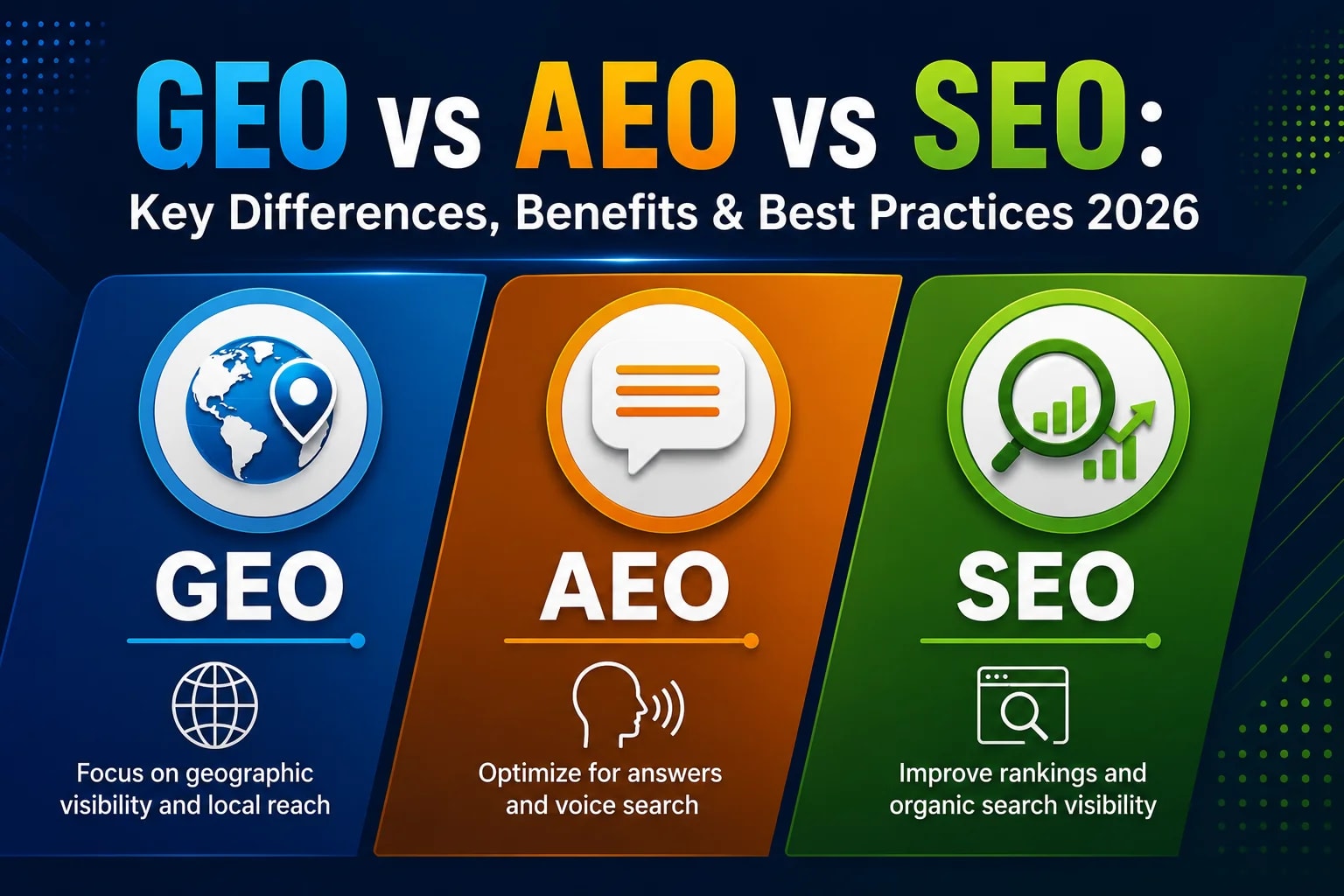
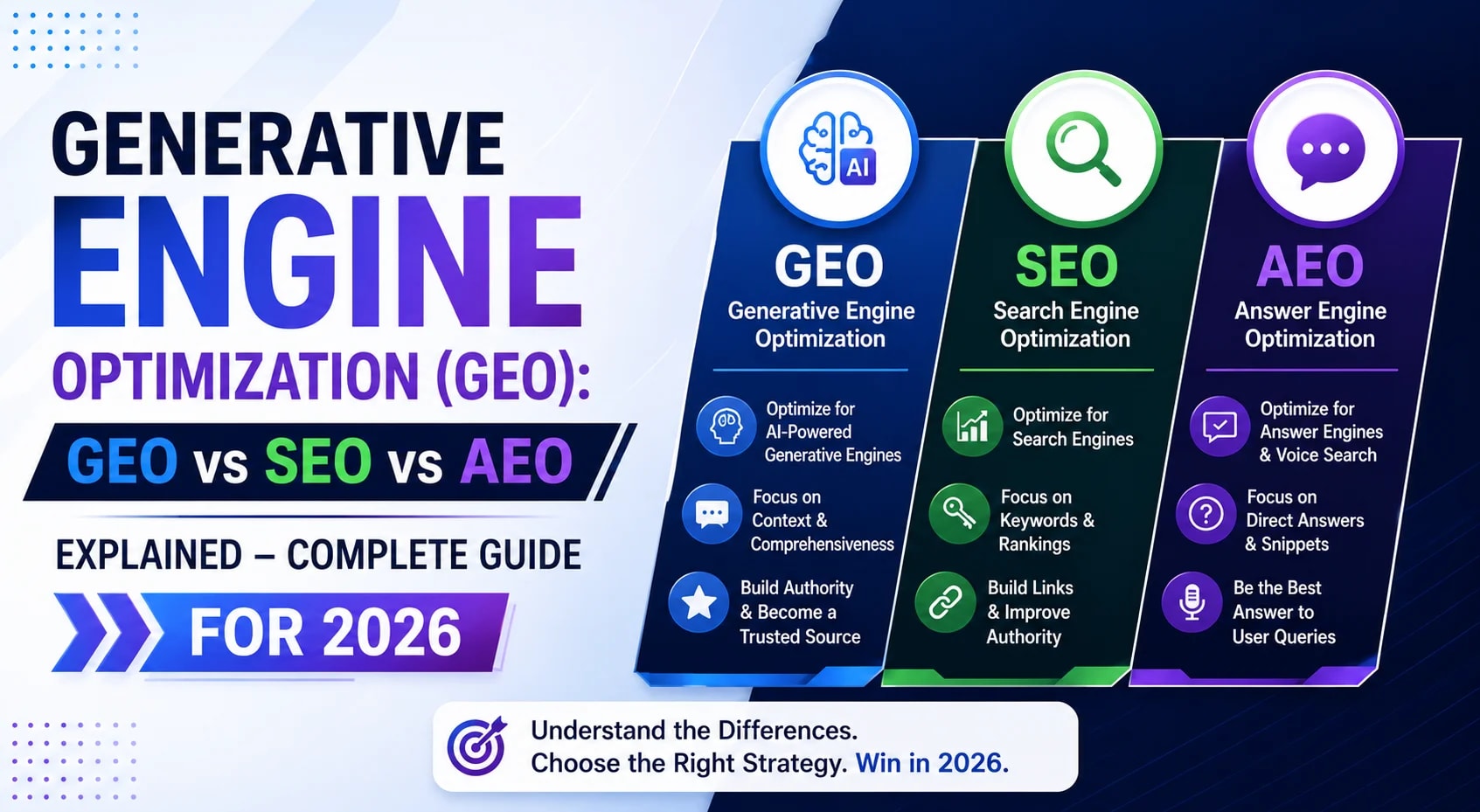
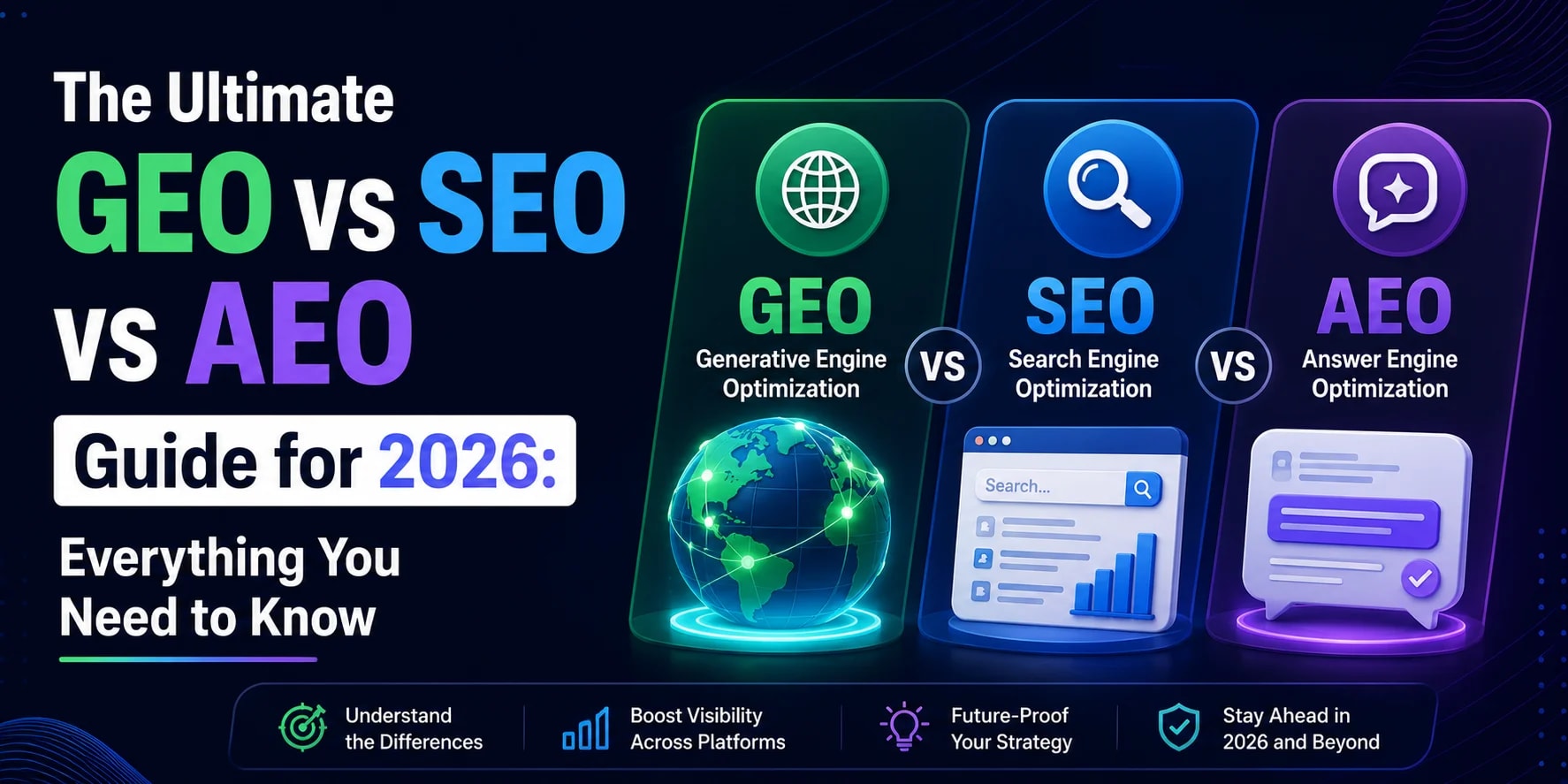
Before building any strategy, it's important to understand the three pillars that now define online visibility.
SEO (Search Engine Optimization)
Traditional SEO focuses on ranking web pages on search engines like Google and Bing through keyword optimization, backlinks, site speed, and technical health. This foundation still matters — but it's no longer the whole picture.
AEO (Answer Engine Optimization)
Answer Engine Optimization is the practice of structuring content so it gets pulled directly into featured snippets, voice search results, and "answer boxes." AEO is about being the source an engine trusts enough to quote.
GEO (Generative Engine Optimization)
Generative Engine Optimization is the newest and fastest-growing discipline. It focuses on making your content easy for generative AI tools — ChatGPT, Gemini, Perplexity, Google AI Overviews — to understand, summarize, and cite as a source in their AI-generated responses.
Together, SEO AEO GEO form a complete visibility framework. Ranking on page one is no longer the finish line; being cited, quoted, and recommended by AI systems is the new goal. This is exactly why Gyaanpost recommends treating these three disciplines as one unified strategy rather than separate projects.
It helps to think of these three pillars as layers of the same funnel. SEO gets your website discoverable in the first place. AEO ensures the most useful snippet of that content gets surfaced when someone asks a direct question. GEO ensures that when a user turns to a generative AI assistant instead of a search engine at all, your brand's information is still the one being referenced, paraphrased, and recommended. Skipping any one layer leaves a gap in your overall visibility, no matter how strong the other two are.
Why AI Search Optimization Is Non-Negotiable in 2026
Search behavior has fundamentally shifted. A growing share of queries never result in a click to a website at all — the answer appears directly inside Google AI Overviews or a chatbot response. This means brands that ignore AI Search Optimization risk becoming invisible, even if their traditional rankings look healthy.
Here's why this matters for every content team, including ours at Gyaanpost:
• AI Overviews now appear on a large percentage of informational searches, pushing organic listings further down the page.
• Users increasingly ask AI assistants questions instead of typing keywords into a search bar.
• Being cited as a source inside an AI answer builds authority and trust, even without a click.
• Brands optimized only for classic SEO are losing visibility share to competitors investing in AEO and GEO.
An effective AI SEO strategy treats generative engines as a new distribution channel — not a threat to fight, but a channel to be optimized for, just like Google was optimized for over the last two decades.
Building an AI Content Strategy for SEO: The Core Framework
A strong AI content strategy for SEO isn't built overnight. It requires a structured approach that blends research, content architecture, technical optimization, and continuous measurement. Below is the framework Gyaanpost uses when planning content built to perform across search engines and AI systems alike.
Step 1: Research Intent Across Search and AI Platforms
Start by researching how your audience searches — not just on Google, but inside AI chat tools. Ask the same questions your customers would ask, and observe how ChatGPT, Gemini, and Perplexity respond. Note which sources they cite and what tone and structure those answers use.
• Identify question-based queries (who, what, why, how) tied to your niche.
• Study competitor content that already appears in AI Overviews or answer boxes.
• Map keywords to intent: informational, navigational, commercial, or transactional.
Step 2: Structure Content for Clarity and Extractability
AI systems and answer engines favor content that is easy to parse. This means clear headings, short paragraphs, direct answers near the top, and logical formatting. A page written purely to "sound good" to a human reader but buried in fluff will rarely get pulled into an AI-generated answer.
• Answer the core question within the first 100 words of a section.
• Use descriptive H2 and H3 headings that mirror real user questions.
• Add FAQ sections formatted with clear question-and-answer pairs.
• Use bullet points, numbered lists, and tables where they aid comprehension.
Step 3: Build Topical Authority, Not Just Individual Pages
Generative Engine Optimization rewards depth. A single blog post rarely earns AI citation trust — a well-linked cluster of content covering a topic from multiple angles does. Build pillar pages supported by related articles, all internally linked, so both search engines and AI crawlers understand the full scope of your expertise.
For example, a pillar page on "AI Search Optimization" could be supported by dedicated articles on schema markup for AI crawlers, writing FAQ content for voice search, and case studies showing before-and-after AI Overview citations. Each supporting article should link back to the pillar page, and the pillar page should link out to each supporting article, creating a tightly connected web of relevant, authoritative content that signals real subject-matter expertise to both search engines and generative AI models.
Step 4: Optimize for Both Humans and Machines
A content strategy for AI search still has to serve real people first. Google's own guidance continues to prioritize helpful, people-first content. The winning approach blends genuinely useful writing with machine-readable structure — satisfying Google's helpful content standards while remaining easy for AI systems to summarize accurately.
Technical Foundations for AI Search Optimization
Content quality alone isn't enough. AI crawlers and answer engines rely on technical signals to understand, trust, and retrieve your content. These technical foundations are core to any serious AI SEO strategy.
Structured Data and Schema Markup
Implement schema markup — including Article, FAQ, HowTo, and Organization schema — so both traditional search engines and generative AI tools can accurately interpret your content's meaning and context.
Site Speed and Crawlability
Slow-loading pages or blocked crawlers prevent AI systems from accessing your content at all. Ensure fast load times, clean XML sitemaps, and crawler-friendly robots.txt settings that don't accidentally block AI bots you want indexing your pages.
E-E-A-T: Experience, Expertise, Authoritativeness, Trust
AI systems increasingly favor content from sources that demonstrably show real experience and expertise. Author bios, credentials, original data, case studies, and transparent sourcing all strengthen the trust signals that both Google and generative engines rely on when deciding what to cite.
Practical ways to strengthen E-E-A-T include publishing author bylines with relevant credentials, linking to primary sources and original research instead of secondary summaries, keeping publish and update dates visible, and citing real-world examples or first-hand experience wherever possible. Brands like Gyaanpost that consistently demonstrate these trust signals across their content library tend to see stronger, more durable visibility gains than those relying on thin, generic articles.
Content Strategy for AI Search: What to Actually Publish
Knowing the theory is one thing — knowing what to actually create is another. Here are the content formats that consistently perform well across SEO, AEO, and GEO.
1. Definitive Guides and Pillar Content
Long-form, comprehensive guides that thoroughly answer a topic tend to earn citations across all three channels because they demonstrate depth and completeness.
2. FAQ and Q&A Formatted Pages
Directly formatted questions and answers are ideal for Answer Engine Optimization because they map almost perfectly to how users phrase voice and chatbot queries.
3. Original Data and Research
Generative engines favor unique information they can't find elsewhere. Original surveys, statistics, or industry research give AI tools a reason to cite your brand specifically rather than a generic competitor.
4. Comparison and "Best Of" Content
Comparison-style content performs well for commercial-intent queries and is frequently pulled into AI Overviews when users are evaluating options before making a decision.
5. Evergreen Explainers
Simple, well-structured explainer content that defines concepts clearly (much like the SEO, AEO, and GEO definitions earlier in this article) is exactly the type of content generative engines love to summarize and cite.
How Google AI Overviews SEO Changes Your Optimization Priorities
Google AI Overviews SEO requires a slightly different mindset than classic ranking optimization. Instead of optimizing purely to rank position one, the goal becomes optimizing to be the quoted, cited, or summarized source inside the AI-generated box at the top of the results page.
• Prioritize direct, factual answers over promotional language.
• Keep key information above the fold and free of unnecessary preamble.
• Use precise, unambiguous phrasing that's easy to extract and paraphrase accurately.
• Regularly update content so AI systems continue to see it as current and reliable.
Brands that adapt to these priorities early gain a meaningful visibility advantage, since AI Overviews and similar features are only expected to expand further across search results in the coming year.
AI Content Optimization: Turning Visibility Into Conversions
Visibility without conversions is a vanity metric. The final, and arguably most important, piece of the puzzle is AI content optimization aimed at turning AI-driven visibility into actual leads, sign-ups, and sales.
Design Content Around the Buyer Journey
Map content to each stage of the funnel — awareness, consideration, and decision — so that even users arriving via an AI-generated answer land on a page that guides them naturally toward a next step.
Add Clear, Low-Friction Calls to Action
Whether the goal is a newsletter signup, a demo request, or a purchase, every page should include a clear, relevant call to action that doesn't interrupt the reading experience.
Track AI-Driven Traffic Separately
Set up analytics segments to monitor traffic and engagement coming from AI platforms and answer engines separately from traditional organic search. This helps identify which content formats are actually converting AI-referred visitors.
Continuously Test and Refine
An AI content strategy for SEO is never "finished." Algorithms, AI models, and user behavior evolve constantly. Regularly audit performance, update outdated content, and refine structure based on what's actually earning citations and clicks.
Measuring Success Across SEO, AEO, and GEO
Traditional rank-tracking tools alone can't tell you whether your content is being cited inside an AI Overview or quoted by a chatbot. Building an effective AI SEO strategy requires expanding your measurement toolkit alongside your content process.
Track Impressions and Clicks Beyond Rank Position
Google Search Console still provides valuable data, but pay closer attention to impressions on queries where AI Overviews appear, even if click-through rate looks lower than expected. Impressions without clicks can still indicate strong brand visibility inside an AI-generated answer.
Monitor Brand Mentions in AI Platforms
Periodically test your own branded and non-branded queries directly inside ChatGPT, Gemini, and Perplexity to see whether your content is being referenced. This manual spot-checking remains one of the most reliable ways to gauge GEO performance today, since dedicated analytics for AI citations are still maturing.
Watch Engagement Metrics, Not Just Traffic Volume
Visitors arriving from an AI-generated answer often already have a strong understanding of the topic. Track time on page, scroll depth, and conversion rate for this segment separately, since it can reveal whether your content is successfully moving pre-informed visitors toward the next step.
A Practical 5-Step Checklist to Get Started
1. Audit your existing content for structure, clarity, and answer-first formatting.
2. Identify high-intent topics where AI Overviews or answer boxes already appear in your niche.
3. Rewrite or restructure priority pages using clear headings, FAQs, and schema markup.
4. Build topical content clusters that establish depth and authority around your core subjects.
5. Measure AI-referred traffic and conversions, then iterate based on real performance data.
Final Thoughts
The brands that win in 2026 won't be the ones chasing keywords alone — they'll be the ones building genuinely helpful, well-structured content that performs across search engines, answer engines, and generative AI platforms simultaneously. Combining SEO AEO GEO into a single, cohesive strategy is no longer optional; it's the new baseline for online visibility.
At Gyaanpost, we believe the future belongs to content that's built for people first and optimized for machines second — content that's clear, credible, and genuinely useful. Start applying the framework in this guide today, and your content won't just rank; it will be seen, cited, and trusted across every channel that matters in 2026 and beyond.